
be - Master This Word
Master this word with our 5-step learning method – Learn English in English
Train English Through Brain Routes, Not Translation.
This page helps you stop memorizing isolated translations and start understanding a word through its shared mental image, native-style thinking, and practical training steps.
Master this word with our 5-step learning method – Learn English in English
Example sentences are the start of understanding. Don't rush to memorize. First feel how the word works in a sentence.
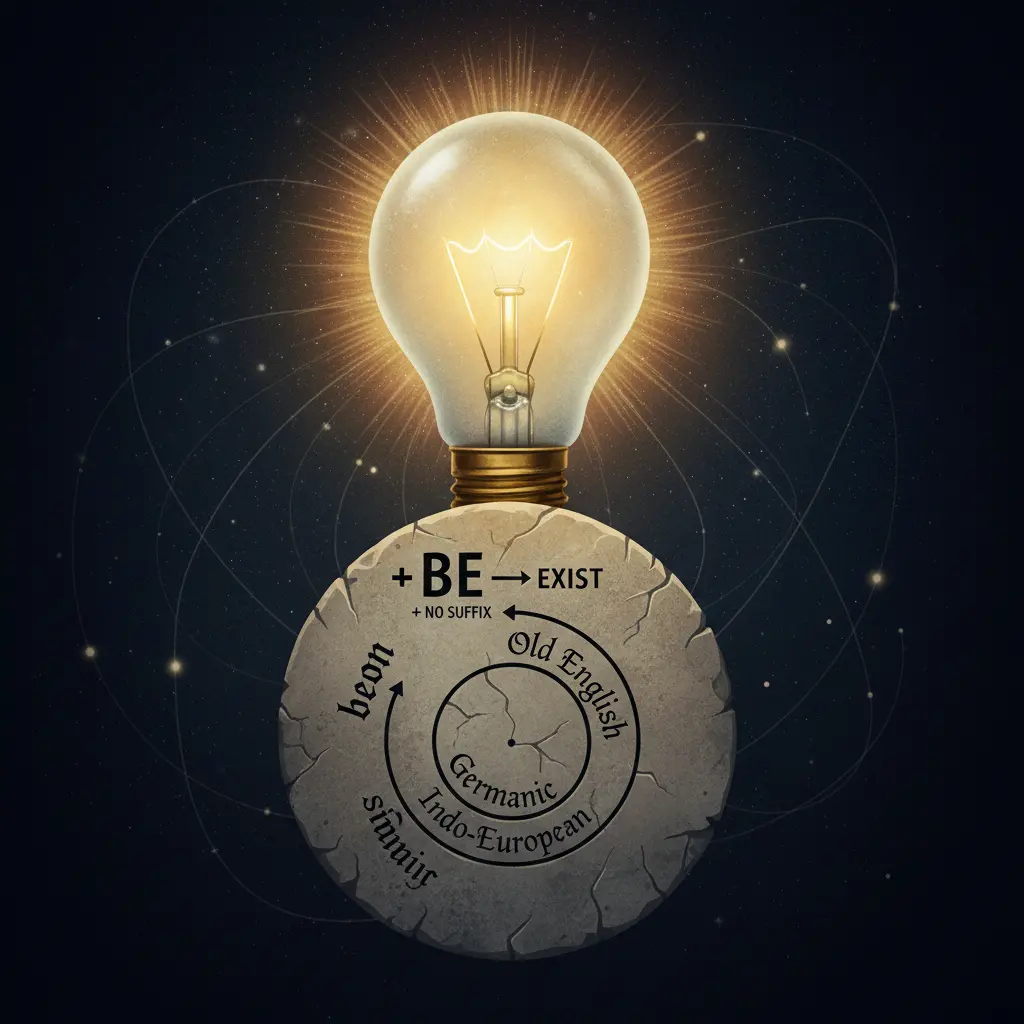
be = exist + (no suffix). Origin: Old English 'beon' → Germanic → Indo-European. Memory image: Imagine a light bulb turning on, signifying the moment something begins to exist.
Note 1: These definitions and etymologies are not standard dictionary definitions, but extended explanations provided to help with memorization and understanding of the actual application of words. Through this background information, we strive to make words more vivid and easier to understand, and help you remember their meanings in real life.
Note 2: LexiTalk designs the learning flow around the linguistics principle of “Comprehensible Input.” When learners encounter material that is slightly above their level but still understandable from context, the brain naturally absorbs the language. That’s why we keep every word inside authentic contexts, using examples and associations to help you understand it and use it flexibly.
Read the FAQ explanation of Comprehensible InputFirst I set my hand on the table and push a thought forward, watching it settle. I shift my weight, feel the chair respond, and notice that I am here in the room. Things change around me as I keep breathing, and the moment simply becomes real. In that small, steady move I glimpse what it means to be—to exist, to carry a little quality, to happen.
Be is one of English’s most essential verbs, serving as both a main verb meaning exist and a helping verb for many tenses and voices. You will see be as am/is/are in the present, was/were in the past, and been/being in perfect or continuous forms. It also links a subject to a description: I am happy, the sky is blue. It helps form the passive voice: The song was written by her. Be is used to express location, existence, and upcoming events (There will be a meeting). A strong memory image is the light turning on when something begins to exist.
Be is a core concept in English: it marks existence, state, and a wide range of tenses. Learners from analytic languages (like Chinese or Japanese) may over-attach time to the verb or confuse be with possession verbs. In English, be also functions as a glue between subject and adjective or noun and as a helper for progressive and passive forms, which is less common in some learners' L1s.
Which sentence uses 'be' correctly?
Which word is most similar to 'be'?
What is the opposite of the word 'be'?
Can you think of a real-life context where using 'be' would be appropriate?
Download LexiTalk app for personalized learning experience
Download AppCookies
We use cookies for essential site functions, analytics, and ads. You can accept, reject, or manage preferences. Privacy Policy