
besides - Master This Word
Master this word with our 5-step learning method – Learn English in English
Train English Through Brain Routes, Not Translation.
This page helps you stop memorizing isolated translations and start understanding a word through its shared mental image, native-style thinking, and practical training steps.
Master this word with our 5-step learning method – Learn English in English
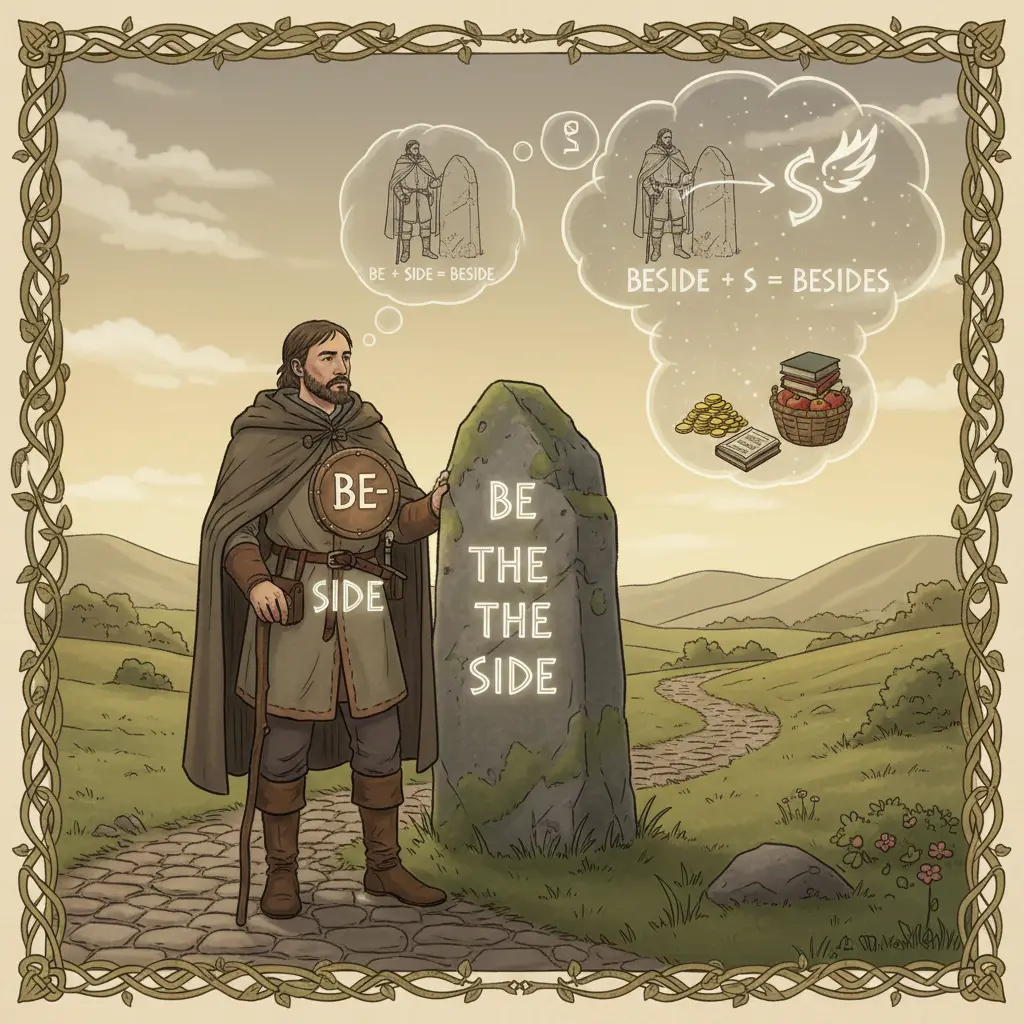
Example sentences are the start of understanding. Don't rush to memorize. First feel how the word works in a sentence.
(a) Root decomposition: be- prefix + side root, forming beside; an -s suffix later attaches to yield besides. (b) Historical origin: from Old English beside (be- + side); development in Middle English extended the sense to mean in addition. (c) Memory image: picture a traveler standing by the side of a road, with a be- badge on the side, and the idea growing into besides as an extra thought.
Note 1: These definitions and etymologies are not standard dictionary definitions, but extended explanations provided to help with memorization and understanding of the actual application of words. Through this background information, we strive to make words more vivid and easier to understand, and help you remember their meanings in real life.
Note 2: LexiTalk designs the learning flow around the linguistics principle of “Comprehensible Input.” When learners encounter material that is slightly above their level but still understandable from context, the brain naturally absorbs the language. That’s why we keep every word inside authentic contexts, using examples and associations to help you understand it and use it flexibly.
Read the FAQ explanation of Comprehensible InputI reach for the jar and move it a little, feeling the shelf tilt under my fingers. I set a second item beside it and push the others back to keep the space neat. As I pause, I notice the word besides on a note and let it settle in my mind, a hint of something more. The small adjustments make the scene feel wider, and I decide what counts besides the main thing.
Besides is a versatile adverb used to add information beyond what has already been stated. It often means in addition to something, or also; it can also introduce a contrast or a restriction when used with the sense of exception: "besides that, I won’t go." In everyday speech, besides frequently appears with phrases like besides you, besides being late, or besides the point. When replacing with also or moreover, be mindful of tone and emphasis: besides adds both extra detail and a subtle contrast. It is common in American and British English alike, and it is accepted in formal writing as well as casual conversation.
Learners often treat besides as a simple synonym of also; in many languages the equivalent emphasizes adding new detail rather than contrast. English users must watch for the nuance of contrast or exception, and for the form besides that introduces a clause.
What does the word 'besides' mean?
Which sentence uses 'besides' correctly?
Which word is most similar to 'besides'?
What is the opposite of 'besides'?
Can you give an example of a real-life scenario of 'besides'?
Download LexiTalk app for personalized learning experience
Download AppCookies
We use cookies for essential site functions, analytics, and ads. You can accept, reject, or manage preferences. Privacy Policy