milk - Master This Word
Master this word with our 5-step learning method – Learn English in English
Train English Through Brain Routes, Not Translation.
This page helps you stop memorizing isolated translations and start understanding a word through its shared mental image, native-style thinking, and practical training steps.
Master this word with our 5-step learning method – Learn English in English
Example sentences are the start of understanding. Don't rush to memorize. First feel how the word works in a sentence.
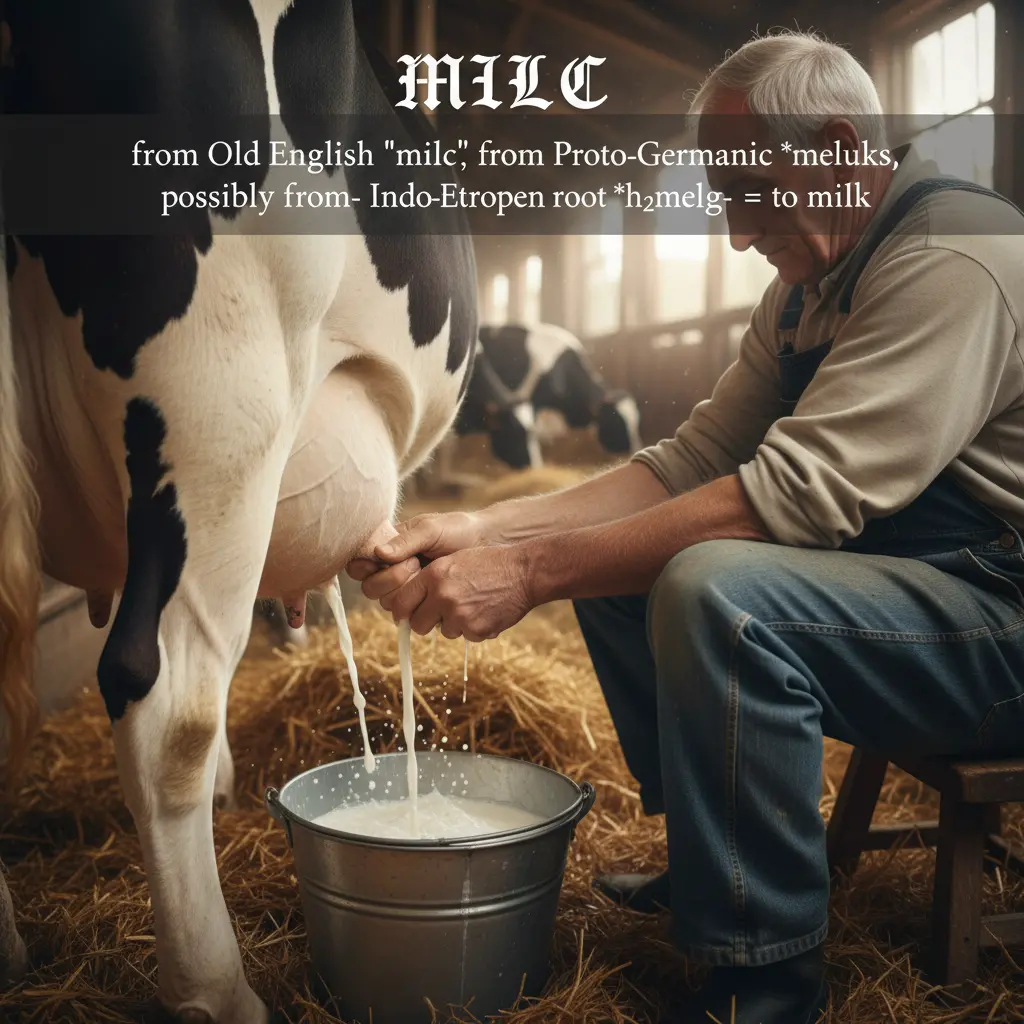
milk: from Old English 'milc', from Proto-Germanic *meluks, possibly from a Proto-Indo-European root *h₂melg- = to milk. Imagine a cow being gently milked, producing a steady stream of white liquid into a pail.
Note 1: These definitions and etymologies are not standard dictionary definitions, but extended explanations provided to help with memorization and understanding of the actual application of words. Through this background information, we strive to make words more vivid and easier to understand, and help you remember their meanings in real life.
Note 2: LexiTalk designs the learning flow around the linguistics principle of “Comprehensible Input.” When learners encounter material that is slightly above their level but still understandable from context, the brain naturally absorbs the language. That’s why we keep every word inside authentic contexts, using examples and associations to help you understand it and use it flexibly.
Read the FAQ explanation of Comprehensible InputI hold the bottle steady, then set my grip and tilt it. Milk slides into the glass, and I adjust my wrist to keep the stream smooth. The cold touch on my fingers and the pull of gravity as the white liquid fills the cup. I take a sip and keep a calm pace, letting the simple motion become part of the morning.
Milk is a common, versatile word with several closely related meanings. As a noun it refers to the white liquid produced by mammals to feed their young, and it is also the everyday drink and a key ingredient in many foods and dairy products. It can describe beverages and products sold as milk, including fortified varieties and different fat contents. As a verb, to milk means to extract milk from an animal, typically by hand or with a milking machine, and it can be used figuratively to mean exploiting a resource or a situation for gain. Learners often confuse milk with other white liquids or mix up noun and verb uses depending on the context.
English users often separate milk as a straightforward dairy noun and also as a verb in farming or metaphorical contexts. Learners from non Indo-European languages may overgeneralize the noun to all white liquids or fail to notice the subtle distinction when talking about products or recipes.
What is the meaning of the word 'milk'?
Which sentence uses the word 'milk' correctly?
What is the most similar word to 'milk'?
What is the opposite of 'milk'?
Can you think of a real-life context for 'milk'?
Download LexiTalk app for personalized learning experience
Download AppCookies
We use cookies for essential site functions, analytics, and ads. You can accept, reject, or manage preferences. Privacy Policy