blocks - Master This Word
Master this word with our 5-step learning method – Learn English in English
Train English Through Brain Routes, Not Translation.
This page helps you stop memorizing isolated translations and start understanding a word through its shared mental image, native-style thinking, and practical training steps.
Master this word with our 5-step learning method – Learn English in English
Example sentences are the start of understanding. Don't rush to memorize. First feel how the word works in a sentence.
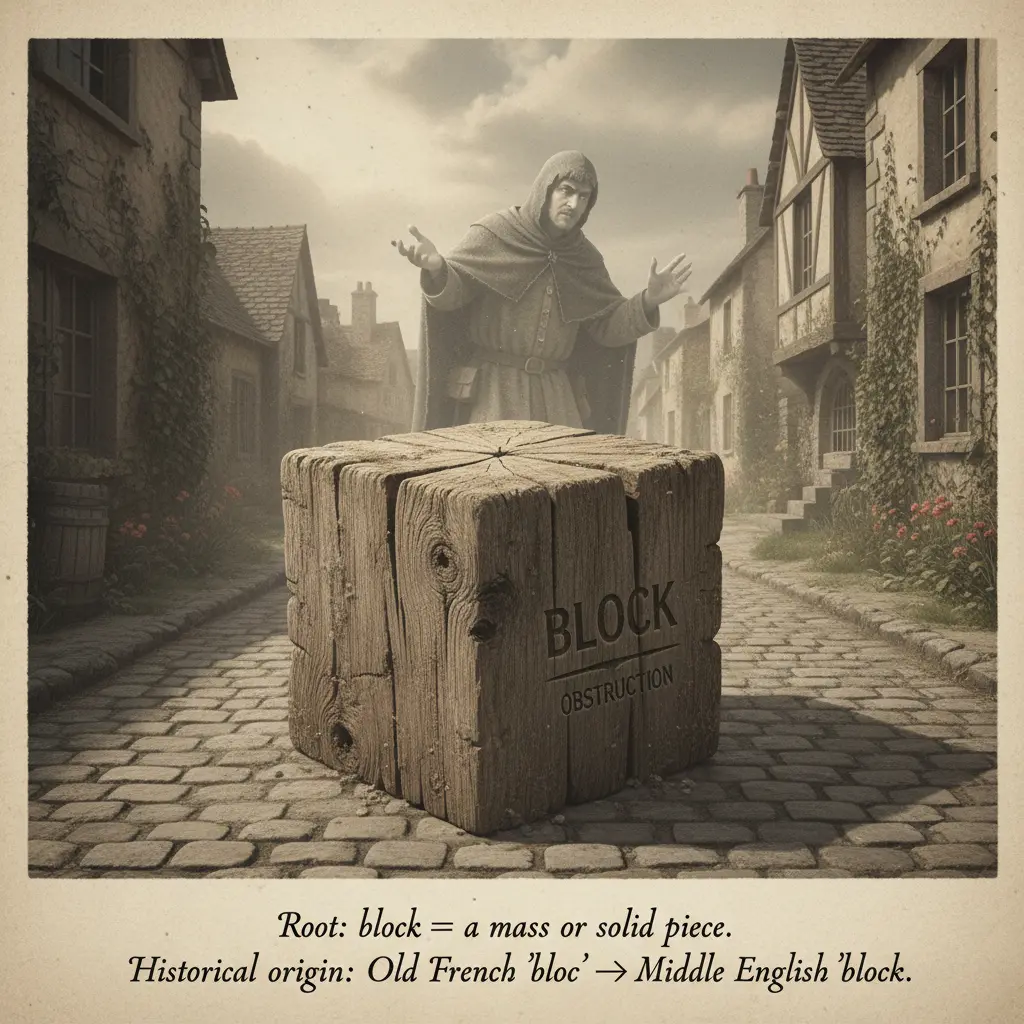
Root: block = a mass or solid piece. Historical origin: Old French 'bloc' → Middle English 'block'. Memory image: Imagine a wooden block being placed in a pathway to prevent movement, representing an obstruction.
Note 1: These definitions and etymologies are not standard dictionary definitions, but extended explanations provided to help with memorization and understanding of the actual application of words. Through this background information, we strive to make words more vivid and easier to understand, and help you remember their meanings in real life.
Note 2: LexiTalk designs the learning flow around the linguistics principle of “Comprehensible Input.” When learners encounter material that is slightly above their level but still understandable from context, the brain naturally absorbs the language. That’s why we keep every word inside authentic contexts, using examples and associations to help you understand it and use it flexibly.
Read the FAQ explanation of Comprehensible InputI pick up a block and move it to the side, feeling my grip tighten and then loosen as I decide where it belongs. I push it a little, then pull it back, watching how the space shifts under my hands. I set my stance, adjust my shoulders, and hold it steady, keeping the line clear or closed as needed. The moment makes the action feel real, and I sense how a simple block can change what comes next in the room.
Block has multiple senses that English learners should keep separate. As a verb, block means to obstruct or prevent passage, whether by placing something in a doorway, closing a road, or blocking someone from doing something such as blocking a request or blocking a number from calling. As a noun, it refers to a solid piece of material such as a wooden block, a concrete block, or a block of cheese, and in phrases like block party or block ice, there are additional collocations. Learners often confuse block with shut, stop, or barrier, because they all involve stopping movement, but block emphasizes obstruction rather than a final closure. Remember memory image: a block in a path.
Think in terms of obstruction and not a final seal; practice verbs that cause obstruction; watch for passive voice in reporting.
What is the meaning of the word 'blocks'?
Which sentence uses the word 'blocks' correctly?
Which word is most similar to 'blocks'?
What is the opposite of 'blocks'?
Can you think of a real-life context where something hinders progress?
Download LexiTalk app for personalized learning experience
Download AppCookies
We use cookies for essential site functions, analytics, and ads. You can accept, reject, or manage preferences. Privacy Policy