business - Master This Word
Master this word with our 5-step learning method – Learn English in English
Train English Through Brain Routes, Not Translation.
This page helps you stop memorizing isolated translations and start understanding a word through its shared mental image, native-style thinking, and practical training steps.
Master this word with our 5-step learning method – Learn English in English
Example sentences are the start of understanding. Don't rush to memorize. First feel how the word works in a sentence.
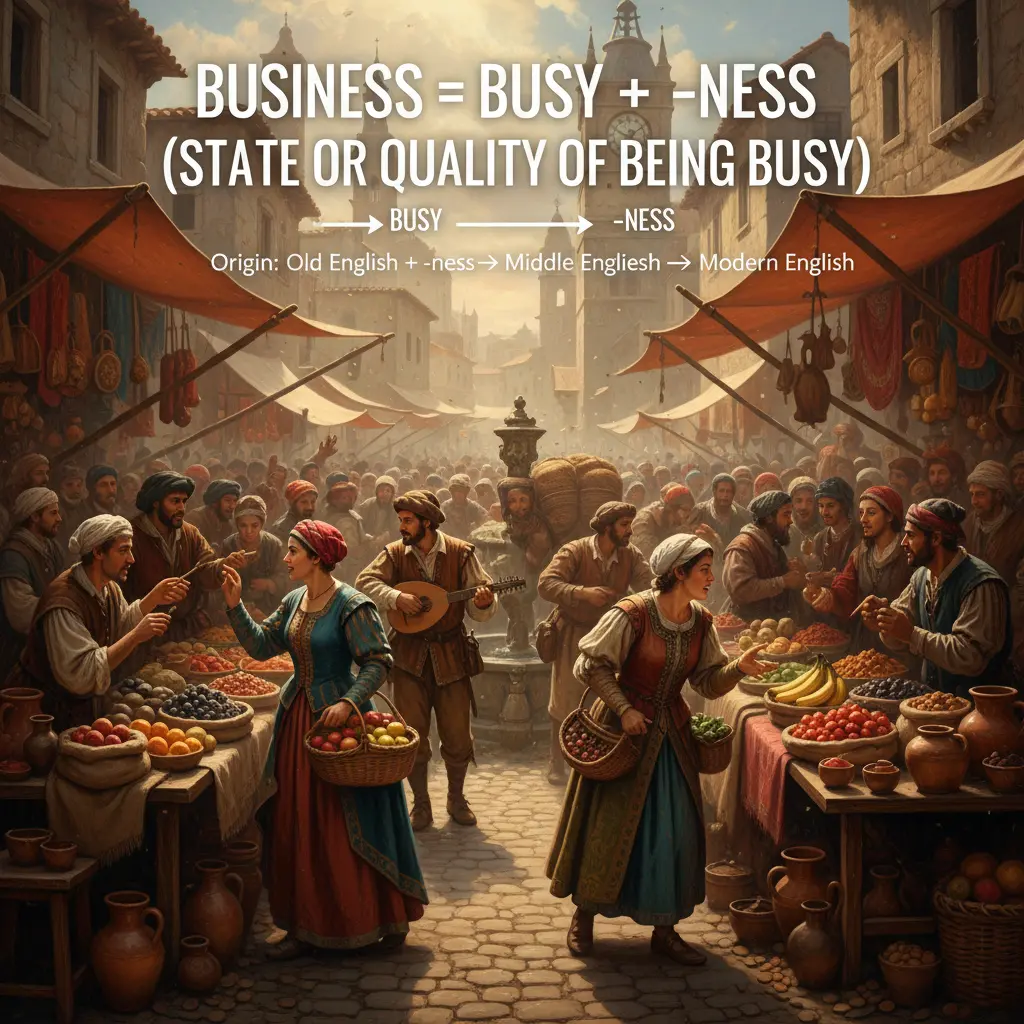
business = busy + -ness (state or quality of being busy). Origin: Old English bisig + -ness → Middle English → Modern English. Memory image: Imagine a bustling marketplace filled with busy people buying and selling goods.
Note 1: These definitions and etymologies are not standard dictionary definitions, but extended explanations provided to help with memorization and understanding of the actual application of words. Through this background information, we strive to make words more vivid and easier to understand, and help you remember their meanings in real life.
Note 2: LexiTalk designs the learning flow around the linguistics principle of “Comprehensible Input.” When learners encounter material that is slightly above their level but still understandable from context, the brain naturally absorbs the language. That’s why we keep every word inside authentic contexts, using examples and associations to help you understand it and use it flexibly.
Read the FAQ explanation of Comprehensible InputI set a notebook on the counter and push aside a stack of receipts. I move the pens and price tags, turning toward the register as orders come in. I adjust my plan, keep track of receipts, and decide what to offer next. In this rhythm of give and take, I sense what business feels like—a small enterprise built from work, decisions, and people.
Business is a broad term that covers activities involved in buying and selling goods or services, as well as the people and organizations that carry them out. It can refer to the field of commerce in general, a specific company, or a person’s profession. The word appears in phrases like business hours, go into business, or run a business. Learners should note that business can be singular or plural in different senses, as in the notion of one business versus many businesses, and some collocations use an adjective rather than a noun, such as business purposes or business strategy. Understanding the distinctions between everyday use and formal terms helps avoid awkward phrasing.
Think of business as both a field and a set of activities. English uses a mass noun for the concept and a countable noun for individual enterprises, which can confuse learners who translate it as company or job. Focus on collocations like hours, start, run, and do business to sound natural.
What is the meaning of the word 'business'?
In which of the following sentences is the word 'business' used correctly?
Which of the following words is most similar to 'business'?
What is the opposite of 'business'?
Can you provide a real-life context in which the word 'business' would be used?
Download LexiTalk app for personalized learning experience
Download AppCookies
We use cookies for essential site functions, analytics, and ads. You can accept, reject, or manage preferences. Privacy Policy