cast - Master This Word
Master this word with our 5-step learning method – Learn English in English
Train English Through Brain Routes, Not Translation.
This page helps you stop memorizing isolated translations and start understanding a word through its shared mental image, native-style thinking, and practical training steps.
Master this word with our 5-step learning method – Learn English in English
Example sentences are the start of understanding. Don't rush to memorize. First feel how the word works in a sentence.
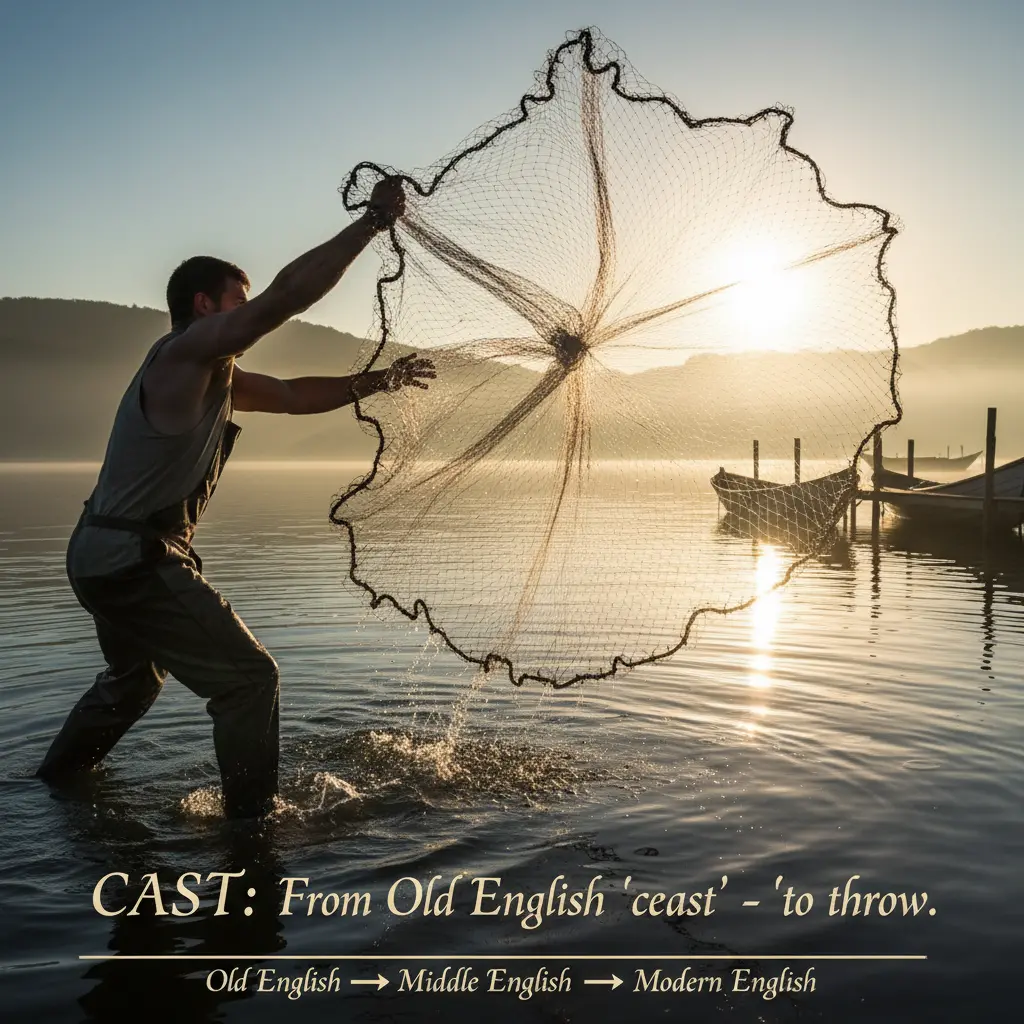
The root 'cast' comes from Old English 'ceast' meaning 'to throw.' Historical origin: Old English → Middle English → Modern English. Imagine a person with a strong arm, launching a fishing net far into the water; this helps remember the power of 'casting' something out.
Note 1: These definitions and etymologies are not standard dictionary definitions, but extended explanations provided to help with memorization and understanding of the actual application of words. Through this background information, we strive to make words more vivid and easier to understand, and help you remember their meanings in real life.
Note 2: LexiTalk designs the learning flow around the linguistics principle of “Comprehensible Input.” When learners encounter material that is slightly above their level but still understandable from context, the brain naturally absorbs the language. That’s why we keep every word inside authentic contexts, using examples and associations to help you understand it and use it flexibly.
Read the FAQ explanation of Comprehensible InputI start with a quick grip, fingers tightening around the tool, and I move my wrist in a clean arc. I push off, feel my weight shift through the shoulder, and the line of action changes as I set my aim. The moment of release is a small, stubborn decision, a test of effort met by focus as I adjust for the result. Watching others step into the same frame, the cast begins to take shape and the scene finally feels real.
Cast is a versatile word in English with three distinct uses. As a verb, cast means to throw something with force, as in casting a fishing line or casting a shadow; it can also mean to form an object by pouring liquid metal or plastic into a mold, a process known as casting. As a noun, cast refers to the group of actors in a play, film, or TV show, for example, the cast of Hamlet. The past tense is cast, and the past participle is also cast, which can be confusing because the form does not change. Distinguishing noun vs verb senses helps avoid common mistakes in writing and speaking.
In English, the word cast spans concrete actions (throwing or shaping) and the people who perform in media, so learners must map meaning from context; many languages separate these senses into different words, making learners hyper-aware of context to avoid false friends.
Which of the following sentences use the word 'cast' correctly?
Which word is most similar to the word 'cast'?
What is the opposite of the word 'cast'?
Can you give an example of a real-life scenario of 'casting'?
Download LexiTalk app for personalized learning experience
Download AppCookies
We use cookies for essential site functions, analytics, and ads. You can accept, reject, or manage preferences. Privacy Policy