cautious - Master This Word
Master this word with our 5-step learning method – Learn English in English
Train English Through Brain Routes, Not Translation.
This page helps you stop memorizing isolated translations and start understanding a word through its shared mental image, native-style thinking, and practical training steps.
Master this word with our 5-step learning method – Learn English in English
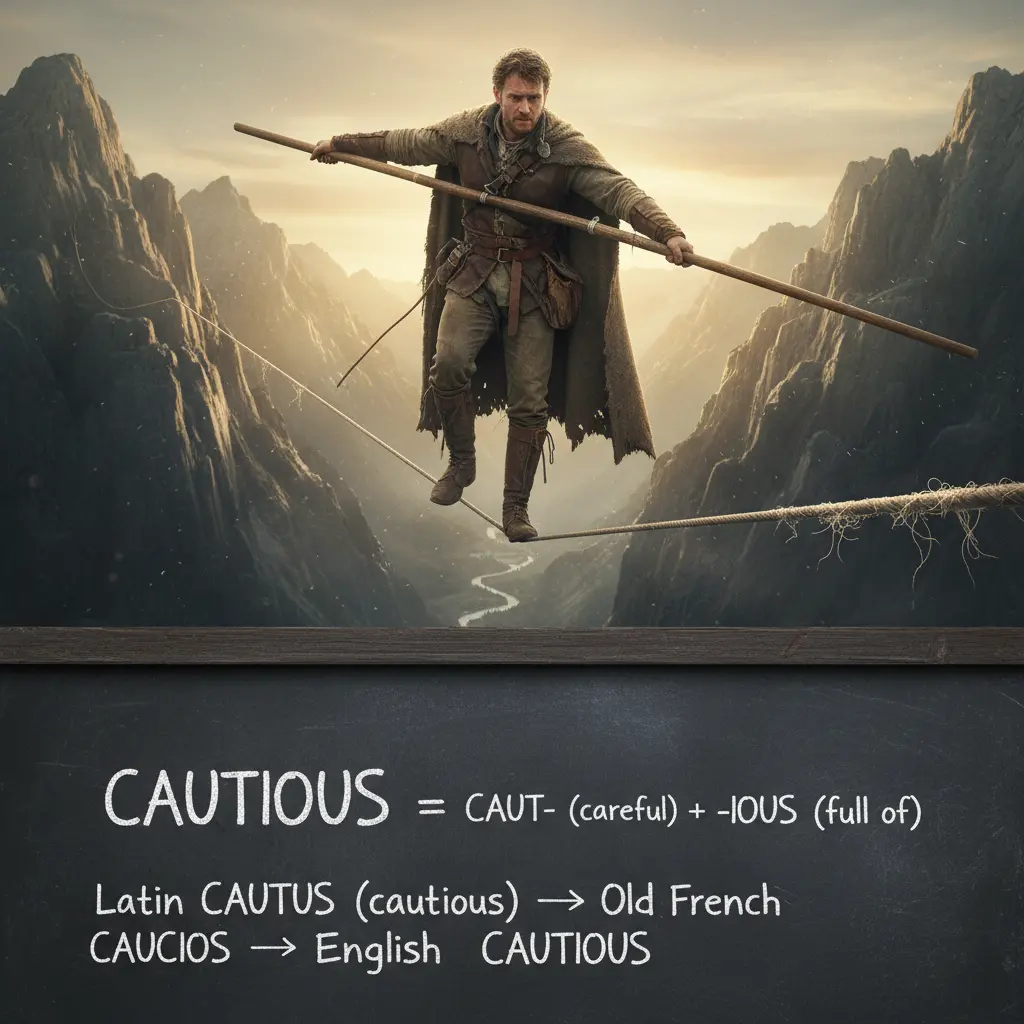
Example sentences are the start of understanding. Don't rush to memorize. First feel how the word works in a sentence.
cautious = caut- (careful) + -ious (full of); Latin cautus (cautious) → Old French caucios → English cautious. Imagine someone walking on a tightrope, carefully placing each foot to avoid falling, illustrating extreme caution.
Note 1: These definitions and etymologies are not standard dictionary definitions, but extended explanations provided to help with memorization and understanding of the actual application of words. Through this background information, we strive to make words more vivid and easier to understand, and help you remember their meanings in real life.
Note 2: LexiTalk designs the learning flow around the linguistics principle of “Comprehensible Input.” When learners encounter material that is slightly above their level but still understandable from context, the brain naturally absorbs the language. That’s why we keep every word inside authentic contexts, using examples and associations to help you understand it and use it flexibly.
Read the FAQ explanation of Comprehensible InputStarting with a slow breath, I move my hand toward the glass and gently turn the knob. A small test: I pull back a touch when I hear a creak and keep my eyes on the edge. The feeling is careful, like tightening a switch of attention, an effort to avoid mistakes. Later, I carry that pause into real life, setting plans more slowly, adjusting as new details appear, and choosing safer options when danger shows up.
Cautious describes a mindset and behavior that aims to avoid danger or mistakes by thinking ahead and weighing options before acting. It captures a steady, proactive tendency to minimize risk, rather than a sudden fear or hesitation. In everyday English, cautious often contrasts with reckless or careless, and with careful, the latter sometimes refers to precision rather than risk awareness. Learners tend to mix cautious with careful or to overuse the word in places where wary or prudent would fit better. Note that cautious can describe a person's attitude, a plan, or a decision, and it commonly appears with adverbs like cautiously.
This explains how English frames cautious as a stable attitude toward risk and as a descriptor for planning or behavior, and cautions learners not to shoehorn it into every careful task.
What is the meaning of the word 'cautious'?
In which of the following sentences is 'cautious' used correctly?
Which word is a synonym of 'cautious'?
Which word is an antonym of 'cautious'?
In what real-life situation would being 'cautious' be important?
Technology & Social Media
Listen NowDownload LexiTalk app for personalized learning experience
Download AppCookies
We use cookies for essential site functions, analytics, and ads. You can accept, reject, or manage preferences. Privacy Policy