
colony - Master This Word
Master this word with our 5-step learning method – Learn English in English
Train English Through Brain Routes, Not Translation.
This page helps you stop memorizing isolated translations and start understanding a word through its shared mental image, native-style thinking, and practical training steps.
Master this word with our 5-step learning method – Learn English in English
Example sentences are the start of understanding. Don't rush to memorize. First feel how the word works in a sentence.
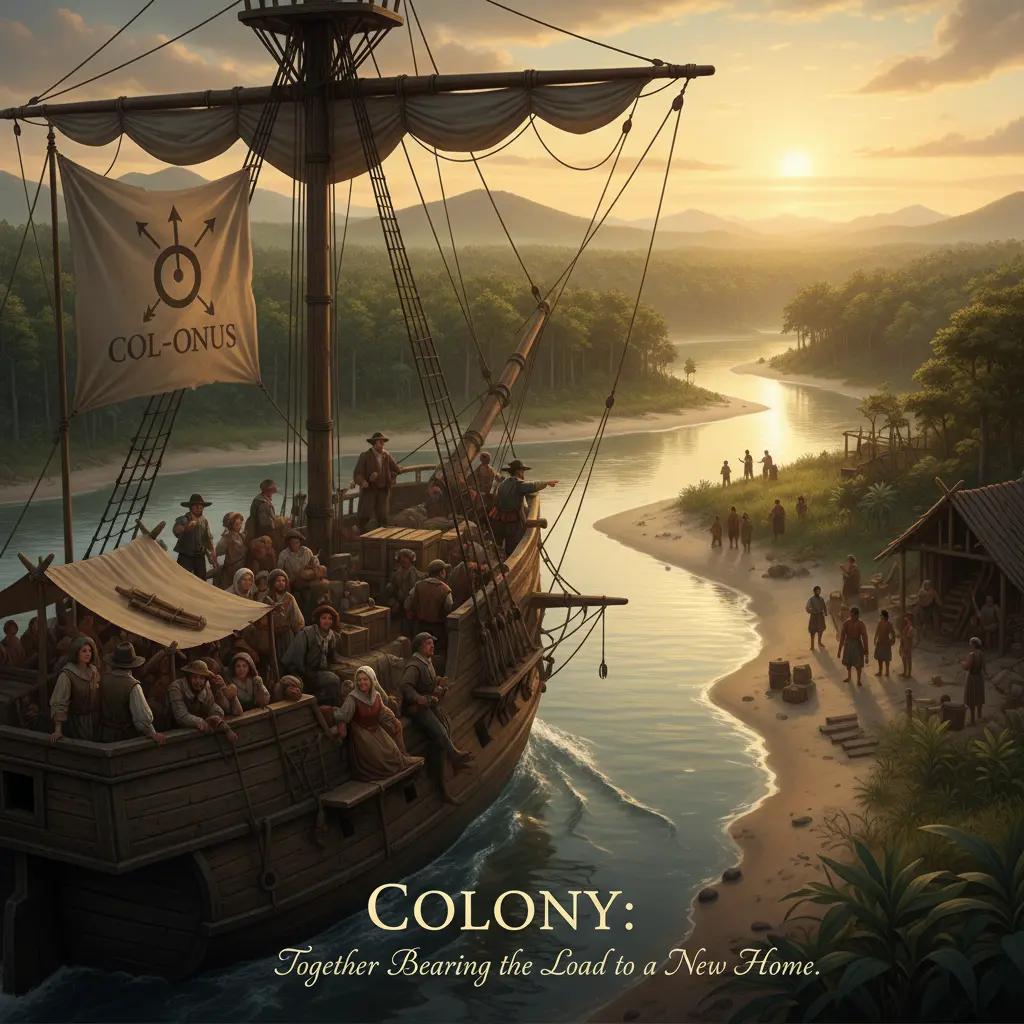
colony = col- (together) + onus (load) → Latin 'colonia' → Old French 'colonie' → English 'colony'. Imagine a ship carrying a load of people to a new land, forming a new community together.
Note 1: These definitions and etymologies are not standard dictionary definitions, but extended explanations provided to help with memorization and understanding of the actual application of words. Through this background information, we strive to make words more vivid and easier to understand, and help you remember their meanings in real life.
Note 2: LexiTalk designs the learning flow around the linguistics principle of “Comprehensible Input.” When learners encounter material that is slightly above their level but still understandable from context, the brain naturally absorbs the language. That’s why we keep every word inside authentic contexts, using examples and associations to help you understand it and use it flexibly.
Read the FAQ explanation of Comprehensible InputI press my finger to the map and move it along the coast, pinning a small circle where people will gather. I set a few markers and pull them closer as the group shares meals and letters from home, keeping the line a living thing rather than a line on paper. The effort to hold ties with the homeland while listening to the voices around me makes the place feel earned, not given, and the land seems to answer with new routines. Soon the idea of a colony grows in my chest, a living pattern of people and place moving together under one roof of belonging.
Colony in English has several related senses: it can refer to a group of people who settle in a new territory but keep ties to their homeland; a territory governed by a foreign power or administered as a colony; or a community of organisms living together in one place. The senses share the idea of a defined group, but the focus differs: settlement and political status in the first two, biology in the third. Learners often confuse colony with settlement, or with microbial colonies when discussing biology, and mix up colonize/colonization versus related adjectives like colonial. Useful collocations include immigrant colony, penal colony, historic colony, and bacterial colony; the verb is colonize and the noun/adj forms appear in colonial contexts.
English learners often separate colony into human settlement vs biology; they may overgeneralize the term to any group, forgetting historical/political nuance or the biology sense.
What is the meaning of the word 'colony'?
In which sentence is the word 'colony' used correctly?
What is a synonym for 'colony'?
What is an antonym for 'colony'?
In what real-life context would you find a 'colony'?
Download LexiTalk app for personalized learning experience
Download AppCookies
We use cookies for essential site functions, analytics, and ads. You can accept, reject, or manage preferences. Privacy Policy