complicated - Master This Word
Master this word with our 5-step learning method – Learn English in English
Train English Through Brain Routes, Not Translation.
This page helps you stop memorizing isolated translations and start understanding a word through its shared mental image, native-style thinking, and practical training steps.
Master this word with our 5-step learning method – Learn English in English
Example sentences are the start of understanding. Don't rush to memorize. First feel how the word works in a sentence.
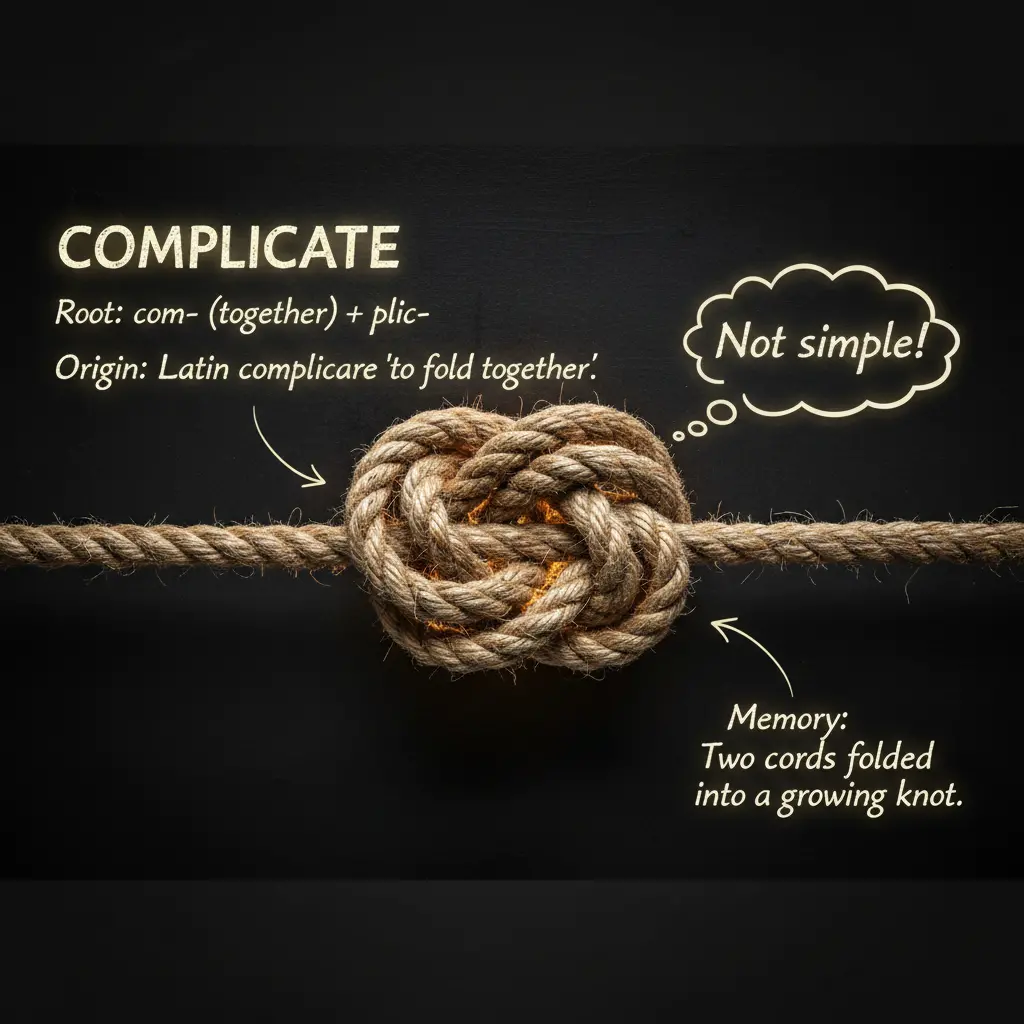
Root: prefix com- (together) + root plic- (to fold) + suffix -ate (to make). Origin: Latin complicare (com + plicare) 'to fold together', later via Old French into English; this folding idea also gave rise to the sense of not being simple. Memory: imagine two cords folded together into a growing knot, illustrating both folding and increasing complexity.
Note 1: These definitions and etymologies are not standard dictionary definitions, but extended explanations provided to help with memorization and understanding of the actual application of words. Through this background information, we strive to make words more vivid and easier to understand, and help you remember their meanings in real life.
Note 2: LexiTalk designs the learning flow around the linguistics principle of “Comprehensible Input.” When learners encounter material that is slightly above their level but still understandable from context, the brain naturally absorbs the language. That’s why we keep every word inside authentic contexts, using examples and associations to help you understand it and use it flexibly.
Read the FAQ explanation of Comprehensible InputI hold a tangled map and start to move the pages, turning corners as I work. The lines shift under my eyes, and I feel the effort of keeping track as I adjust my grip. I push past a quick shortcut, change tack, and the route slips into something more intricate. Only then does the scene feel complicated in a human way, because understanding must be earned through effort and careful nudges.
Complicated describes something that is not simple or straightforward. As a verb, to complicate means to introduce more problems or make something harder to understand or do. In everyday speech you might note that a plan became complicated after adding new steps, or that a question grew complicated as details emerged. In technical settings, a simple system can become complicated when many parts interact in unexpected ways. Learners often mix up complex and complicated: complex refers to many interconnected parts, while complicated emphasizes the difficulty of understanding or solving. The Latin root com- (together) + plic- (to fold) reminds us of folding ideas together to create knots of meaning.
In English, 'complicated' often signals a subjective difficulty or a situation that has become harder due to added steps. Learners tend to overuse it where 'complex' would fit for systems with many interacting parts. Remember that 'to complicate' is a verb meaning to cause trouble, while 'complicated' describes the state, not the action.
What is the meaning of the word 'complicated'?
In which of the following sentences is 'complicated' used correctly?
Select the word most similar to 'complicated'.
Select the word opposite in meaning to 'complicated'.
In what real-life scenario would you use the word 'complicated'?
English Learning Listening Content
Listen NowDownload LexiTalk app for personalized learning experience
Download AppCookies
We use cookies for essential site functions, analytics, and ads. You can accept, reject, or manage preferences. Privacy Policy