
credulity - Master This Word
Master this word with our 5-step learning method – Learn English in English
Train English Through Brain Routes, Not Translation.
This page helps you stop memorizing isolated translations and start understanding a word through its shared mental image, native-style thinking, and practical training steps.
Master this word with our 5-step learning method – Learn English in English
Example sentences are the start of understanding. Don't rush to memorize. First feel how the word works in a sentence.
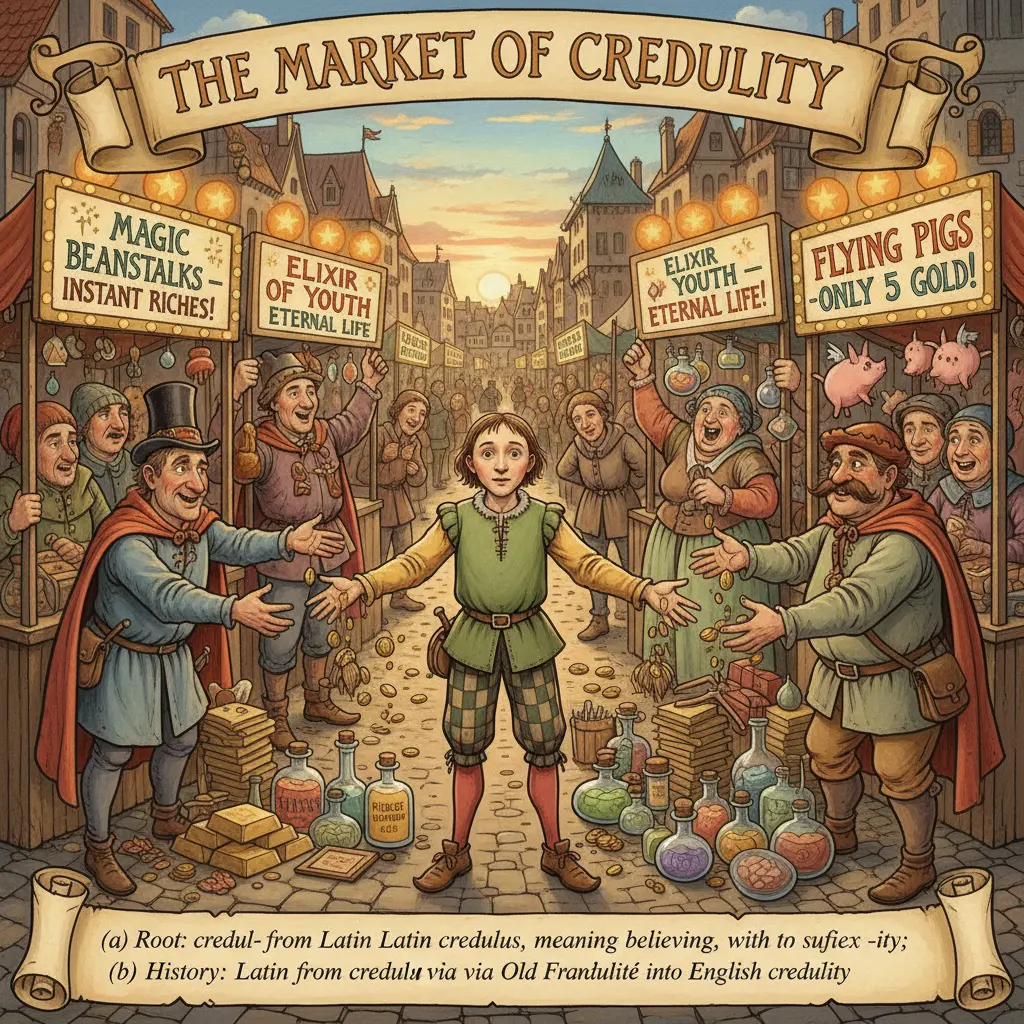
(a) Root: credul- from Latin credulus, meaning believing, with suffix -ity; (b) History: Latin credulitas from credulus via Old French credulité into English credulity; (c) Memory: imagine a person at a market who trusts every flashy claim and hands over money to every seller because they believe what they are told.
Note 1: These definitions and etymologies are not standard dictionary definitions, but extended explanations provided to help with memorization and understanding of the actual application of words. Through this background information, we strive to make words more vivid and easier to understand, and help you remember their meanings in real life.
Note 2: LexiTalk designs the learning flow around the linguistics principle of “Comprehensible Input.” When learners encounter material that is slightly above their level but still understandable from context, the brain naturally absorbs the language. That’s why we keep every word inside authentic contexts, using examples and associations to help you understand it and use it flexibly.
Read the FAQ explanation of Comprehensible InputCredulity is the tendency to believe what someone says with little or no evidence, and to accept statements at face value. It describes a disposition to be easily convinced, sometimes leading to gullibility or being misled. People may show credulity when they rely on persuasive stories, bright claims, or rumors rather than on careful verification. In everyday life, credulity can range from accepting a harmless compliment to falling for a sophisticated scam; the key idea is a bias toward trust rather than healthy skepticism. Understanding credulity helps learners recognize contrasts with skepticism, critical thinking, and the value of checking sources before believing.
Meta note for English speakers: in English, credulity is a fixed noun describing a bias toward trust that can vary in intensity from slight to pronounced; learners should contrast it with skepticism and verify sources.
Which best defines the word 'credulity'?
Which sentence uses 'credulity' correctly?
Which word is most similar in meaning to 'credulity'?
Which word is the opposite of 'credulity'?
Can you think of a real-life scenario that shows someone displaying this trait?
Download LexiTalk app for personalized learning experience
Download AppCookies
We use cookies for essential site functions, analytics, and ads. You can accept, reject, or manage preferences. Privacy Policy