
dependence - Master This Word
Master this word with our 5-step learning method – Learn English in English
Train English Through Brain Routes, Not Translation.
This page helps you stop memorizing isolated translations and start understanding a word through its shared mental image, native-style thinking, and practical training steps.
Master this word with our 5-step learning method – Learn English in English
Example sentences are the start of understanding. Don't rush to memorize. First feel how the word works in a sentence.
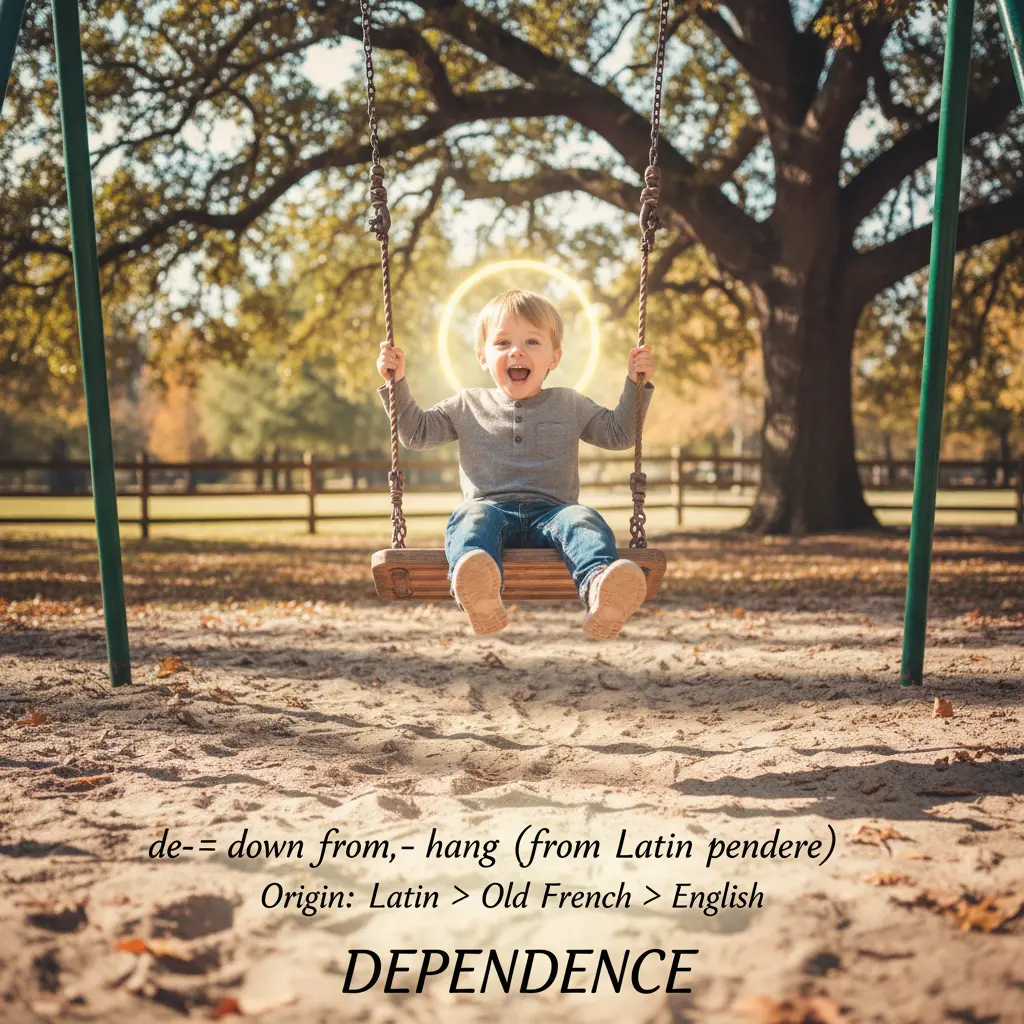
de- = down from, pend = hang (from Latin pendere); Origin: Latin > Old French > English. Imagine a child hanging on a swing, reliant on it to have fun, which symbolizes dependence.
Note 1: These definitions and etymologies are not standard dictionary definitions, but extended explanations provided to help with memorization and understanding of the actual application of words. Through this background information, we strive to make words more vivid and easier to understand, and help you remember their meanings in real life.
Note 2: LexiTalk designs the learning flow around the linguistics principle of “Comprehensible Input.” When learners encounter material that is slightly above their level but still understandable from context, the brain naturally absorbs the language. That’s why we keep every word inside authentic contexts, using examples and associations to help you understand it and use it flexibly.
Read the FAQ explanation of Comprehensible InputI place my palm on the steering wheel, push gently, and the car begins to move. The road changes, and my body shifts as I adjust my grip and pace. I notice I keep leaning on familiar routines, even as new paths appear, and I try to set a steady rhythm. From this moment I sense how dependence can be a map I use to keep going, not a trap, as I feel my choices guided by what I rely on.
Dependence describes the state of relying on someone or something for support, guidance, or resources. It covers everyday reliance, financial or logistical needs, and psychological patterns such as substance or behavioral dependence. The term appears across social, medical, and professional contexts, from a child depending on a caregiver to a patient following a treatment plan. You’ll often see idiomatic phrases like dependence on others, financial dependence, or dependence syndrome. In academic writing, distinctions are made between dependence on a person versus a thing, and between dependence and addiction, dependency, or reliance, depending on nuance and domain.
To an English speaker, dependence often maps to relying on another person for daily support or to a need that constrains autonomy. In English, addiction is a narrower term typically reserved for compulsive substance use, while dependence can be neutral or negative depending on context. Learners frequently mix risk-related phrases with reliance and confuse ‘dependence on’ with ‘dependence from’ or with the adjective ‘dependent.’
What is the meaning of 'dependence'?
In which sentence is 'dependence' used correctly?
Which word is an antonym of 'dependence'?
In what real-life scenario might 'dependence' be a significant factor?
Reflect on a situation where 'dependence' can be positive.
Download LexiTalk app for personalized learning experience
Download AppCookies
We use cookies for essential site functions, analytics, and ads. You can accept, reject, or manage preferences. Privacy Policy