despite - Master This Word
Master this word with our 5-step learning method – Learn English in English
Train English Through Brain Routes, Not Translation.
This page helps you stop memorizing isolated translations and start understanding a word through its shared mental image, native-style thinking, and practical training steps.
Master this word with our 5-step learning method – Learn English in English
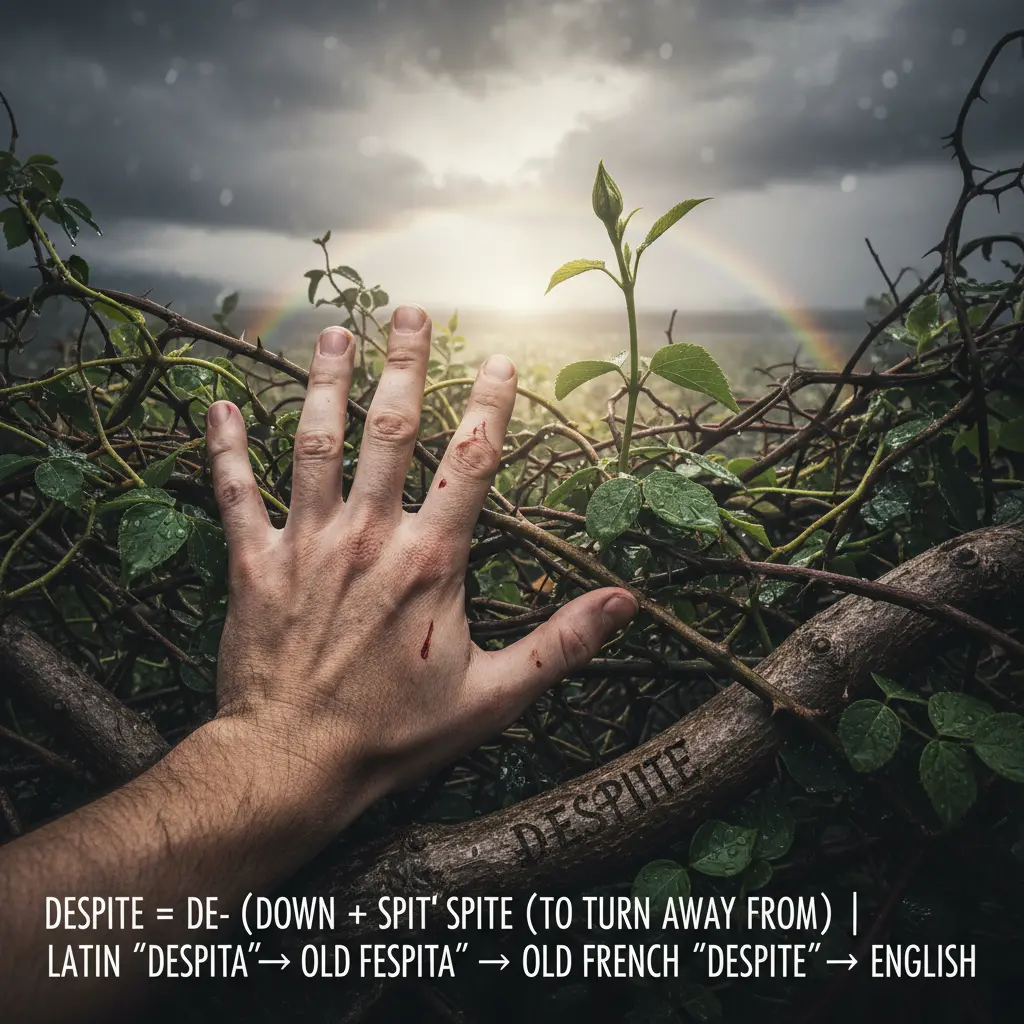
Example sentences are the start of understanding. Don't rush to memorize. First feel how the word works in a sentence.
despite = de- (down) + spite (to turn away from) | Latin 'despita' → Old French 'despite' → English. Imagine facing opposition but continuing, illustrating resilience despite challenges.
Note 1: These definitions and etymologies are not standard dictionary definitions, but extended explanations provided to help with memorization and understanding of the actual application of words. Through this background information, we strive to make words more vivid and easier to understand, and help you remember their meanings in real life.
Note 2: LexiTalk designs the learning flow around the linguistics principle of “Comprehensible Input.” When learners encounter material that is slightly above their level but still understandable from context, the brain naturally absorbs the language. That’s why we keep every word inside authentic contexts, using examples and associations to help you understand it and use it flexibly.
Read the FAQ explanation of Comprehensible InputI grip the door handle and pull, watching the frame shift under the effort. I step into the street, set my shoulders, and keep moving. Rain taps the pavement, but I push forward and change my line to stay on course despite the weather. I adjust my pace and hold steady as the wind tries to pull me off balance.
Despite is a preposition used to show that something happened or is true even though something else might have suggested the opposite. It expresses contrast with expectations by introducing a noun phrase or gerund. It can appear at the beginning of a sentence or after a clause and is equivalent to in spite of. Remember that you follow despite with a noun, pronoun, or -ing form, not with 'of' afterward. Common mistakes include saying despite of, or treating it like a synonym for because. In formal writing, despite stands alone after a comma when introducing the contrasting information. Understanding the nuance helps learners express resilience or obstacles clearly.
For English speakers, despite emphasizes a conscious contrast and is often used to highlight resilience, with a strong, formal tone in writing. Learners may over-rely on despite of or treat it as a synonym for because, missing the subtle contrast it signals.
What is the meaning of 'despite'?
Which sentence uses 'despite' correctly?
Which word is most similar to 'despite'?
What is the opposite of 'despite'?
Can you think of a real-life context where 'despite' would be used?
Download LexiTalk app for personalized learning experience
Download AppCookies
We use cookies for essential site functions, analytics, and ads. You can accept, reject, or manage preferences. Privacy Policy