
dielectric - Master This Word
Master this word with our 5-step learning method – Learn English in English
Train English Through Brain Routes, Not Translation.
This page helps you stop memorizing isolated translations and start understanding a word through its shared mental image, native-style thinking, and practical training steps.
Master this word with our 5-step learning method – Learn English in English
Example sentences are the start of understanding. Don't rush to memorize. First feel how the word works in a sentence.
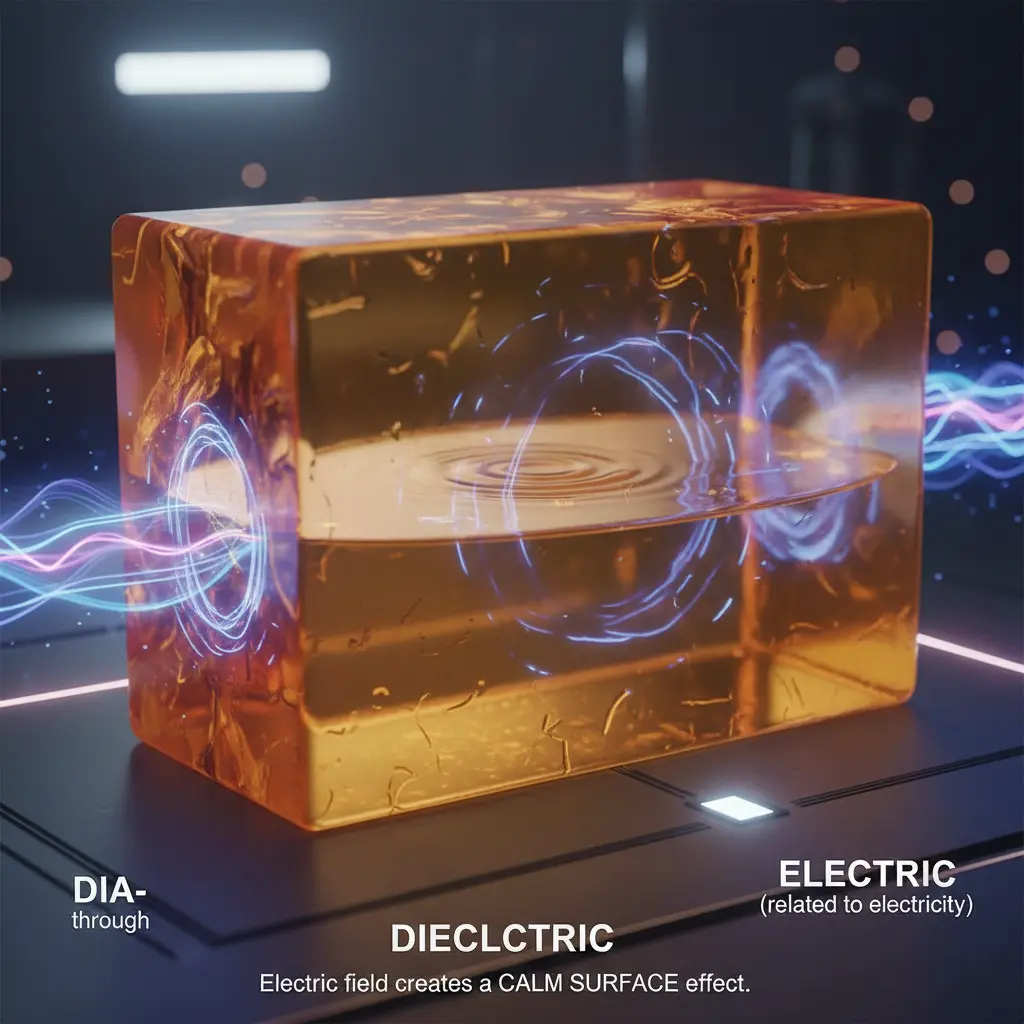
Root decomposition: 'dia-' (through) + 'electric' (related to electricity). Historical origin: from Greek 'dia' + 'ēlektron' (amber) to Latin, then Old French to English. Memory image: Imagine an electric field flowing through an insulator like water through a pipe, but it can’t flow; it just creates a calm surface effect.
Note 1: These definitions and etymologies are not standard dictionary definitions, but extended explanations provided to help with memorization and understanding of the actual application of words. Through this background information, we strive to make words more vivid and easier to understand, and help you remember their meanings in real life.
Note 2: LexiTalk designs the learning flow around the linguistics principle of “Comprehensible Input.” When learners encounter material that is slightly above their level but still understandable from context, the brain naturally absorbs the language. That’s why we keep every word inside authentic contexts, using examples and associations to help you understand it and use it flexibly.
Read the FAQ explanation of Comprehensible InputA dielectric is a noun for a substance that does not conduct electricity but can be polarized by an electric field. In electronics, dielectrics are used to store energy and insulate components; between capacitor plates, a dielectric layer increases capacitance by reducing the electric field leakage while preventing current flow. The term comes from Greek dia (through) + ēlektron (amber), later entering English via Latin and French. A handy image is to picture the field passing through a nonconductive medium that can shift its molecular orientation but cannot carry charge across. This polarized response enables devices to function without a steady current.
Explain to an English speaker: Dielectric is a nonconductive, polarizable material used in electronics; learners often mix it up with 'insulator' or think it always blocks all electrical effects. Emphasize context: capacitors, polarization, and dielectric constant.
What is the meaning of the word 'dielectric'?
How is the word 'dielectric' used in a sentence?
Which word is most similar to 'dielectric'?
What is the opposite of 'dielectric'?
Can you think of a real-life context where the concept of 'dielectric' is applicable?
Download LexiTalk app for personalized learning experience
Download AppCookies
We use cookies for essential site functions, analytics, and ads. You can accept, reject, or manage preferences. Privacy Policy