
dispose - Master This Word
Master this word with our 5-step learning method – Learn English in English
Train English Through Brain Routes, Not Translation.
This page helps you stop memorizing isolated translations and start understanding a word through its shared mental image, native-style thinking, and practical training steps.
Master this word with our 5-step learning method – Learn English in English
Example sentences are the start of understanding. Don't rush to memorize. First feel how the word works in a sentence.
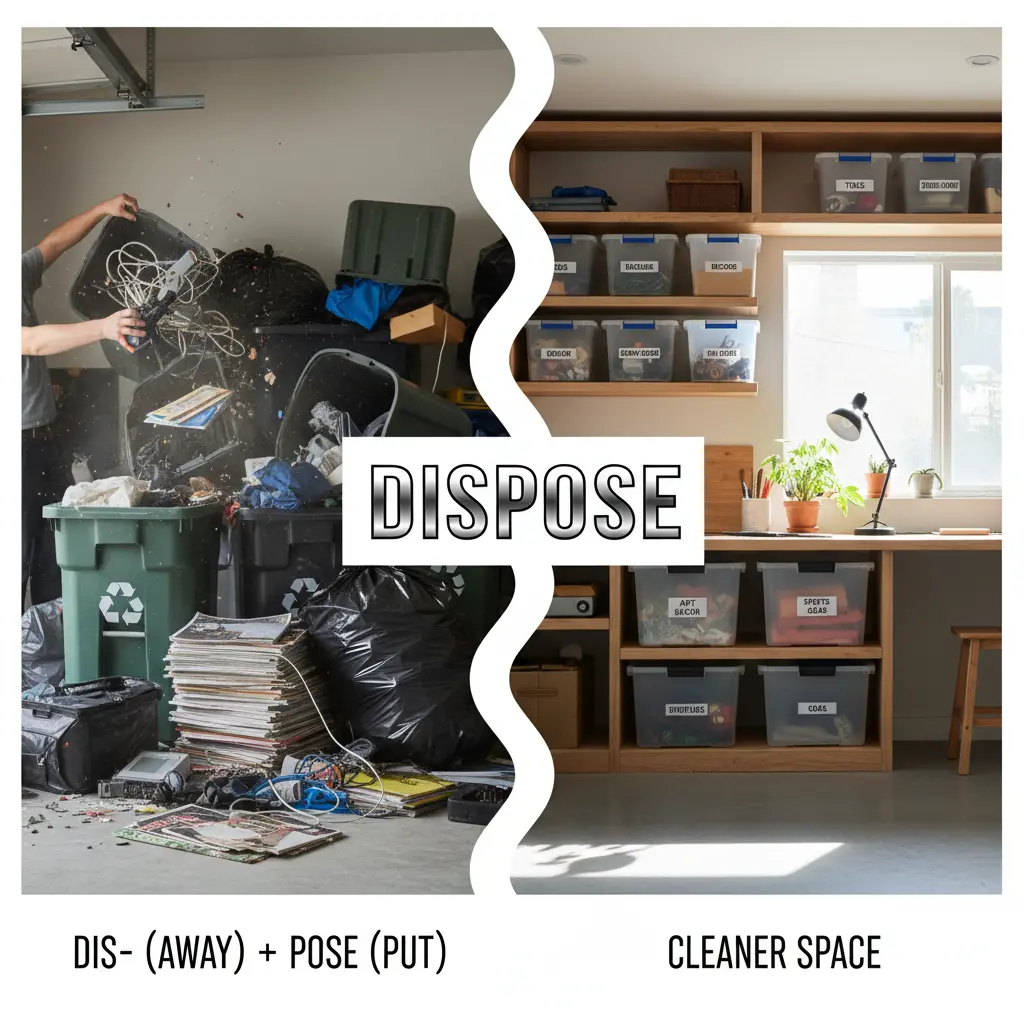
dispose = dis- (away) + pose (put/place); Latin → Old French → English. Imagine throwing away unwanted items and arranging what remains for a cleaner space.
Note 1: These definitions and etymologies are not standard dictionary definitions, but extended explanations provided to help with memorization and understanding of the actual application of words. Through this background information, we strive to make words more vivid and easier to understand, and help you remember their meanings in real life.
Note 2: LexiTalk designs the learning flow around the linguistics principle of “Comprehensible Input.” When learners encounter material that is slightly above their level but still understandable from context, the brain naturally absorbs the language. That’s why we keep every word inside authentic contexts, using examples and associations to help you understand it and use it flexibly.
Read the FAQ explanation of Comprehensible InputFirst I pick up a crumpled bottle and move it toward the trash can. I set it down, then push the lid and feel a small shift in how I control the scene. I hold my breath for a moment, adjust my grip, and decide to let go. This tiny dispose moment keeps the space tidy and teaches me to keep the same control in other everyday tasks.
Dispose is a versatile verb with several related senses. The most common meaning is to get rid of something you no longer want, by throwing it away, recycling, or donating it. You can dispose of old clothes, trash, or furniture. The word can also refer to the arrangement or disposition of items, as in deciding how furniture or equipment should be placed in a space. A more formal sense is to control or arrange something, such as resources, tasks, or a problem, to achieve a desired outcome. The etymology traces to dis- (away) and pose (put/place), through Latin and Old French into English. In everyday English, beware the noun 'disposition' which means mood or tendency, not a verb form.
Native English speakers often separate 'dispose' into distinct senses: discard, arrange, and have/allocate (as in 'dispose of resources'). Learners tend to mix the senses or overgeneralize 'dispose' to mean simply 'arrange'.
What does the word 'dispose' mean?
In which sentence is 'dispose' used correctly?
Which word is a synonym of 'dispose'?
What is the opposite of 'dispose'?
In what real-life situation would you use the word 'dispose'?
Download LexiTalk app for personalized learning experience
Download AppCookies
We use cookies for essential site functions, analytics, and ads. You can accept, reject, or manage preferences. Privacy Policy