distinctive - Master This Word
Master this word with our 5-step learning method – Learn English in English
Train English Through Brain Routes, Not Translation.
This page helps you stop memorizing isolated translations and start understanding a word through its shared mental image, native-style thinking, and practical training steps.
Master this word with our 5-step learning method – Learn English in English
Example sentences are the start of understanding. Don't rush to memorize. First feel how the word works in a sentence.
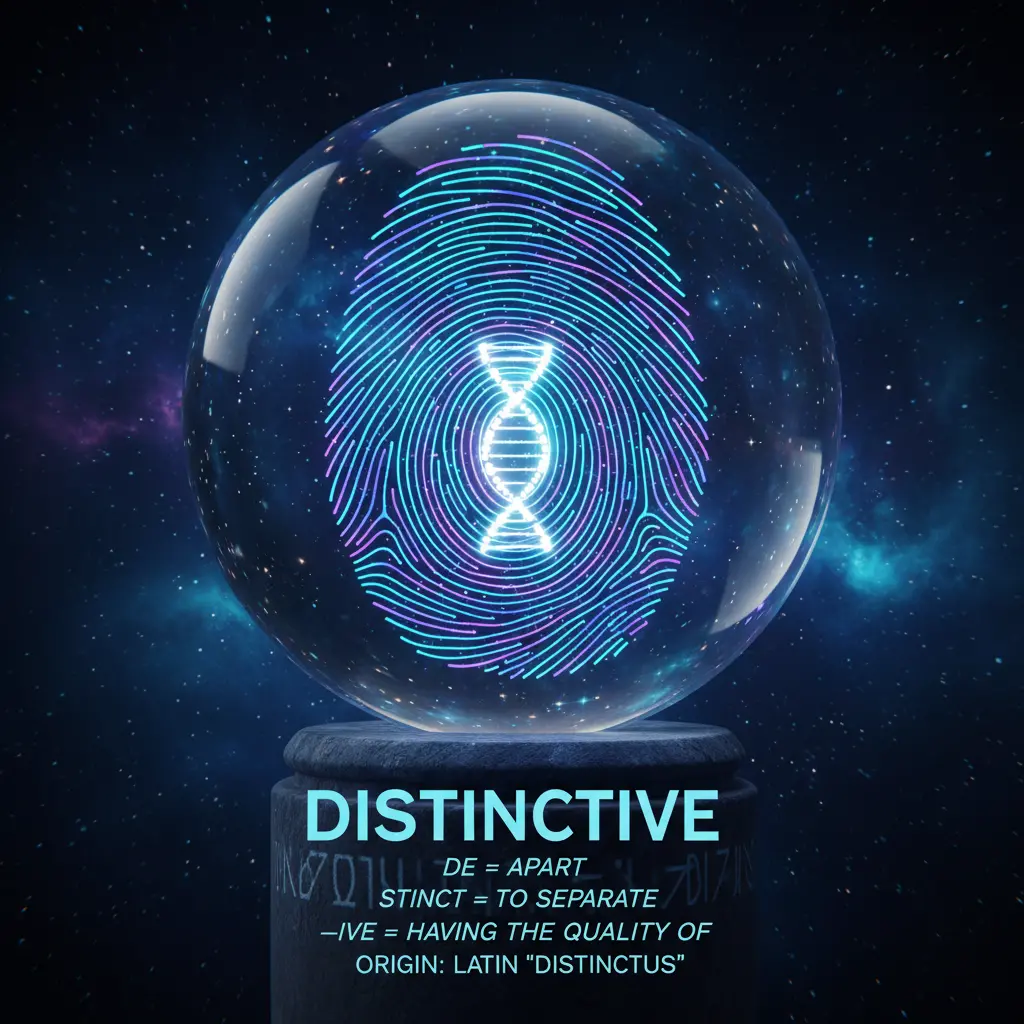
de- = apart + stinct = to separate + -ive = having the quality of. Origin: Latin 'distinctus' → Old French 'distinct' → English. Imagine a unique fingerprint that sets you apart from everyone else.
Note 1: These definitions and etymologies are not standard dictionary definitions, but extended explanations provided to help with memorization and understanding of the actual application of words. Through this background information, we strive to make words more vivid and easier to understand, and help you remember their meanings in real life.
Note 2: LexiTalk designs the learning flow around the linguistics principle of “Comprehensible Input.” When learners encounter material that is slightly above their level but still understandable from context, the brain naturally absorbs the language. That’s why we keep every word inside authentic contexts, using examples and associations to help you understand it and use it flexibly.
Read the FAQ explanation of Comprehensible InputI lean in, move my hand over the shelf, and push aside the plain mugs to reach the one that feels different. I turn it slightly in my grip and set it on the counter. Holding it there, I notice a bright edge and a tiny mark that makes it stand out from the rest. That quick shift in attention shapes how I use it for a drink, and I keep choosing it when I want a touch of personality.
Distinctive describes something that has a quality that makes it stand apart from others; it often refers to characteristics that are noticeable, memorable, or unique, and it can apply to people, objects, or styles. In everyday use, you might say a distinctive scent, a distinctive handwriting, or a distinctive voice that identifies a person. It carries a positive or neutral nuance, emphasizing individuality rather than mere difference. When choosing distinctive, consider whether you want to highlight the mark that distinguishes something in a crowded context rather than merely noting a difference.
In English, distinctive often has a positive emphasis on memorable, identifying traits; learners sometimes mix it with 'different' or 'unique'. Distinctive calls attention to the specific feature that makes something stand out, not just any difference.
In which sentence is 'distinctive' used correctly?
Which word is a synonym of 'distinctive'?
Which word is an antonym of 'distinctive'?
How can you apply the word 'distinctive' in a real-life situation?
Download LexiTalk app for personalized learning experience
Download AppCookies
We use cookies for essential site functions, analytics, and ads. You can accept, reject, or manage preferences. Privacy Policy