drain - Master This Word
Master this word with our 5-step learning method – Learn English in English
Train English Through Brain Routes, Not Translation.
This page helps you stop memorizing isolated translations and start understanding a word through its shared mental image, native-style thinking, and practical training steps.
Master this word with our 5-step learning method – Learn English in English
Example sentences are the start of understanding. Don't rush to memorize. First feel how the word works in a sentence.
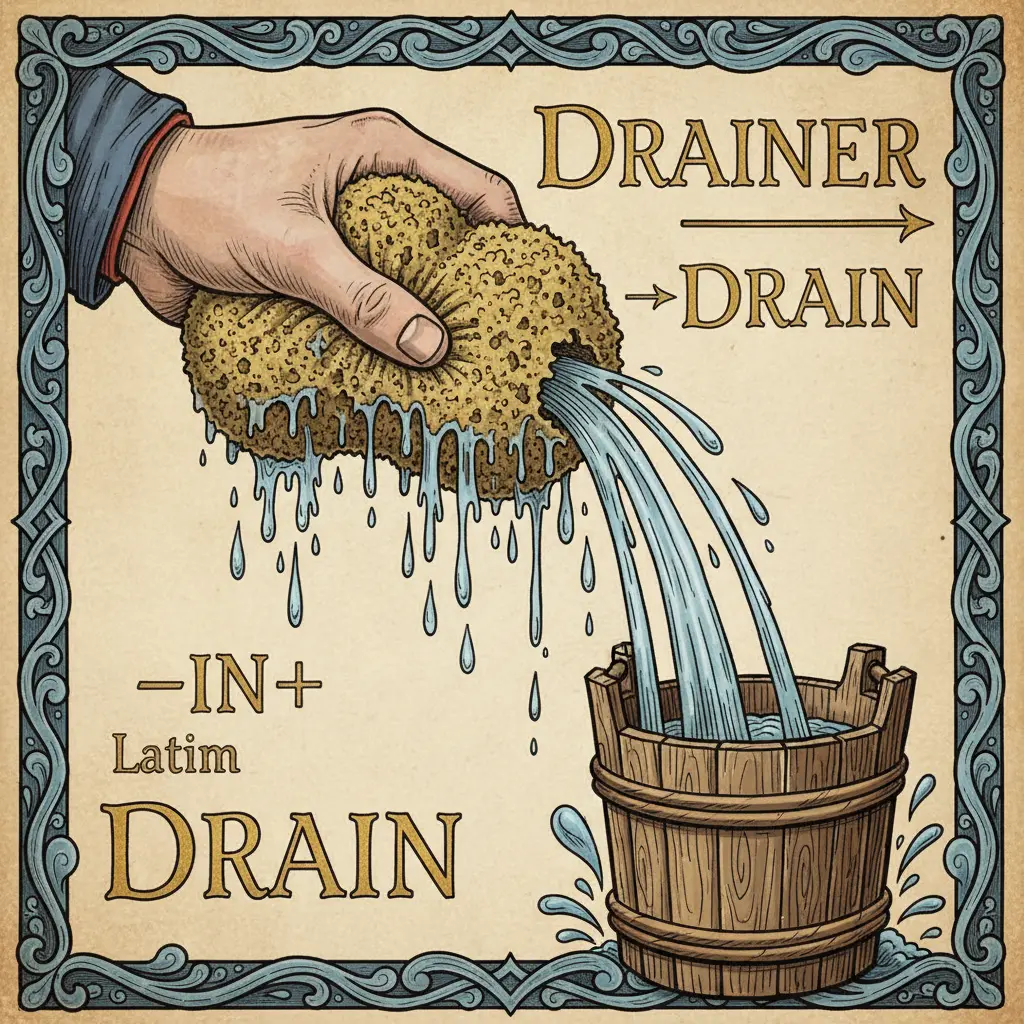
decompose: drain (from 'drain' = to draw off) + -in (verb-forming suffix). Historical origin: Middle English 'drain' from Old French 'drainer' (to draw off). Memory image: Imagine a sponge soaked with water being squeezed, with the water draining out.
Note 1: These definitions and etymologies are not standard dictionary definitions, but extended explanations provided to help with memorization and understanding of the actual application of words. Through this background information, we strive to make words more vivid and easier to understand, and help you remember their meanings in real life.
Note 2: LexiTalk designs the learning flow around the linguistics principle of “Comprehensible Input.” When learners encounter material that is slightly above their level but still understandable from context, the brain naturally absorbs the language. That’s why we keep every word inside authentic contexts, using examples and associations to help you understand it and use it flexibly.
Read the FAQ explanation of Comprehensible InputI lift a pot from the table, move it to the sink, and tilt to let the water drain away. I watch the stream slow, then pull back as the last droplets pull free. The small push and hold of my wrists steadies the flow, and I feel a quiet shift in effort as I adjust the pace. When the pot is empty, the air feels lighter and I keep the rhythm for the next task.
Drain is a versatile word that can describe a physical action and a metaphorical one. As a verb, to drain means to remove liquid from somewhere, for example to drain a sink, a pot, or a lake. It can also mean to cause something or someone to lose energy, strength, or resources, as in draining a battery or draining someone’s patience. As a noun, a drain is a pipe or channel that carries away waste or excess liquid, such as a bathroom drain or a street drain. Etymology traces back to Middle English from Old French drainer; the memory image is a sponge being squeezed, water draining out. In everyday English, collocations include drain away, drain off, drain out, and drain on someone.
For English learners, drain blends physical and metaphorical uses and relies on natural collocations (drain away, drain the battery). Phrasal verbs matter, and learners often misplace the object or confuse with dry-related terms.
What does the word 'drain' mean?
Which sentence uses the word 'drain' correctly?
Pick the synonym for 'drain'.
What is the opposite of 'drain'?
In what real-life situation would you use the word 'drain'?
Download LexiTalk app for personalized learning experience
Download AppCookies
We use cookies for essential site functions, analytics, and ads. You can accept, reject, or manage preferences. Privacy Policy