
dullard - Master This Word
Master this word with our 5-step learning method – Learn English in English
Train English Through Brain Routes, Not Translation.
This page helps you stop memorizing isolated translations and start understanding a word through its shared mental image, native-style thinking, and practical training steps.
Master this word with our 5-step learning method – Learn English in English
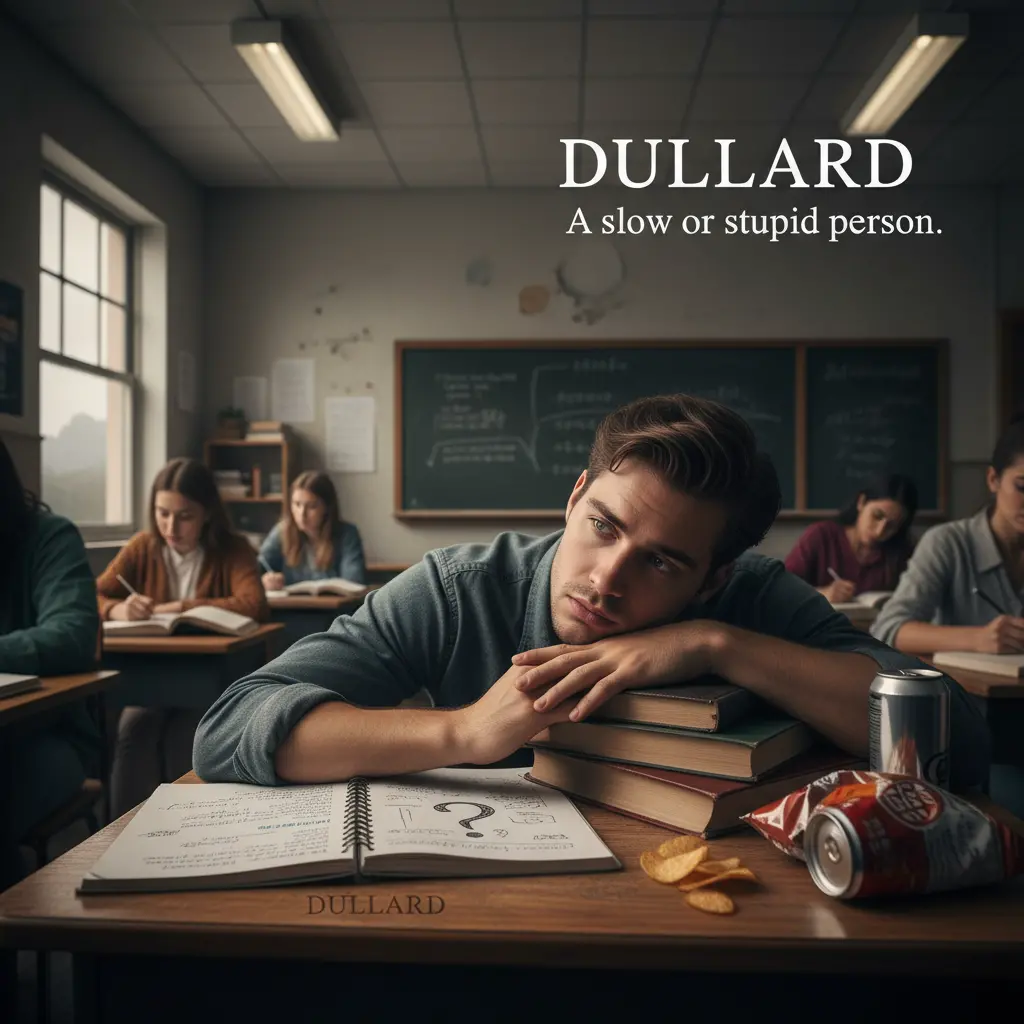
Example sentences are the start of understanding. Don't rush to memorize. First feel how the word works in a sentence.
Root: dull (lacking sharpness) + -ard (a suffix indicating a person). Historical origin: from Old French 'dolard' derived from Latin 'dullus'. Memory Image: Imagine a tired, uninspired person sitting in a dull classroom, unable to engage or understand.
Note 1: These definitions and etymologies are not standard dictionary definitions, but extended explanations provided to help with memorization and understanding of the actual application of words. Through this background information, we strive to make words more vivid and easier to understand, and help you remember their meanings in real life.
Note 2: LexiTalk designs the learning flow around the linguistics principle of “Comprehensible Input.” When learners encounter material that is slightly above their level but still understandable from context, the brain naturally absorbs the language. That’s why we keep every word inside authentic contexts, using examples and associations to help you understand it and use it flexibly.
Read the FAQ explanation of Comprehensible InputDullard is a somewhat archaic insult for a person lacking sharpness of mind or perception. It implies slow thinking, poor insight, or failure to grasp obvious points. It can be playful among friends, but it's insulting and best avoided in formal settings. In literature, a dullard often appears as a character who misses subtle cues or sticks rigidly to routines. The term echoes the 'dull' meaning lacking sharpness, plus the agentive suffix -ard, turning it into a label for a person. Because of its strong flavor, many learners choose milder terms like 'fool' or 'nitwit' in casual conversation, or use 'slow-witted person' in neutral contexts.
Dullard carries a cultural weight in English that flags a person’s perceived lack of mental sharpness. Learners should note that it is both antiquated and insulting, more aggressive than most neutral descriptors. English speakers often reserve it for literary or humorous contexts; using it in real-life work or education contexts may create a hostile impression.
What does the word 'dullard' mean?
Choose the correct usage of the word 'dullard' in a sentence.
Which word is most similar to 'dullard'?
What is the opposite of 'dullard'?
Can you think of a real-life context where someone might be called a dullard?
Download LexiTalk app for personalized learning experience
Download AppCookies
We use cookies for essential site functions, analytics, and ads. You can accept, reject, or manage preferences. Privacy Policy