harder - Master This Word
Master this word with our 5-step learning method – Learn English in English
Train English Through Brain Routes, Not Translation.
This page helps you stop memorizing isolated translations and start understanding a word through its shared mental image, native-style thinking, and practical training steps.
Master this word with our 5-step learning method – Learn English in English
Example sentences are the start of understanding. Don't rush to memorize. First feel how the word works in a sentence.
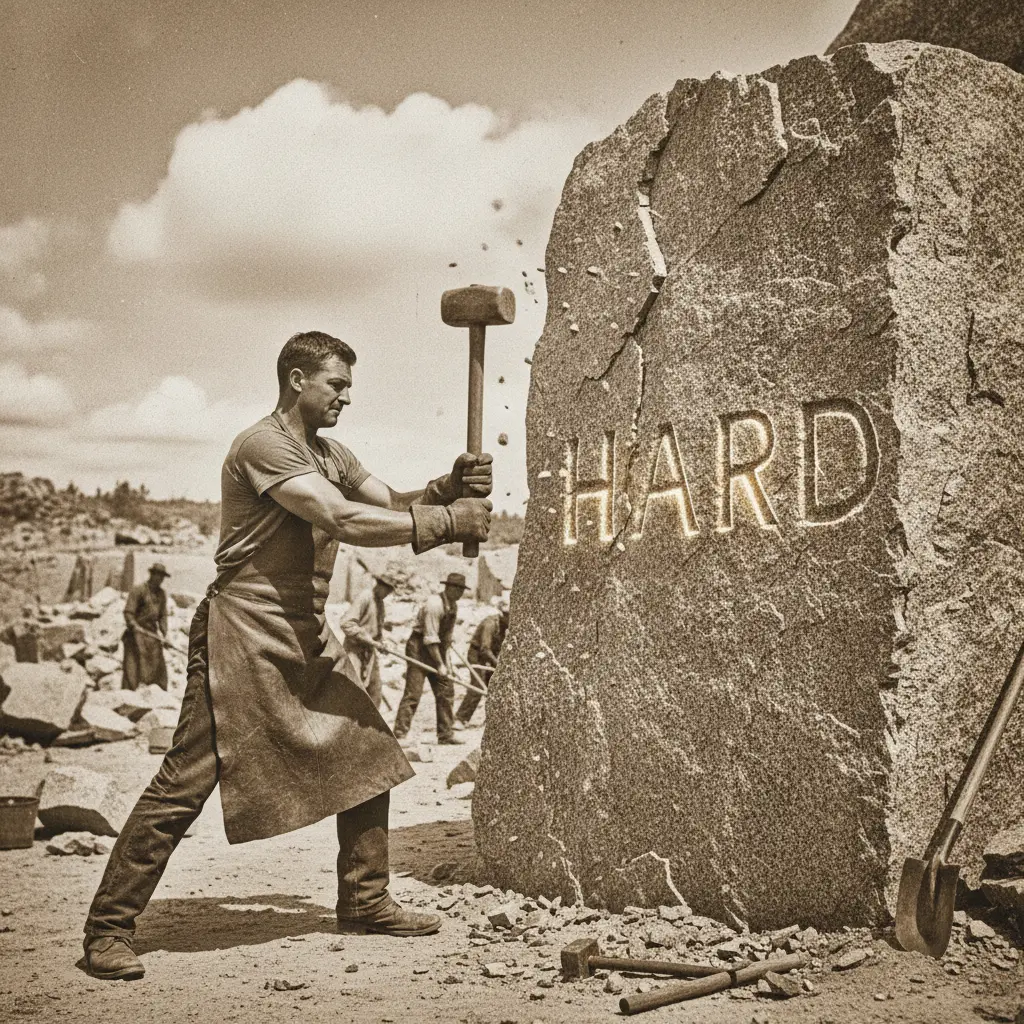
hard = firm/hard + -ly (suffix for manner). Historical origin: Old English heard → Middle English hard → Modern English hard. Memory image: Imagine trying to break a strong rock with a hammer; the effort needed represents the word 'hard'.
Note 1: These definitions and etymologies are not standard dictionary definitions, but extended explanations provided to help with memorization and understanding of the actual application of words. Through this background information, we strive to make words more vivid and easier to understand, and help you remember their meanings in real life.
Note 2: LexiTalk designs the learning flow around the linguistics principle of “Comprehensible Input.” When learners encounter material that is slightly above their level but still understandable from context, the brain naturally absorbs the language. That’s why we keep every word inside authentic contexts, using examples and associations to help you understand it and use it flexibly.
Read the FAQ explanation of Comprehensible InputI place my palm on a wooden door and push, feeling the hard grain bite back with solid resistance. The door doesn’t yield, so I shift my weight, tighten my grip, and keep steady as it slides shut. I change my approach, easing off a moment to line up the latch, then pull and push in a measured rhythm until it settles with a firm thud. In that small push-pull, I sense how hard things hold their form, demanding patience and a careful touch for real use.
Hard describes something solid and firm, and it also refers to tasks or situations that are difficult to endure or accomplish. It can describe physical toughness, as in a hard surface or a hard material, and metaphorically as in a hard problem or a hard choice. In everyday speech, we say 'work hard,' 'come to a hard decision,' or 'a hard day at work' to stress effort and resistance. The word contrasts with soft or easy, and with hard we often imply stamina, persistence, or severity (as in hard rules). Etymology is from Old English heard, through Middle English hard to modern English, with a separate sense development alongside -ly adverbs.
To English learners, hard often carries a strong sense of effort, endurance, or strictness, and learners may confuse it with tough or difficult in subtle ways, especially when comparing physical hardness to abstract challenges.
What is the meaning of the word 'harder'?
Choose the correct usage of 'harder' in a sentence.
Which word is most similar to 'harder'?
What is the opposite of 'harder'?
Can you think of a real-life scenario where you need to try harder?
Download LexiTalk app for personalized learning experience
Download AppCookies
We use cookies for essential site functions, analytics, and ads. You can accept, reject, or manage preferences. Privacy Policy