
empires - Master This Word
Master this word with our 5-step learning method – Learn English in English
Train English Through Brain Routes, Not Translation.
This page helps you stop memorizing isolated translations and start understanding a word through its shared mental image, native-style thinking, and practical training steps.
Master this word with our 5-step learning method – Learn English in English
Example sentences are the start of understanding. Don't rush to memorize. First feel how the word works in a sentence.
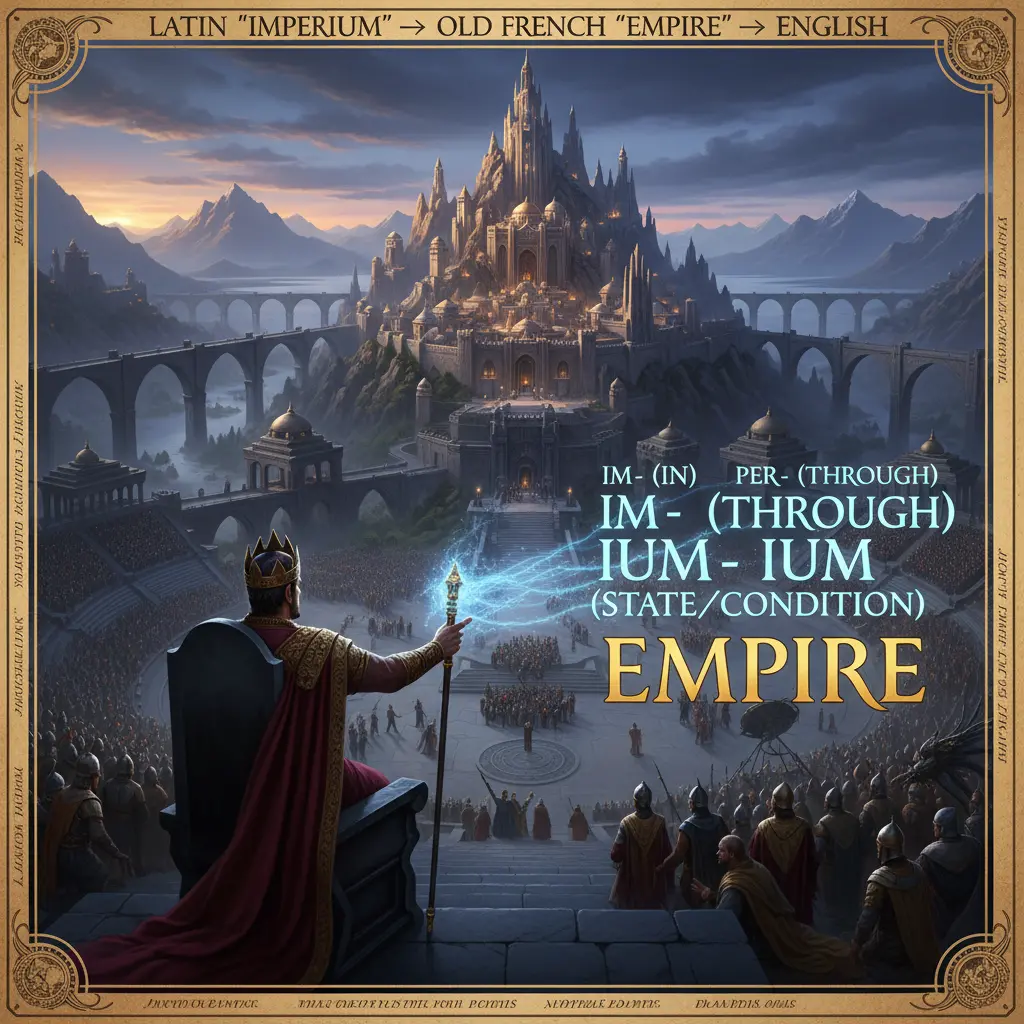
From Latin 'imperium' meaning 'command' (im- = in, per- = through, ium = condition/state). Historical origin: Latin → Old French 'empire' → English. Memory image: Picture a vast empire, spanning continents, ruled by a powerful emperor who gives commands to his subjects, showing authority and control.
Note 1: These definitions and etymologies are not standard dictionary definitions, but extended explanations provided to help with memorization and understanding of the actual application of words. Through this background information, we strive to make words more vivid and easier to understand, and help you remember their meanings in real life.
Note 2: LexiTalk designs the learning flow around the linguistics principle of “Comprehensible Input.” When learners encounter material that is slightly above their level but still understandable from context, the brain naturally absorbs the language. That’s why we keep every word inside authentic contexts, using examples and associations to help you understand it and use it flexibly.
Read the FAQ explanation of Comprehensible InputI place my hand on a spinning globe and turn it, feeling distant lands slide under my fingers. I push and pull coastlines and borders, adjusting until a single thread of rule seems to hold. Each move makes the world feel tighter, and the weight of many places becomes real. From this, empire stops being a history word and becomes how I picture a vast reach—whether a single realm or a company that keeps many teams moving.
An empire is a large political unit, typically built on conquest, ruled by an emperor or empress. Historically, empires unify diverse peoples and lands under a central authority, often spanning continents and lasting for centuries. In modern usage, the term can also describe a very large organization, not necessarily monarchic, such as a business empire or media empire. People commonly cite the Roman Empire or the British Empire as iconic examples, and the word is also used metaphorically to denote overwhelming power or influence in a particular field, like an entertainment empire or a tech empire.
English often uses empire as both a historical political entity and a broad metaphor for powerful organizations; learners may confuse it with kingdom or misuse it for everyday business names.
Download LexiTalk app for personalized learning experience
Download AppCookies
We use cookies for essential site functions, analytics, and ads. You can accept, reject, or manage preferences. Privacy Policy