employees - Master This Word
Master this word with our 5-step learning method – Learn English in English
Train English Through Brain Routes, Not Translation.
This page helps you stop memorizing isolated translations and start understanding a word through its shared mental image, native-style thinking, and practical training steps.
Master this word with our 5-step learning method – Learn English in English
Example sentences are the start of understanding. Don't rush to memorize. First feel how the word works in a sentence.
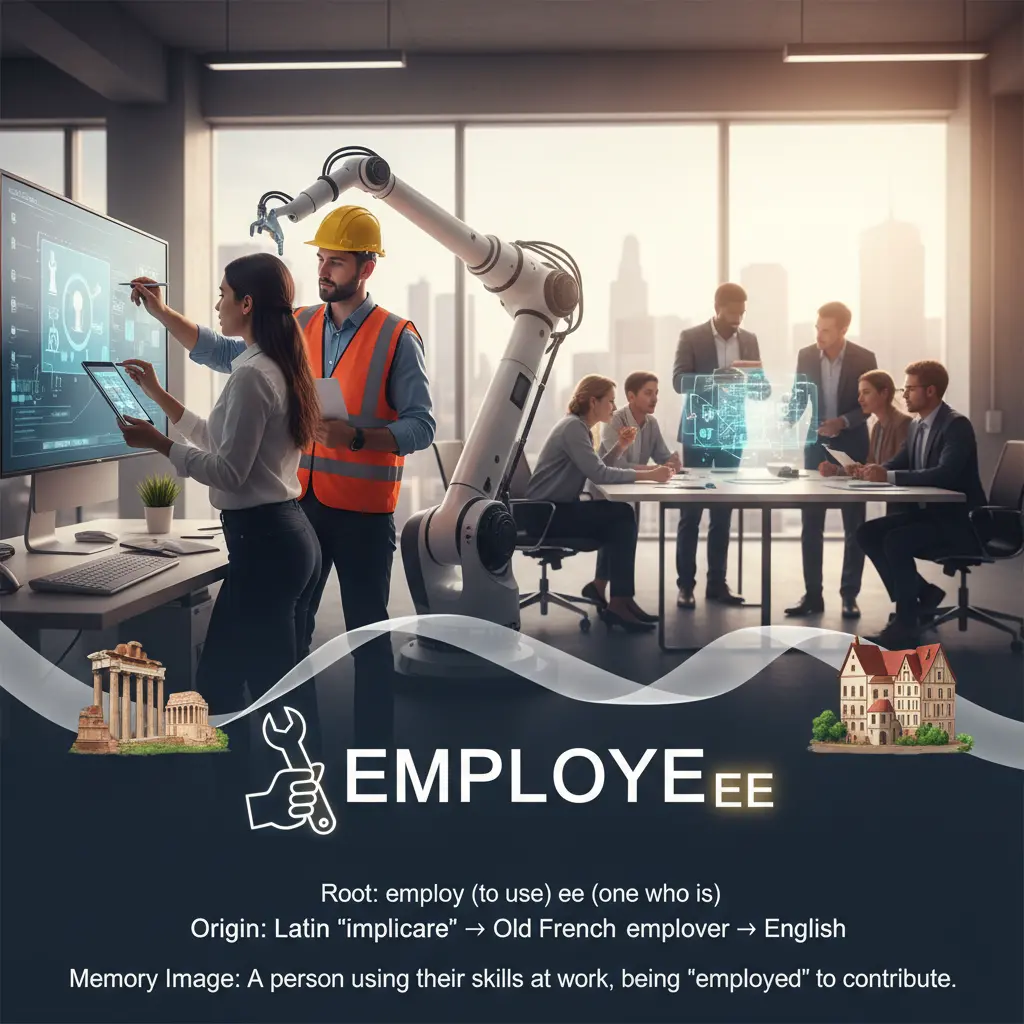
Root: employ (to use) + ee (one who is), Origin: Latin 'implicare' → Old French 'employer' → English, Memory Image: Imagine a person using their skills at work, being 'employed' to contribute.
Note 1: These definitions and etymologies are not standard dictionary definitions, but extended explanations provided to help with memorization and understanding of the actual application of words. Through this background information, we strive to make words more vivid and easier to understand, and help you remember their meanings in real life.
Note 2: LexiTalk designs the learning flow around the linguistics principle of “Comprehensible Input.” When learners encounter material that is slightly above their level but still understandable from context, the brain naturally absorbs the language. That’s why we keep every word inside authentic contexts, using examples and associations to help you understand it and use it flexibly.
Read the FAQ explanation of Comprehensible InputI push open the office door and step into the low hum of keyboards. I set my bag on the desk, sit, and adjust the chair until my back relaxes. I move through a quick rhythm of tasks, shift my attention from email ping to a coworker's question, and keep the pace steady. By noon, the day settles into a rhythm and the moment feels like the start of a true role, showing up, helping the team, and getting things done as an employee.
An employee is a person who works for another person or a company in exchange for pay. The word covers a wide range of roles, from entry level to senior manager. In English, employee emphasizes the employment relationship rather than the task. People aren’t only workers; they have rights and responsibilities under a contract, including pay, benefits, and job duties. Learners should note the subtle distinction between employee and other related terms like worker and employer and avoid using employee to describe the company’s owner. The concept appears in many legal and HR texts, in contracts, payroll forms, and job postings, and it often appears alongside titles such as manager or supervisor.
Explain to an English speaker: emphasize that 'employee' denotes a formal employment status under a contract, not ownership or a temporary role; many learners confuse it with 'worker' or 'employer'.
What is the definition of 'employees'?
Choose the correctly used sentence with 'employees':
Which word is most similar to 'employees'?
What is the opposite of 'employees'?
Can you think of a real-life context where employees play a role?
Download LexiTalk app for personalized learning experience
Download AppCookies
We use cookies for essential site functions, analytics, and ads. You can accept, reject, or manage preferences. Privacy Policy