
entangled - Master This Word
Master this word with our 5-step learning method – Learn English in English
Train English Through Brain Routes, Not Translation.
This page helps you stop memorizing isolated translations and start understanding a word through its shared mental image, native-style thinking, and practical training steps.
Master this word with our 5-step learning method – Learn English in English
Example sentences are the start of understanding. Don't rush to memorize. First feel how the word works in a sentence.
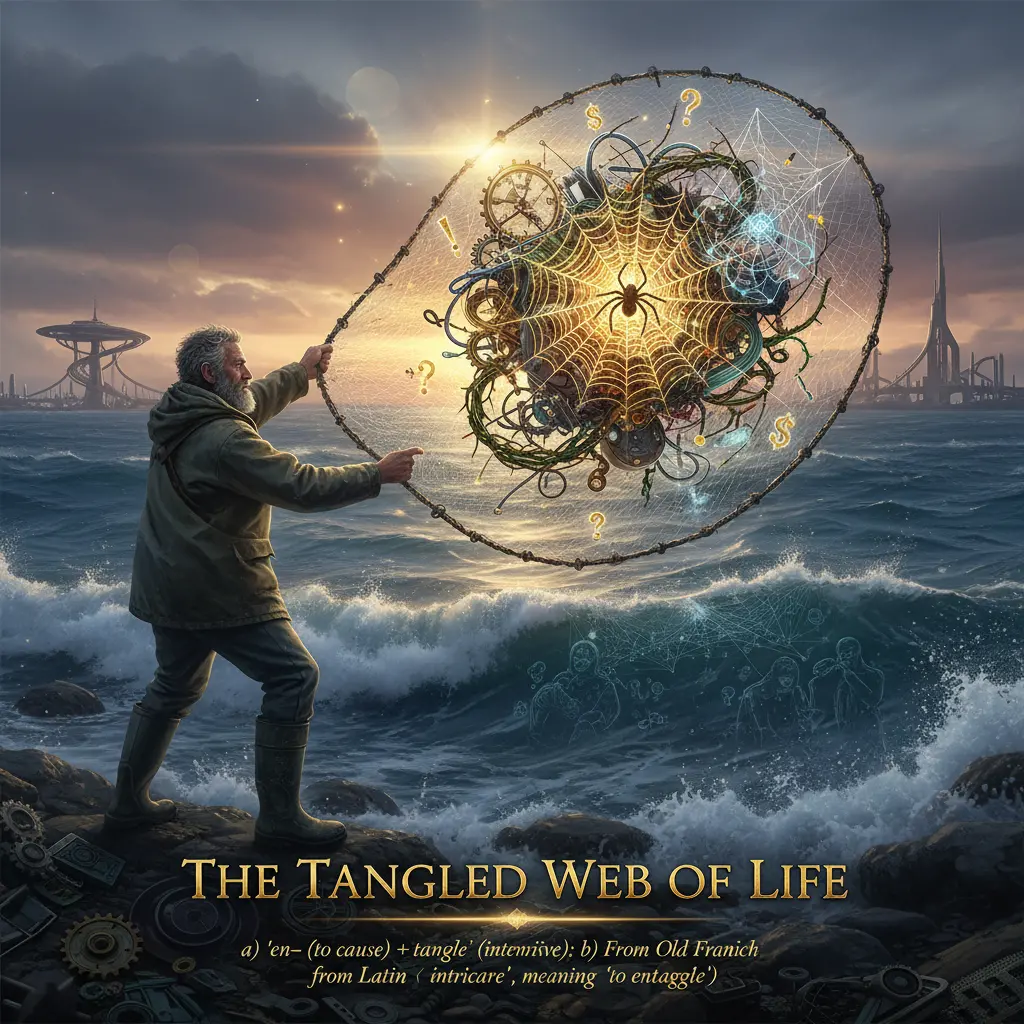
(a) 'en-' (to cause) + 'tangle' (intertwine); (b) From Old French 'entangler', from Latin 'intricare', meaning 'to entangle'. (c) Picture a fisherman casting his net into the water and tangling up everything he catches, symbolizing how complexities can ensnare us in life's web.
Note 1: These definitions and etymologies are not standard dictionary definitions, but extended explanations provided to help with memorization and understanding of the actual application of words. Through this background information, we strive to make words more vivid and easier to understand, and help you remember their meanings in real life.
Note 2: LexiTalk designs the learning flow around the linguistics principle of “Comprehensible Input.” When learners encounter material that is slightly above their level but still understandable from context, the brain naturally absorbs the language. That’s why we keep every word inside authentic contexts, using examples and associations to help you understand it and use it flexibly.
Read the FAQ explanation of Comprehensible InputEntangle is a versatile verb that describes physically twisting things into a tangled mass, like cords or wires, or metaphorically pulling someone into a confounding situation. It conveys both the act of entangling and the consequence of becoming hard to separate. You might entangle cords, nets, or tangle someone up in a debate, a controversy, or bureaucratic red tape. In everyday use, it often emphasizes complexity, complication, or entrapment rather than mere confusion. The word can carry a sense of being trapped, ensnared, or tangled up in responsibilities, relationships, or problems, reminding us that simple matters can gradually become intricate if not handled carefully.
In English, entangle often feels like a heavier knot of complexity than simply 'involve' or 'confuse.' Native speakers picture physical entanglement first and then extended situations that trap people in problems. Learners may overuse entangle for any confusion or misplace it with 'involve' when the emphasis is on being caught in a knot.
Download LexiTalk app for personalized learning experience
Download AppCookies
We use cookies for essential site functions, analytics, and ads. You can accept, reject, or manage preferences. Privacy Policy