
ethnology - Master This Word
Master this word with our 5-step learning method – Learn English in English
Train English Through Brain Routes, Not Translation.
This page helps you stop memorizing isolated translations and start understanding a word through its shared mental image, native-style thinking, and practical training steps.
Master this word with our 5-step learning method – Learn English in English
Example sentences are the start of understanding. Don't rush to memorize. First feel how the word works in a sentence.
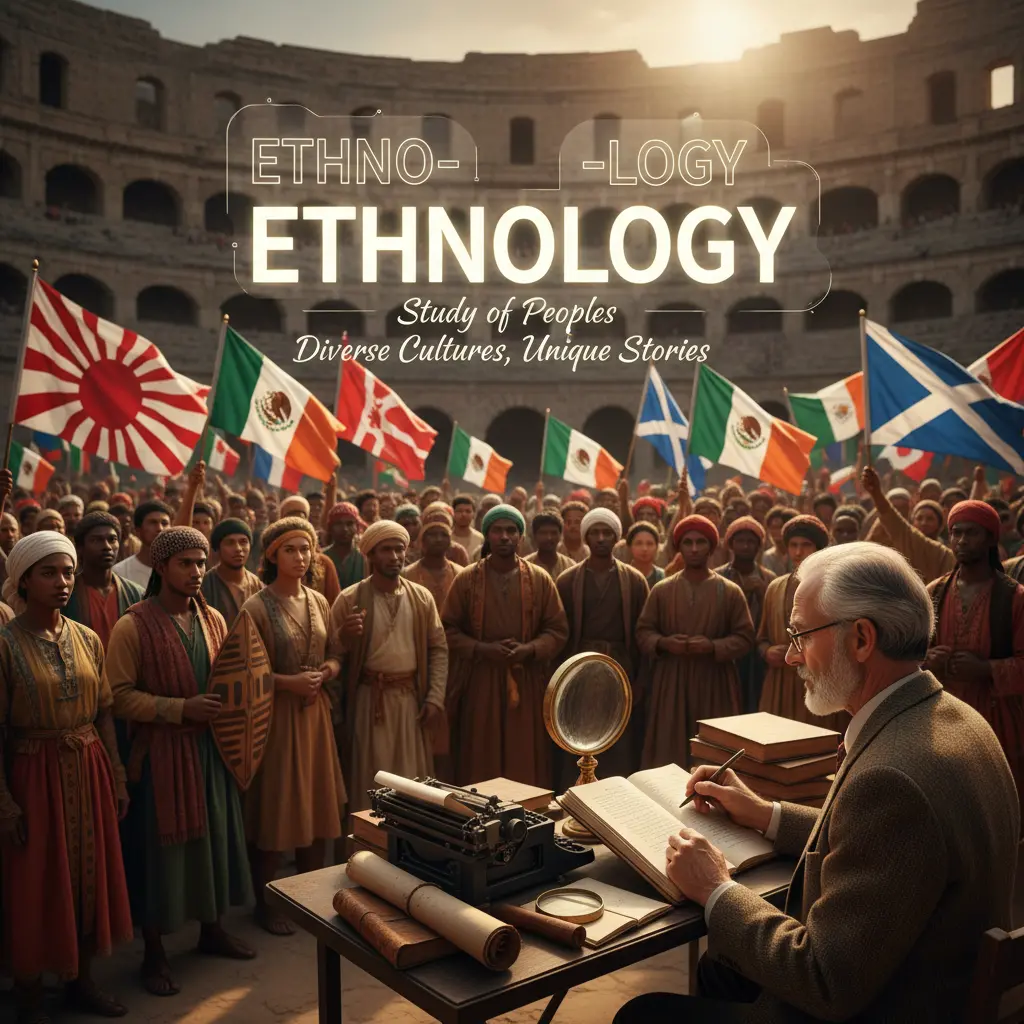
Root decomposition: 'ethno-' (people) + '-logy' (study). Historical origin: from Greek 'ethnos' (people) + French 'ethnologie' → English. Memory image: imagine a diverse crowd of people holding flags representing their cultures while a scholar observes and takes notes, highlighting their unique traditions and stories.
Note 1: These definitions and etymologies are not standard dictionary definitions, but extended explanations provided to help with memorization and understanding of the actual application of words. Through this background information, we strive to make words more vivid and easier to understand, and help you remember their meanings in real life.
Note 2: LexiTalk designs the learning flow around the linguistics principle of “Comprehensible Input.” When learners encounter material that is slightly above their level but still understandable from context, the brain naturally absorbs the language. That’s why we keep every word inside authentic contexts, using examples and associations to help you understand it and use it flexibly.
Read the FAQ explanation of Comprehensible InputEthnology is the scholarly study of cultures, their origins, practices, and how peoples shape and are shaped by history. It compares social systems, beliefs, and daily life across communities, often using fieldwork, interviews, and comparative analysis to understand development and divergence. Ethnologists examine language, rituals, kinship, economy, and art to reveal patterns of meaning and change over time. The field emphasizes cultural relativism, avoiding judgments while documenting diverse worldviews. By tracing migrations and exchanges, ethnology helps explain why cultures differ and how contact, adaptation, and globalization alter traditions.
Ethnology in English often frames culture through cross-cultural comparison and field methods; learners may confuse ethnology with archaeology or anthropology, and may overgeneralize from a few case studies.
What is the definition of the word 'ethnology'?
Which sentence uses 'ethnology' correctly?
Which word is most similar to 'ethnology'?
What is the opposite of 'ethnology'?
Can you think of a real-life context where the concept of 'ethnology' is applicable?
Download LexiTalk app for personalized learning experience
Download AppCookies
We use cookies for essential site functions, analytics, and ads. You can accept, reject, or manage preferences. Privacy Policy