
fallibility - Master This Word
Master this word with our 5-step learning method – Learn English in English
Train English Through Brain Routes, Not Translation.
This page helps you stop memorizing isolated translations and start understanding a word through its shared mental image, native-style thinking, and practical training steps.
Master this word with our 5-step learning method – Learn English in English
Example sentences are the start of understanding. Don't rush to memorize. First feel how the word works in a sentence.
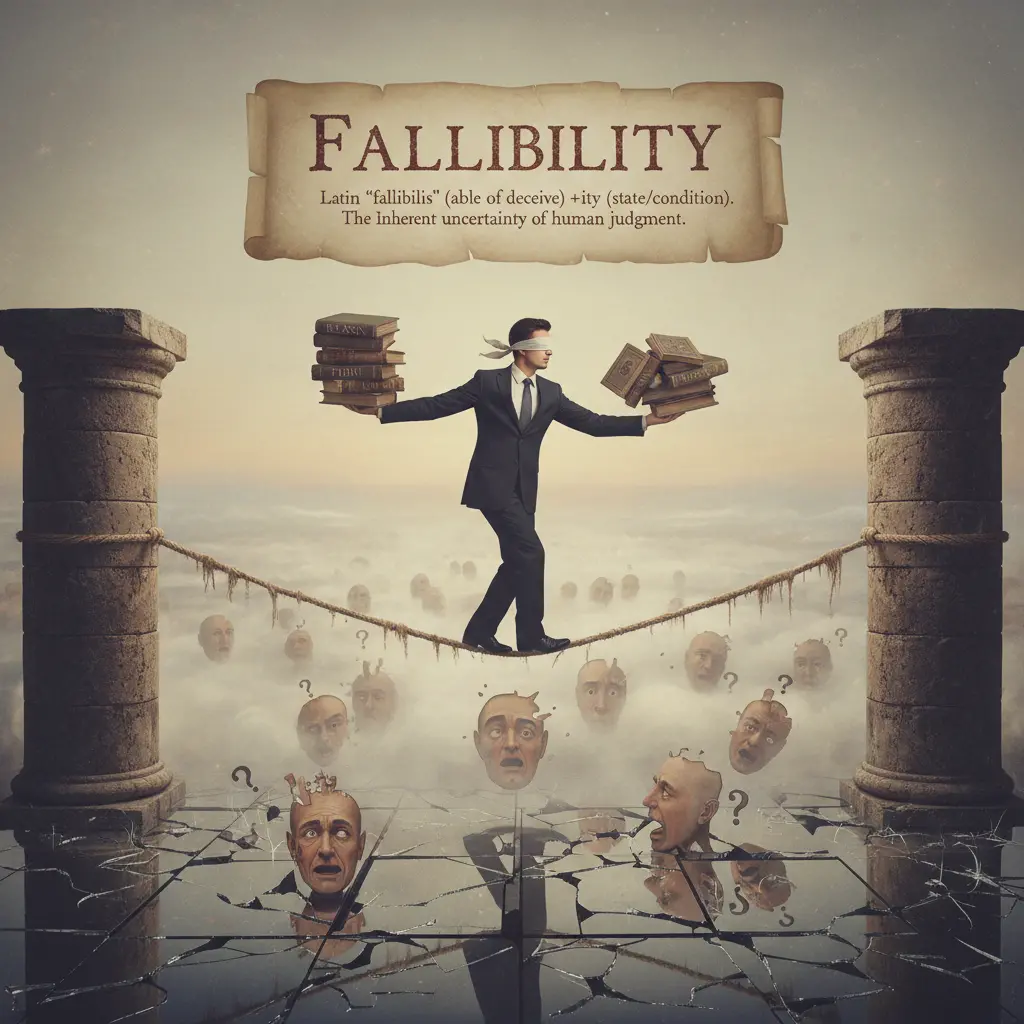
(fallible) from Latin 'fallibilis' (able to deceive) + (ity) a suffix indicating a state or condition. Originating from Latin via Old French into English. Picture a person trying to balance on a tightrope, knowing they can slip and fall, symbolizing the inherent uncertainty of human judgment.
Note 1: These definitions and etymologies are not standard dictionary definitions, but extended explanations provided to help with memorization and understanding of the actual application of words. Through this background information, we strive to make words more vivid and easier to understand, and help you remember their meanings in real life.
Note 2: LexiTalk designs the learning flow around the linguistics principle of “Comprehensible Input.” When learners encounter material that is slightly above their level but still understandable from context, the brain naturally absorbs the language. That’s why we keep every word inside authentic contexts, using examples and associations to help you understand it and use it flexibly.
Read the FAQ explanation of Comprehensible InputFallibility is the natural limitation of human judgment, memory, and perception. It means we cannot assume perfect accuracy, even with knowledge and care. The word invites humility and caution in reasoning, decision making, and evaluating information. In everyday life, professionals such as scientists, journalists, and lawyers often confront fallibility: hypotheses are tested, memories fade, and new data can contradict previous conclusions. Acknowledging fallibility helps set realistic expectations, plan margin for error, and design checks and corrections. Etymologically, fallible comes from Latin fallibilis meaning able to deceive or err; through Old French into English, the noun fallibility denotes this state of being prone to error.
In English, fallibility is treated as a neutral, abstract quality of human judgment. Learners often confuse it with fault or blame, and may expect ‘fallibility’ to imply personal weakness. The challenge is separating the idea of susceptibility to error from moral judgment and applying it to diverse domains (memory, data, plans).
What is the meaning of the word 'fallibility'?
Select the correct usage of the word 'fallibility' in a sentence.
Which word is most similar to 'fallibility'?
What is the opposite of 'fallibility'?
Can you think of a situation where a person's fallibility would be relevant?
Download LexiTalk app for personalized learning experience
Download AppCookies
We use cookies for essential site functions, analytics, and ads. You can accept, reject, or manage preferences. Privacy Policy