far - Master This Word
Master this word with our 5-step learning method – Learn English in English
Train English Through Brain Routes, Not Translation.
This page helps you stop memorizing isolated translations and start understanding a word through its shared mental image, native-style thinking, and practical training steps.
Master this word with our 5-step learning method – Learn English in English
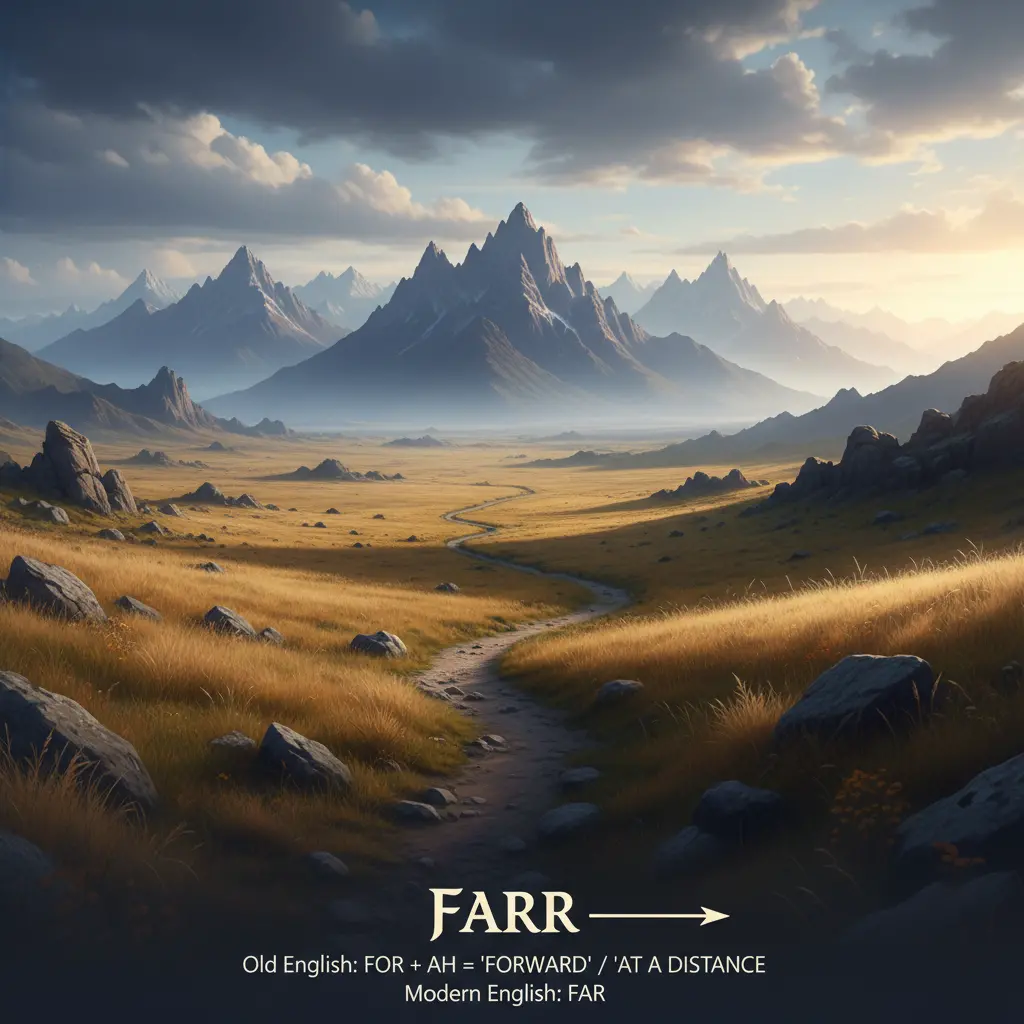
Example sentences are the start of understanding. Don't rush to memorize. First feel how the word works in a sentence.
far = for + ah, meaning 'forward' or 'at a distance'. Origin: Old English → Middle English → Modern English. Picture a vast endless horizon, where distant mountains loom in the background, representing something far away.
Note 1: These definitions and etymologies are not standard dictionary definitions, but extended explanations provided to help with memorization and understanding of the actual application of words. Through this background information, we strive to make words more vivid and easier to understand, and help you remember their meanings in real life.
Note 2: LexiTalk designs the learning flow around the linguistics principle of “Comprehensible Input.” When learners encounter material that is slightly above their level but still understandable from context, the brain naturally absorbs the language. That’s why we keep every word inside authentic contexts, using examples and associations to help you understand it and use it flexibly.
Read the FAQ explanation of Comprehensible InputFirst I breathe in and reach my hand toward the edge of the table. I move my fingers, turn my wrist, and press a little to test what sits beyond. The effort makes the space real, my shoulders settle, and I pull the object closer. In that small tug, the feeling of far grows from a line on a map to something I can touch and to moments I might reach in the future or recall from the past.
Far is a flexible word used to describe distance, extent, or time that is not near. Physically distant places are far from us, but far can also express a large degree or contrast, as in far more or far from the truth. It also refers to the distant future or past when talking about events that are not immediate. In everyday speech, far often appears with phrases like far away, far from home, or far into the future, and it commonly takes modifiers such as very or much to emphasize intensity. The idea of far hinges on perspective, balance between literal distance and figurative reach, and cultural imagery of horizons.
Think of far as a broad canvas: distance, amount, and time can all be 'far'. Learners often default to near or confuse far with longer adjectives; remember far can describe both literal space and figurative distance, and context decides.
What is the meaning of the word 'far'?
Which sentence below uses the word 'far' correctly?
Which word is most similar to 'far'?
What is the opposite of 'far'?
Can you think of a real-life scenario where the word 'far' would be used?
Download LexiTalk app for personalized learning experience
Download AppCookies
We use cookies for essential site functions, analytics, and ads. You can accept, reject, or manage preferences. Privacy Policy