
foreshorten - Master This Word
Master this word with our 5-step learning method – Learn English in English
Train English Through Brain Routes, Not Translation.
This page helps you stop memorizing isolated translations and start understanding a word through its shared mental image, native-style thinking, and practical training steps.
Master this word with our 5-step learning method – Learn English in English
Example sentences are the start of understanding. Don't rush to memorize. First feel how the word works in a sentence.
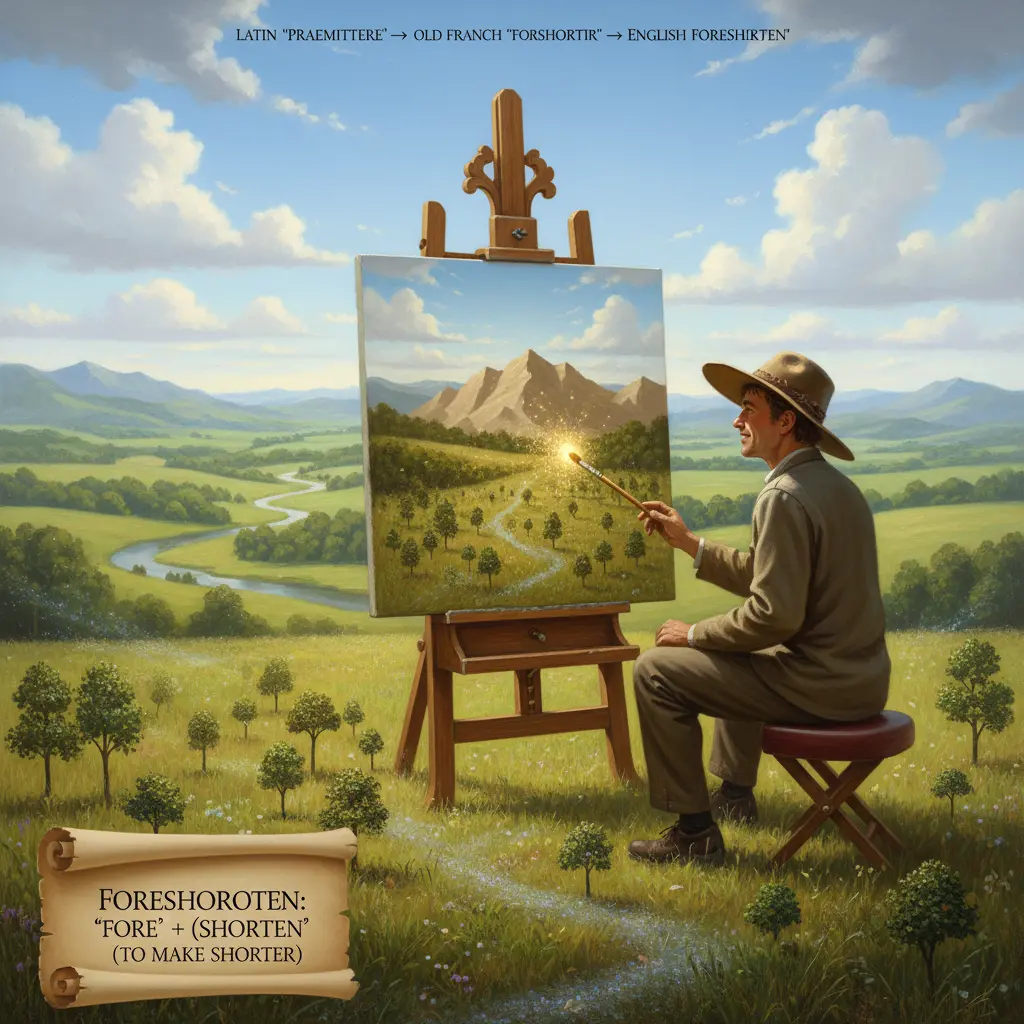
Root decomposition: 'fore-' (before) + 'shorten' (to make shorter). Historical origin: Latin 'praemittere' → Old French 'forshortir' → English 'foreshorten'. Memory image: Imagine an artist with a magic brush that can instantly shrink objects in front of them, making distant trees look like tiny toy models.
Note 1: These definitions and etymologies are not standard dictionary definitions, but extended explanations provided to help with memorization and understanding of the actual application of words. Through this background information, we strive to make words more vivid and easier to understand, and help you remember their meanings in real life.
Note 2: LexiTalk designs the learning flow around the linguistics principle of “Comprehensible Input.” When learners encounter material that is slightly above their level but still understandable from context, the brain naturally absorbs the language. That’s why we keep every word inside authentic contexts, using examples and associations to help you understand it and use it flexibly.
Read the FAQ explanation of Comprehensible InputForeshorten is a verb that describes making an object appear shorter than it is because of perspective, especially in drawing or photography. In art, artists use foreshortening to simulate depth by compressing parts of a figure or object that are closer to the viewer, while distant parts look smaller. The term also extends to summarizing or shortening a longer text or plan, though this usage is less common and may carry a sense of truncation. In everyday language, you might say a scene foreshortens when a camera angle makes the foreground seem much larger than the background. Understanding this word helps describe visual techniques and, more loosely, the act of reducing length in any plan.
English learners often focus on the literal meaning of shorten and misread foreshorten as a generic 'shorten.' The concept hinges on perspective, depth cues, and how viewers perceive space, so learners should connect it to angles, vanishing points, and compositional balance rather than editing language alone.
What does 'foreshorten' mean?
Identify the correctly used sentence of 'foreshorten'.
Which word is most similar to 'foreshorten'?
What is the opposite of 'foreshorten'?
Can you think of a real-life context where something could be foreshortened?
Download LexiTalk app for personalized learning experience
Download AppCookies
We use cookies for essential site functions, analytics, and ads. You can accept, reject, or manage preferences. Privacy Policy