time - Master This Word
Master this word with our 5-step learning method – Learn English in English
Train English Through Brain Routes, Not Translation.
This page helps you stop memorizing isolated translations and start understanding a word through its shared mental image, native-style thinking, and practical training steps.
Master this word with our 5-step learning method – Learn English in English
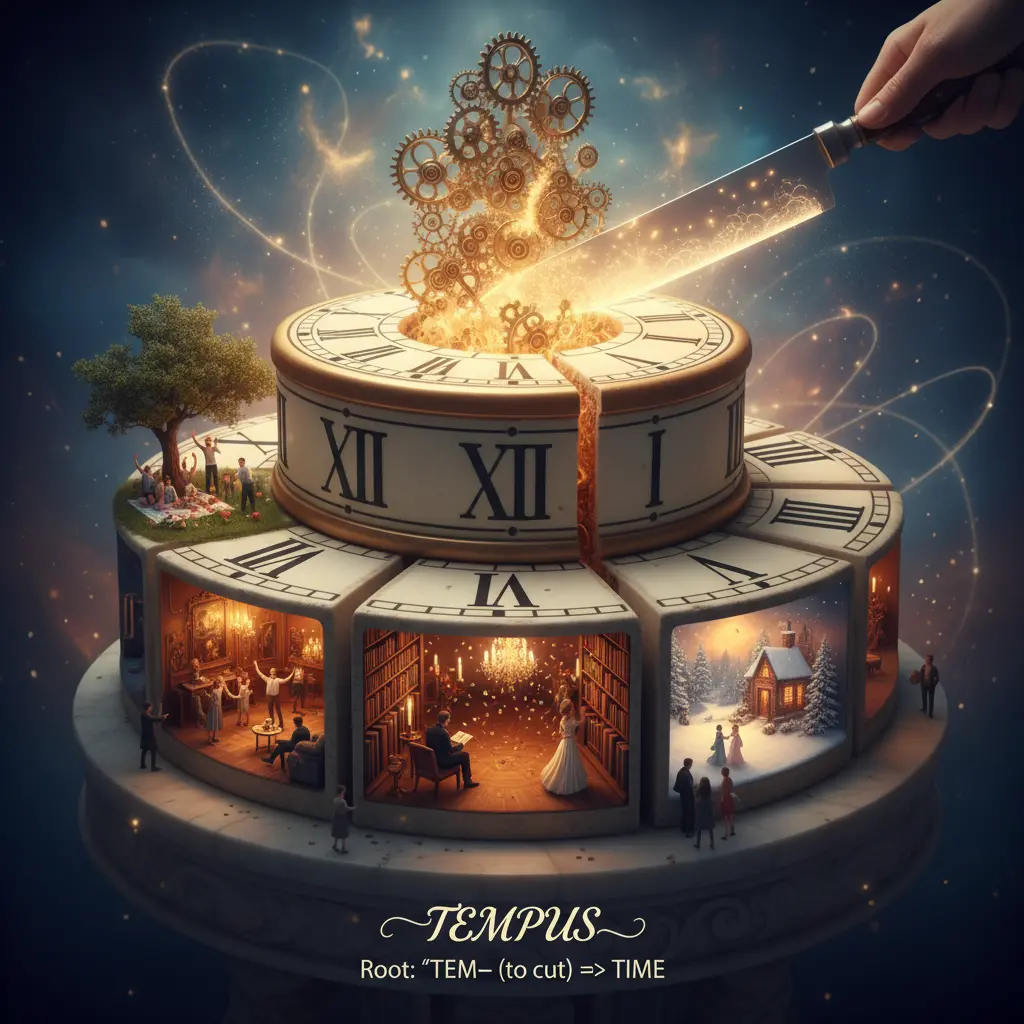
Example sentences are the start of understanding. Don't rush to memorize. First feel how the word works in a sentence.
Root: 'tem-', meaning 'to cut', reflects the division of time into measurable parts. Origin: Latin 'tempus' → Old French 'temps' → English 'time'. Memory image: Imagine slicing a cake into pieces, each slice representing a different moment in life.
Note 1: These definitions and etymologies are not standard dictionary definitions, but extended explanations provided to help with memorization and understanding of the actual application of words. Through this background information, we strive to make words more vivid and easier to understand, and help you remember their meanings in real life.
Note 2: LexiTalk designs the learning flow around the linguistics principle of “Comprehensible Input.” When learners encounter material that is slightly above their level but still understandable from context, the brain naturally absorbs the language. That’s why we keep every word inside authentic contexts, using examples and associations to help you understand it and use it flexibly.
Read the FAQ explanation of Comprehensible InputI press the clock and watch the hands move. I shift the dial and feel my attention tighten as the minutes tick. I hold my breath for a beat, then adjust my pace and let the moment guide my steps. The rhythm of this moment keeps me choosing what to do next, and I keep inside the flow of time.
Time is our universal tool for measuring and ordering everything that happens. In English, time can denote a duration—a period during which an action occurs—and a specific moment, as in a clock time. It also frames the ongoing flow of life, deadlines, and planned future activities. Different cultures sometimes treat time differently: some see it as a scarce resource to be managed, others emphasize processes and the experience of the present. For learners, common challenges include choosing between time as a duration and a moment, and using the right prepositions with phrases like time of day, in time, or on time. Remember that time is both abstract and practical, so practice verb forms and collocations with care.
English blends both duration and clock time; learners often slip between 'time' as a length and 'time' as a moment, and mix up on-time vs in-time vs during with prepositions.
What is the meaning of the word 'time'?
Which sentence below uses the word 'time' correctly?
Which word is most similar to 'time'?
What is the opposite of 'time'?
Can you think of a real-life scenario where the concept of 'time' plays an important role?
Download LexiTalk app for personalized learning experience
Download AppCookies
We use cookies for essential site functions, analytics, and ads. You can accept, reject, or manage preferences. Privacy Policy