frequency - Master This Word
Master this word with our 5-step learning method – Learn English in English
Train English Through Brain Routes, Not Translation.
This page helps you stop memorizing isolated translations and start understanding a word through its shared mental image, native-style thinking, and practical training steps.
Master this word with our 5-step learning method – Learn English in English
Example sentences are the start of understanding. Don't rush to memorize. First feel how the word works in a sentence.
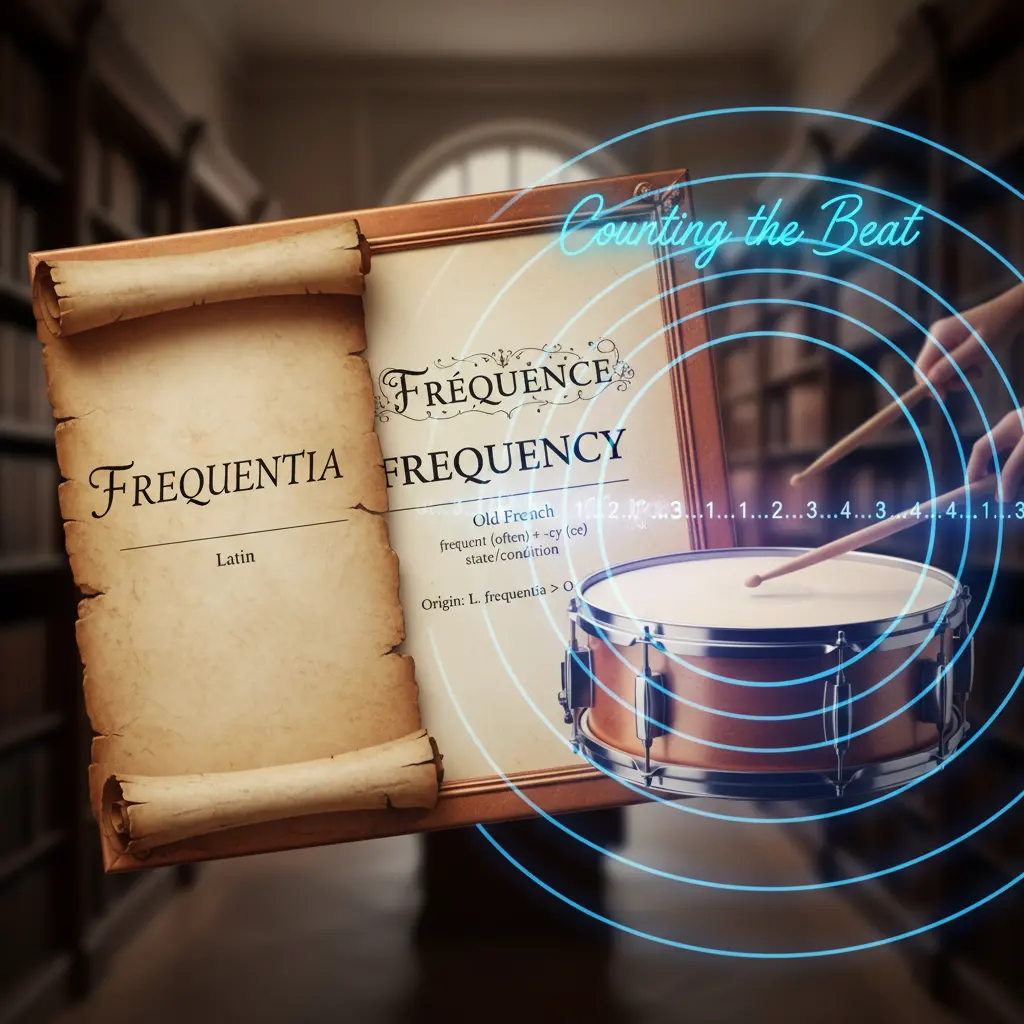
The word 'frequency' breaks down into 'frequent' (meaning occurring often) + the suffix '-cy' (state or condition). It originated from Latin 'frequentia' → Old French 'frequence' → English. Imagine counting the beat of a drum, where each count represents the frequency of sound in a rhythm.
Note 1: These definitions and etymologies are not standard dictionary definitions, but extended explanations provided to help with memorization and understanding of the actual application of words. Through this background information, we strive to make words more vivid and easier to understand, and help you remember their meanings in real life.
Note 2: LexiTalk designs the learning flow around the linguistics principle of “Comprehensible Input.” When learners encounter material that is slightly above their level but still understandable from context, the brain naturally absorbs the language. That’s why we keep every word inside authentic contexts, using examples and associations to help you understand it and use it flexibly.
Read the FAQ explanation of Comprehensible InputPalm on a ticking metronome, I push to start it and watch the needle move. I adjust the tempo, turning the dial until the beat settles and the shift feels right. I lean in, hold a moment, and decide whether to keep the pace or change it again. That small push and turn help me sense how often things happen and guide what I do next in real life.
Frequency is a noun that describes how often something happens in a given period. In everyday speech, we talk about the frequency of events like emails received per day or buses arriving per hour. In science, frequency also has a precise meaning in physics: the number of complete cycles per unit of time, measured in hertz. Musicians refer to frequency when describing pitch, while statisticians discuss the frequency distribution of data. The common idea across uses is a rate or count per time, not just a single event.
English speakers often treat frequency as a concrete rate per time unit and rely on specific units (per second, per minute). Learners should watch for phrases like 'frequency of' and 'per' to express the rate.
What is the meaning of the word 'frequency'?
How is the word 'frequency' used in a sentence?
Which word is similar to 'frequency'?
Which word is the opposite of 'frequency'?
In what real-life context would you hear the word 'frequency'?
English Learning Listening Content
Listen NowDownload LexiTalk app for personalized learning experience
Download AppCookies
We use cookies for essential site functions, analytics, and ads. You can accept, reject, or manage preferences. Privacy Policy