fresco - Master This Word
Master this word with our 5-step learning method – Learn English in English
Train English Through Brain Routes, Not Translation.
This page helps you stop memorizing isolated translations and start understanding a word through its shared mental image, native-style thinking, and practical training steps.
Master this word with our 5-step learning method – Learn English in English
Example sentences are the start of understanding. Don't rush to memorize. First feel how the word works in a sentence.
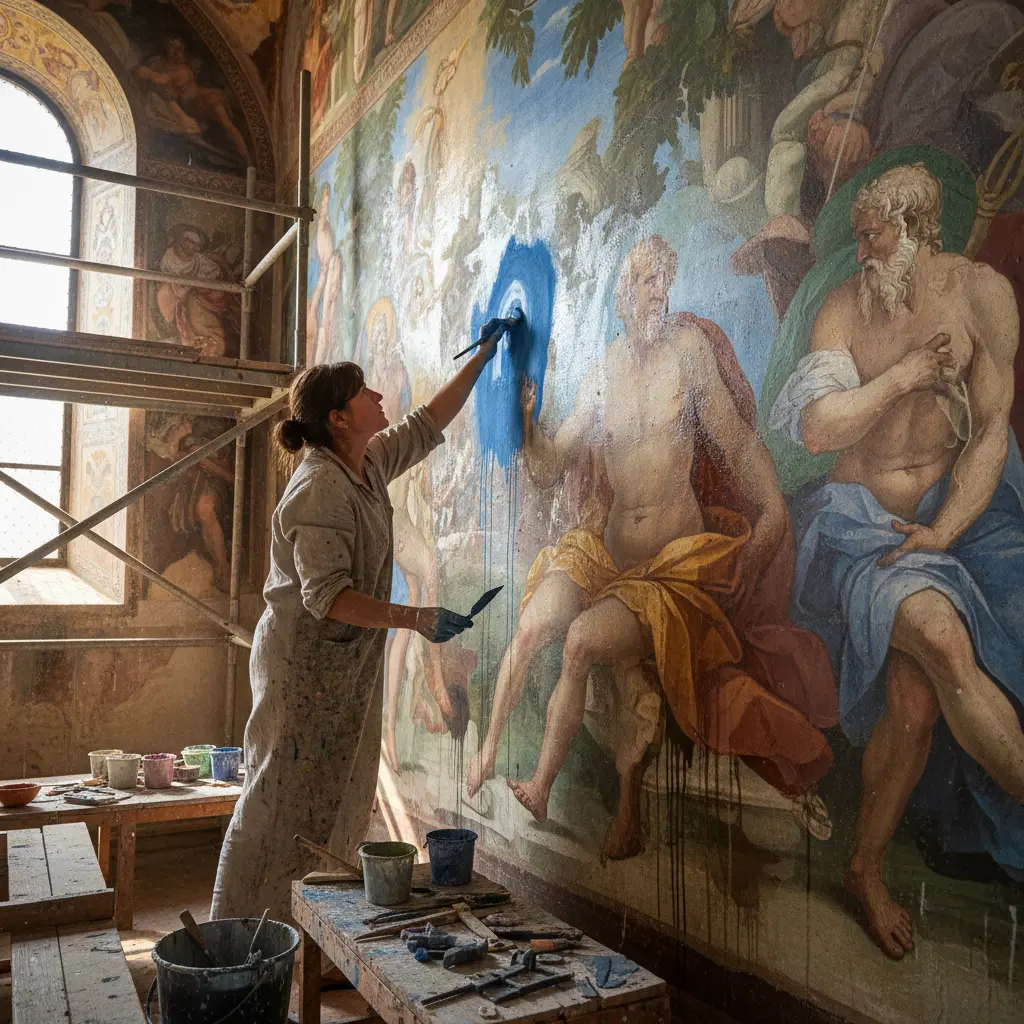
Root decomposition: from 'fresco' (Italian) related to 'frisch' (German, meaning 'fresh'). Historical origin: from Latin 'frescus' → Italian 'fresco' → English 'fresco'. Memory image: picture an artist working energetically on a large wall, where vibrant colors mix with the fresh wet plaster, creating a living artwork.
Note 1: These definitions and etymologies are not standard dictionary definitions, but extended explanations provided to help with memorization and understanding of the actual application of words. Through this background information, we strive to make words more vivid and easier to understand, and help you remember their meanings in real life.
Note 2: LexiTalk designs the learning flow around the linguistics principle of “Comprehensible Input.” When learners encounter material that is slightly above their level but still understandable from context, the brain naturally absorbs the language. That’s why we keep every word inside authentic contexts, using examples and associations to help you understand it and use it flexibly.
Read the FAQ explanation of Comprehensible InputFresco is a noun referring to a painting created rapidly on wet plaster while the plaster is still damp, allowing the pigments to become permanently bound as it dries. The term also describes the mural painting technique where artists apply color to freshly laid plaster in sections, often resulting in luminous, durable wall images. Historically associated with Italian wall frescoes from the Renaissance, the word carries connotations of speed, freshness, and integration with architecture. In English, fresco can also denote a work produced in the same style, even if painted on dry plaster, though purists would call that a fresco-secco. The memory image: imagine a busy artist rushing a large wall, colors mingling with wet plaster to form a living scene.
English speakers tend to separate 'fresco' as a specific wall-painting technique with Italian origins, and may worry about the 'secco' distinction more than speakers of some other languages.
What does the word 'fresco' mean?
Which sentence uses 'fresco' correctly?
Which word is most similar to 'fresco'?
What is the opposite of 'fresco'?
Can you think of a real-life context involving 'fresco'?
Download LexiTalk app for personalized learning experience
Download AppCookies
We use cookies for essential site functions, analytics, and ads. You can accept, reject, or manage preferences. Privacy Policy