grain - Master This Word
Master this word with our 5-step learning method – Learn English in English
Train English Through Brain Routes, Not Translation.
This page helps you stop memorizing isolated translations and start understanding a word through its shared mental image, native-style thinking, and practical training steps.
Master this word with our 5-step learning method – Learn English in English
Example sentences are the start of understanding. Don't rush to memorize. First feel how the word works in a sentence.
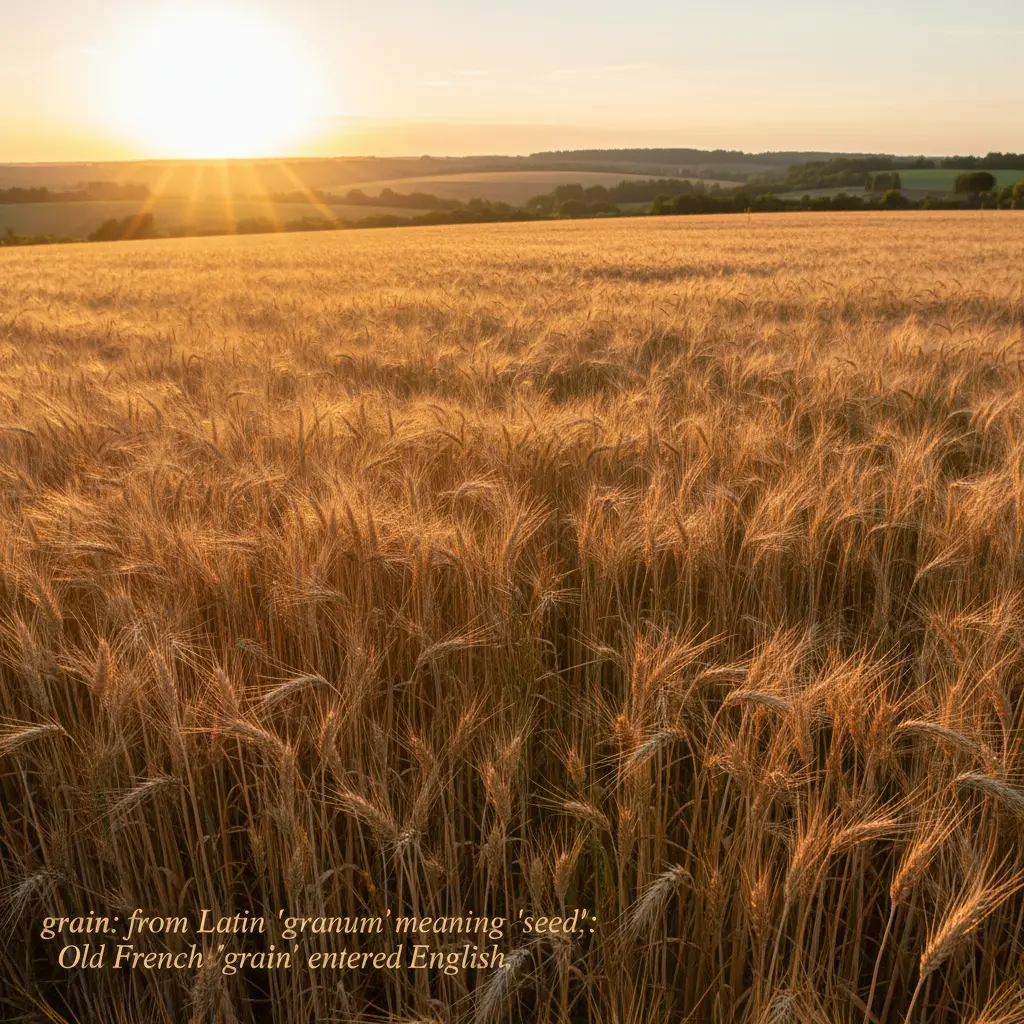
grain: from Latin 'granum' meaning 'seed'; Old French 'grain' entered English. Picture a golden grain field swaying under the sun, symbolizing the foundation of life and sustenance.
Note 1: These definitions and etymologies are not standard dictionary definitions, but extended explanations provided to help with memorization and understanding of the actual application of words. Through this background information, we strive to make words more vivid and easier to understand, and help you remember their meanings in real life.
Note 2: LexiTalk designs the learning flow around the linguistics principle of “Comprehensible Input.” When learners encounter material that is slightly above their level but still understandable from context, the brain naturally absorbs the language. That’s why we keep every word inside authentic contexts, using examples and associations to help you understand it and use it flexibly.
Read the FAQ explanation of Comprehensible InputI cup my hand and hold a small grain, then tilt my palm, letting a few slide out onto the plate one by one. I move the grain from palm to surface, pull back my fingers to keep control, and adjust the angle as it settles. I change the setup, turning the plate slightly and setting the grain where it won’t spill, keeping a steady rhythm. The grain's tiny texture, felt on skin, whispers about what it can become in use.
Grain is a versatile English word with three core senses: it can mean the small, hard seed of a plant, especially a cereal like wheat or rice; it can also refer to a small particle or fragment, such as sand or dust; and it can describe a substance or quality, such as the texture or grain of wood, fabric, or even a metaphor like 'the grain of truth.' You will hear phrases like 'a grain of salt,' 'fine grain,' or 'to the grain of truth.' Note that grains are countable when referring to individual seeds ('three grains') but not when speaking of material or texture. Etymology traces to Latin granum.
Grain bridges seed, particle, and texture concepts; English often relies on context and collocations to separate them. Learners may wrongly treat grain as only a seed or as a weight unit.
What does the word 'grain' mean?
How is the word 'grain' used in a sentence?
Which of the following is a similar word to 'grain'?
What is the opposite of 'grain'?
In what context would you find the word 'grain'?
Download LexiTalk app for personalized learning experience
Download AppCookies
We use cookies for essential site functions, analytics, and ads. You can accept, reject, or manage preferences. Privacy Policy