ground - Master This Word
Master this word with our 5-step learning method – Learn English in English
Train English Through Brain Routes, Not Translation.
This page helps you stop memorizing isolated translations and start understanding a word through its shared mental image, native-style thinking, and practical training steps.
Master this word with our 5-step learning method – Learn English in English
Example sentences are the start of understanding. Don't rush to memorize. First feel how the word works in a sentence.
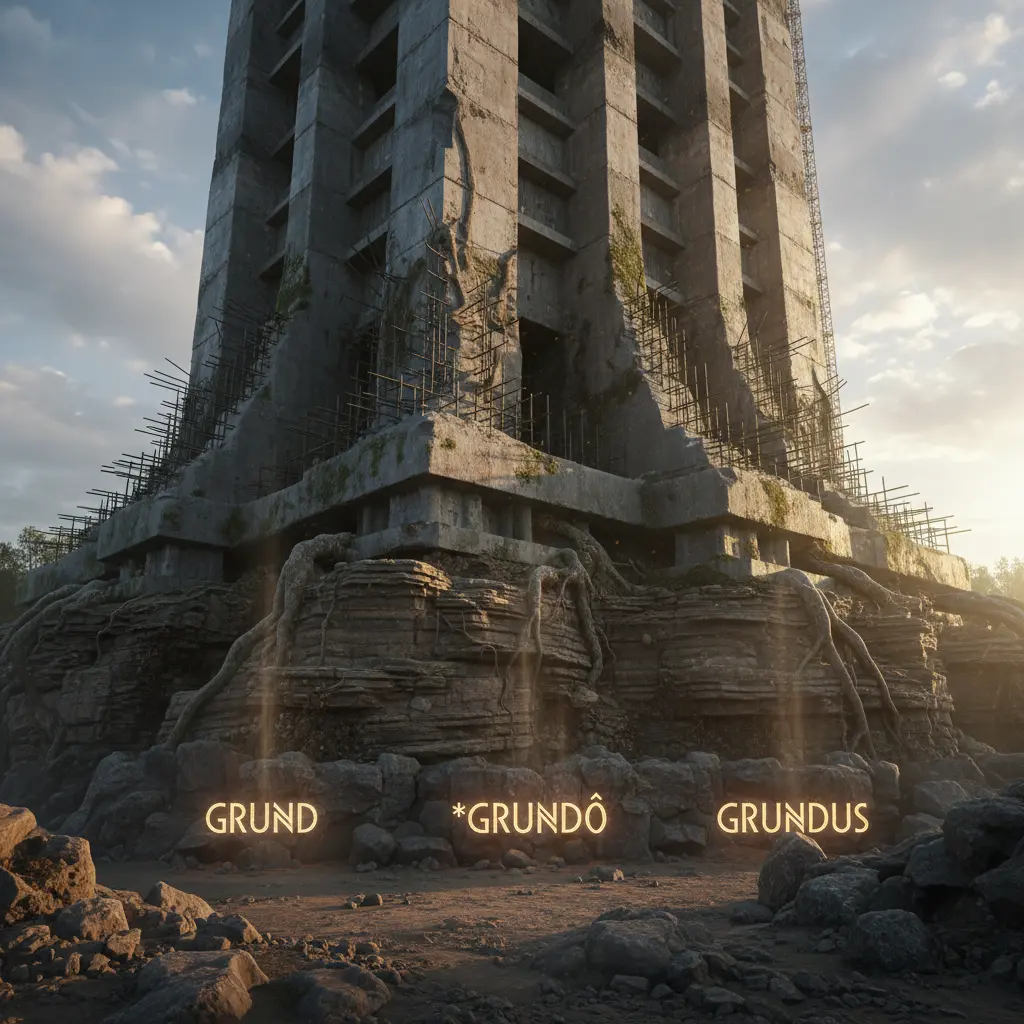
(a) From Old English 'grund', meaning 'ground, foundation'. (b) Derived from Proto-Germanic *grundō, related to Old Dutch 'grond' and Gothic 'grundus'. (c) Imagine the strong foundation of a building, solid and unyielding, cemented into the earth; this strength ties the concept of grounding to stability in many contexts.
Note 1: These definitions and etymologies are not standard dictionary definitions, but extended explanations provided to help with memorization and understanding of the actual application of words. Through this background information, we strive to make words more vivid and easier to understand, and help you remember their meanings in real life.
Note 2: LexiTalk designs the learning flow around the linguistics principle of “Comprehensible Input.” When learners encounter material that is slightly above their level but still understandable from context, the brain naturally absorbs the language. That’s why we keep every word inside authentic contexts, using examples and associations to help you understand it and use it flexibly.
Read the FAQ explanation of Comprehensible InputI bend my knees and push the bag toward the floor, watching it move until it sits on the ground. I adjust my grip, hold it steady, and feel the weight shift as I keep it from wobbling. That small act of setting something down becomes a quiet decision to build a base for what comes next. Ground here feels like the solid surface I rely on as plans start to take shape.
Ground functions as both a verb and a noun in everyday English. As a verb, to ground something can mean lowering it to the surface, or more commonly, restricting someone’s movements or privileges (parents grounding a teen, a plane grounded due to weather). As a noun, ground refers to the solid surface of the earth, the area on which something stands or lies, or the basis for a plan, argument, or rule (grounds for a decision). The etymology links these senses to stability and support, the idea of a firm base for action and thought.
This entry treats ground as both a concrete surface and an abstract basis, which is common in English but may be less explicit in some learners’ L1s where the distinction between surface and basis is expressed with different terms.
What is the meaning of the word 'ground'?
In which of the following sentences is 'ground' used correctly?
Which word is an opposite of 'ground'?
Which of the following is a similar word to 'ground'?
In what context might you use the word 'ground'?
Download LexiTalk app for personalized learning experience
Download AppCookies
We use cookies for essential site functions, analytics, and ads. You can accept, reject, or manage preferences. Privacy Policy