habitats - Master This Word
Master this word with our 5-step learning method – Learn English in English
Train English Through Brain Routes, Not Translation.
This page helps you stop memorizing isolated translations and start understanding a word through its shared mental image, native-style thinking, and practical training steps.
Master this word with our 5-step learning method – Learn English in English
Example sentences are the start of understanding. Don't rush to memorize. First feel how the word works in a sentence.
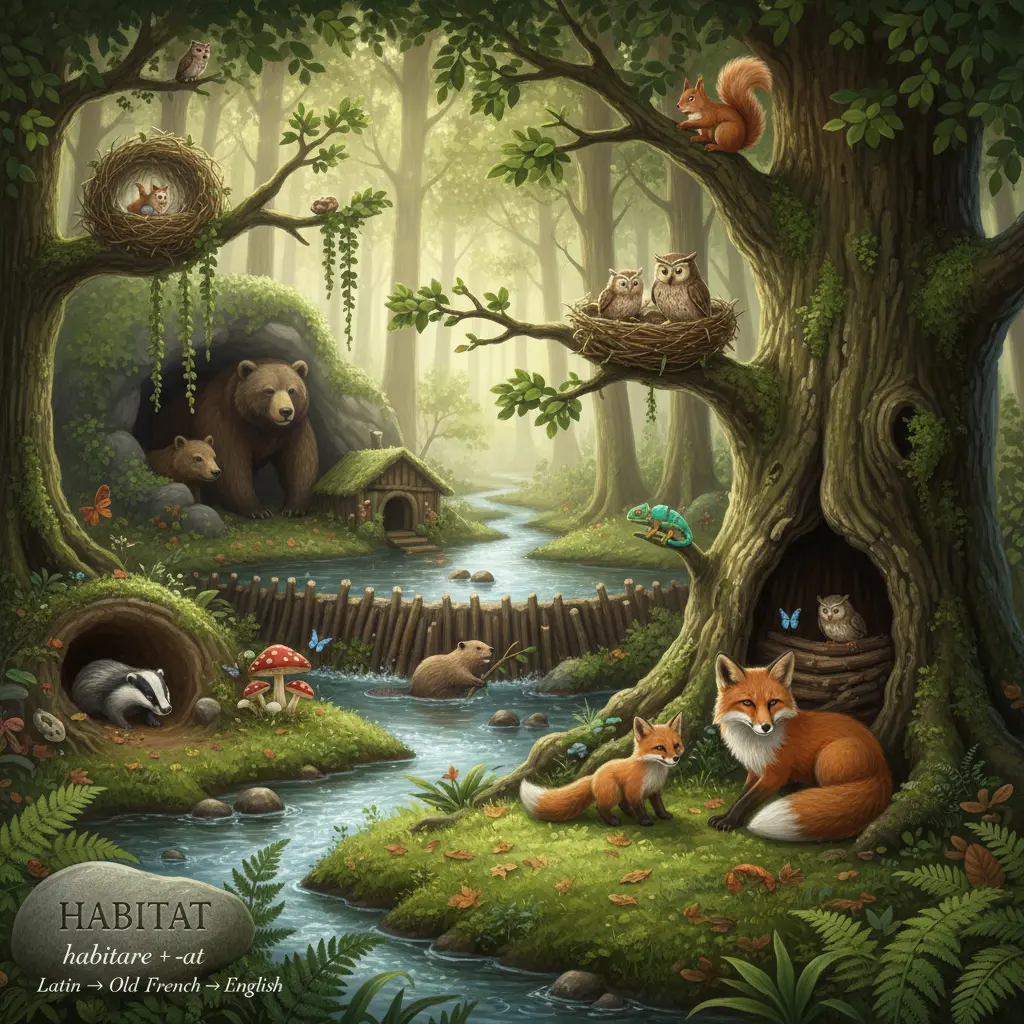
habitat = habitare (to have a home) + -at (suffix indicating a place); Latin → Old French → English. Imagine a peaceful forest where animals find their homes, each in their habitat, illustrating the diverse places life can thrive.
Note 1: These definitions and etymologies are not standard dictionary definitions, but extended explanations provided to help with memorization and understanding of the actual application of words. Through this background information, we strive to make words more vivid and easier to understand, and help you remember their meanings in real life.
Note 2: LexiTalk designs the learning flow around the linguistics principle of “Comprehensible Input.” When learners encounter material that is slightly above their level but still understandable from context, the brain naturally absorbs the language. That’s why we keep every word inside authentic contexts, using examples and associations to help you understand it and use it flexibly.
Read the FAQ explanation of Comprehensible InputI squat and move my hands over a patch of imagined ground, nudging grasses and rocks into new places. I push, pull, and adjust until the scene feels just right for a creature to live there, and the light shifts with the change. The effort makes me feel careful and grounded, like I'm keeping a doorway open for life to stay. That sense of place sticks with me when I hear someone talk about habitat in real use, as the natural home where a plant or animal belongs.
Habitat is the natural home or environment where a living thing lives and thrives. In biology, it describes the place with the specific combination of climate, vegetation, water, and shelter that supports a species. Habitats vary widely: a polar bear’s habitat is the Arctic sea ice; a coral reef supports many fish and invertebrates; a rainforest hosts thousands of species with complex interactions. The term also helps explain patterns of where organisms occur and how they respond to change, such as habitat loss from human activity or climate shifts. Learners should note that habitat differs from range: a species can exist in one range but use several habitats within it.
For English speakers, habitat is a precise scientific term; learners often confuse it with home or 'where someone lives'. Emphasize that habitat is about the natural environment that supports survival and reproduction, not a residence.
English Learning Listening Content
Listen NowDownload LexiTalk app for personalized learning experience
Download AppCookies
We use cookies for essential site functions, analytics, and ads. You can accept, reject, or manage preferences. Privacy Policy