
hibernation - Master This Word
Master this word with our 5-step learning method – Learn English in English
Train English Through Brain Routes, Not Translation.
This page helps you stop memorizing isolated translations and start understanding a word through its shared mental image, native-style thinking, and practical training steps.
Master this word with our 5-step learning method – Learn English in English
Example sentences are the start of understanding. Don't rush to memorize. First feel how the word works in a sentence.
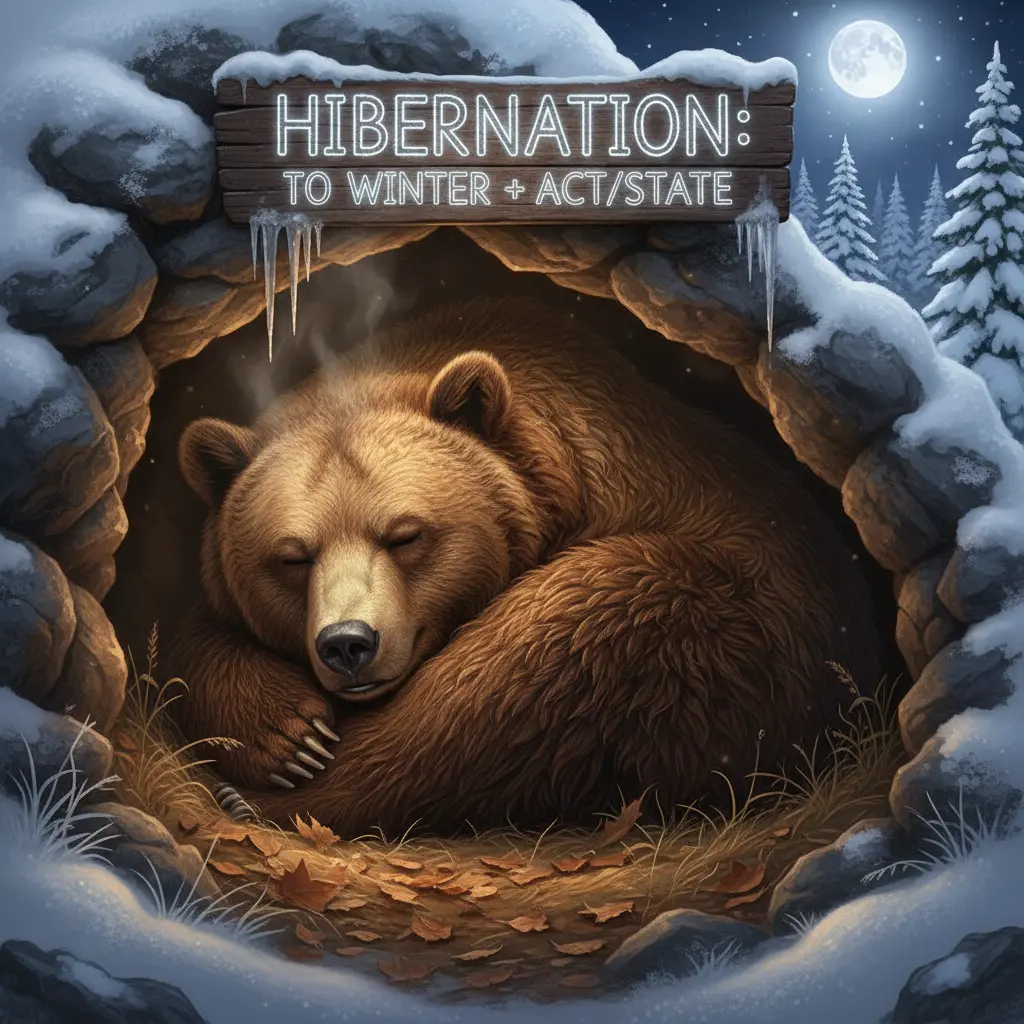
Hibernation can be broken down into 'hiber' (to winter) + 'nation' (act or state), from Latin 'hibernare' (to spend the winter). Picture a bear curled up in a cozy den, sleeping peacefully through the cold winter months, embodying both rest and survival.
Note 1: These definitions and etymologies are not standard dictionary definitions, but extended explanations provided to help with memorization and understanding of the actual application of words. Through this background information, we strive to make words more vivid and easier to understand, and help you remember their meanings in real life.
Note 2: LexiTalk designs the learning flow around the linguistics principle of “Comprehensible Input.” When learners encounter material that is slightly above their level but still understandable from context, the brain naturally absorbs the language. That’s why we keep every word inside authentic contexts, using examples and associations to help you understand it and use it flexibly.
Read the FAQ explanation of Comprehensible InputHibernation is a biological state where animals dramatically slow their metabolism, conserve energy, and stay inactive through winter. In science, it describes bears, hedgehogs, bats, and others that lower heart rate and body temperature to survive food-scarce months. In everyday language, the term is used more loosely: a prolonged dormancy or sleep, or even a figurative pause for reflection or rest after a busy period. Learners often confuse 'hibernation' with 'hibernating' or think it strictly means 'long sleep,' ignoring the metabolic aspect. The Latin roots hiber- (winter) and -nation (state) help remember the sense of winter-time rest. Picture a bear curled up in a den, conserving energy until spring arrives.
In English, hibernation is a formal scientific term and a noun; learners often forget the verb to hibernate and use 'hibernate' as a noun. Think of it as a winter-specific state rather than just long sleep. Collocations like 'enter hibernation' and 'in hibernation' are common.
What does 'hibernation' mean?
Choose the correct usage of the word 'hibernation'.
Which word is most similar to 'hibernation'?
What is the opposite of 'hibernation'?
Can you give an example of a real-life scenario involving seasons and sleep?
Download LexiTalk app for personalized learning experience
Download AppCookies
We use cookies for essential site functions, analytics, and ads. You can accept, reject, or manage preferences. Privacy Policy