inadvertence - Master This Word
Master this word with our 5-step learning method – Learn English in English
Train English Through Brain Routes, Not Translation.
This page helps you stop memorizing isolated translations and start understanding a word through its shared mental image, native-style thinking, and practical training steps.
Master this word with our 5-step learning method – Learn English in English
Example sentences are the start of understanding. Don't rush to memorize. First feel how the word works in a sentence.
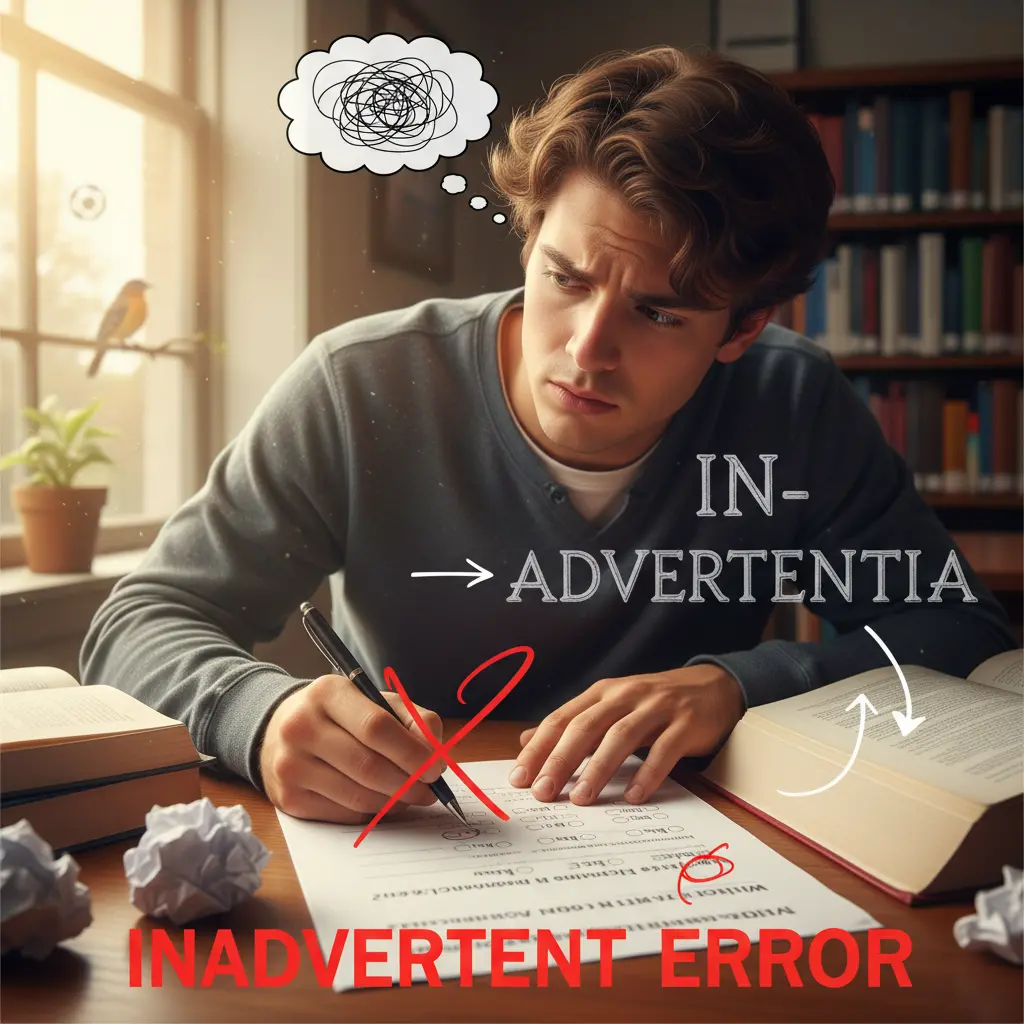
Inadvertence decomposes into 'in-' (not) + 'advertent' (paying attention). It originates from Latin 'inadvertentia' through Old French to English. Visualize a distracted student who overlooks a crucial detail on a test, leading to an inadvertent error.
Note 1: These definitions and etymologies are not standard dictionary definitions, but extended explanations provided to help with memorization and understanding of the actual application of words. Through this background information, we strive to make words more vivid and easier to understand, and help you remember their meanings in real life.
Note 2: LexiTalk designs the learning flow around the linguistics principle of “Comprehensible Input.” When learners encounter material that is slightly above their level but still understandable from context, the brain naturally absorbs the language. That’s why we keep every word inside authentic contexts, using examples and associations to help you understand it and use it flexibly.
Read the FAQ explanation of Comprehensible InputInadvertence describes a failure to notice or act, caused by lack of attention rather than carelessness or intent. It covers mistakes that happen when someone overlooks a detail, forgets a procedure, or misreads a situation through distraction. In everyday use, it often replaces terms like 'oversight' or 'an unintentional error' in formal or written contexts. While it implies no malice, it can have real consequences, from a missed deadline to a skipped warning sign. Learners should distinguish inadvertence from negligence and aim for awareness, checks, and reflection to reduce errors born of distraction.
English tends to reserve inadvertence for mild, nonmalicious errors and relies on context to convey intent; learners must fine‑tune the nuance between accidental oversights and negligent behavior.
What is the definition of the word 'inadvertence'?
Choose the correct usage of 'inadvertence' in a sentence.
Which word is most similar to 'inadvertence'?
What is the opposite of 'inadvertence'?
Can you think of a real-life context where 'inadvertence' applies?
Technology & Social Media
Listen NowDownload LexiTalk app for personalized learning experience
Download AppCookies
We use cookies for essential site functions, analytics, and ads. You can accept, reject, or manage preferences. Privacy Policy