instinct - Master This Word
Master this word with our 5-step learning method – Learn English in English
Train English Through Brain Routes, Not Translation.
This page helps you stop memorizing isolated translations and start understanding a word through its shared mental image, native-style thinking, and practical training steps.
Master this word with our 5-step learning method – Learn English in English
Example sentences are the start of understanding. Don't rush to memorize. First feel how the word works in a sentence.
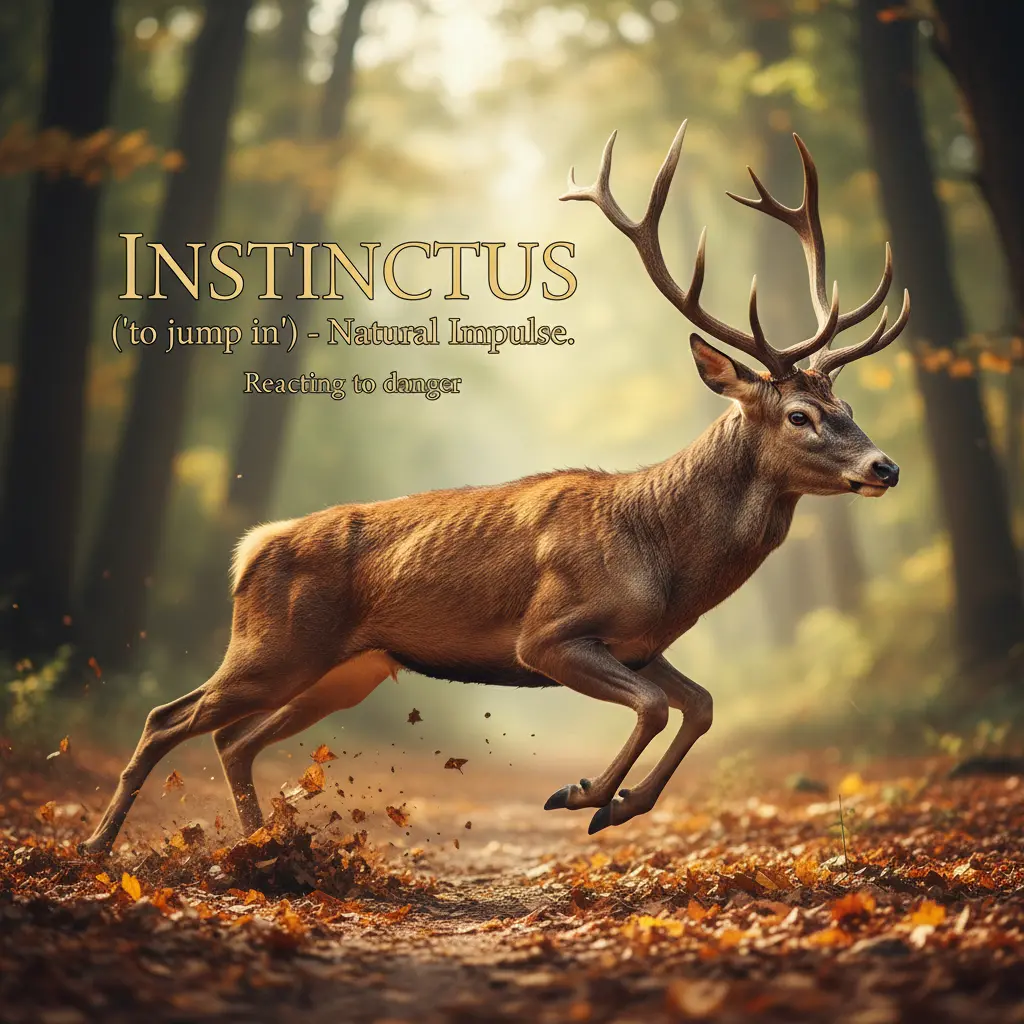
instinct = in- (not) + stinct (to jump). Latin instictus ('to jump in') suggests a natural impulse; imagine a deer suddenly leaping forward at the rustle of leaves, instinctively reacting to danger.
Note 1: These definitions and etymologies are not standard dictionary definitions, but extended explanations provided to help with memorization and understanding of the actual application of words. Through this background information, we strive to make words more vivid and easier to understand, and help you remember their meanings in real life.
Note 2: LexiTalk designs the learning flow around the linguistics principle of “Comprehensible Input.” When learners encounter material that is slightly above their level but still understandable from context, the brain naturally absorbs the language. That’s why we keep every word inside authentic contexts, using examples and associations to help you understand it and use it flexibly.
Read the FAQ explanation of Comprehensible InputFirst I place my hand on the steering wheel and breathe in, feeling the road pass through my grip. The wheel moves beneath my fingers as I shift my weight and steer, a sense that comes from somewhere inside before I think it through. I push and pull with steady effort, keeping my eyes on the road and adjusting my posture to stay balanced. That quiet pull of action—an instinct—pushes me to act when the moment wants a decision, turning feeling into a quick move.
Instinct is a natural, inborn drive that shapes how we respond before we think things through. In everyday English, it covers both a basic, automatic reaction to danger or pleasure and a broader, stronger impulse that guides choices without conscious reasoning. You might say a parent has an instinct to protect a child, or that a wild animal relies on instinct to hunt and evade predators. Learners should note that instinct is not the same as skill learned by practice, nor is it a mysterious force; it is the body’s deeply rooted tendency to act in familiar, often survival-related ways.
Instinct is often described as a natural impulse; English tends to separate instinct from rational planning or learned skills, which can lead learners to think of it as a simple, automatic judgment rather than a nuanced tendency.
What is the meaning of the word 'instinct'?
In which sentence is 'instinct' used correctly?
Which word is a synonym of 'instinct'?
What is the opposite of 'instinct'?
How does 'instinct' apply in real-world situations?
Download LexiTalk app for personalized learning experience
Download AppCookies
We use cookies for essential site functions, analytics, and ads. You can accept, reject, or manage preferences. Privacy Policy