protect - Master This Word
Master this word with our 5-step learning method – Learn English in English
Train English Through Brain Routes, Not Translation.
This page helps you stop memorizing isolated translations and start understanding a word through its shared mental image, native-style thinking, and practical training steps.
Master this word with our 5-step learning method – Learn English in English
Example sentences are the start of understanding. Don't rush to memorize. First feel how the word works in a sentence.
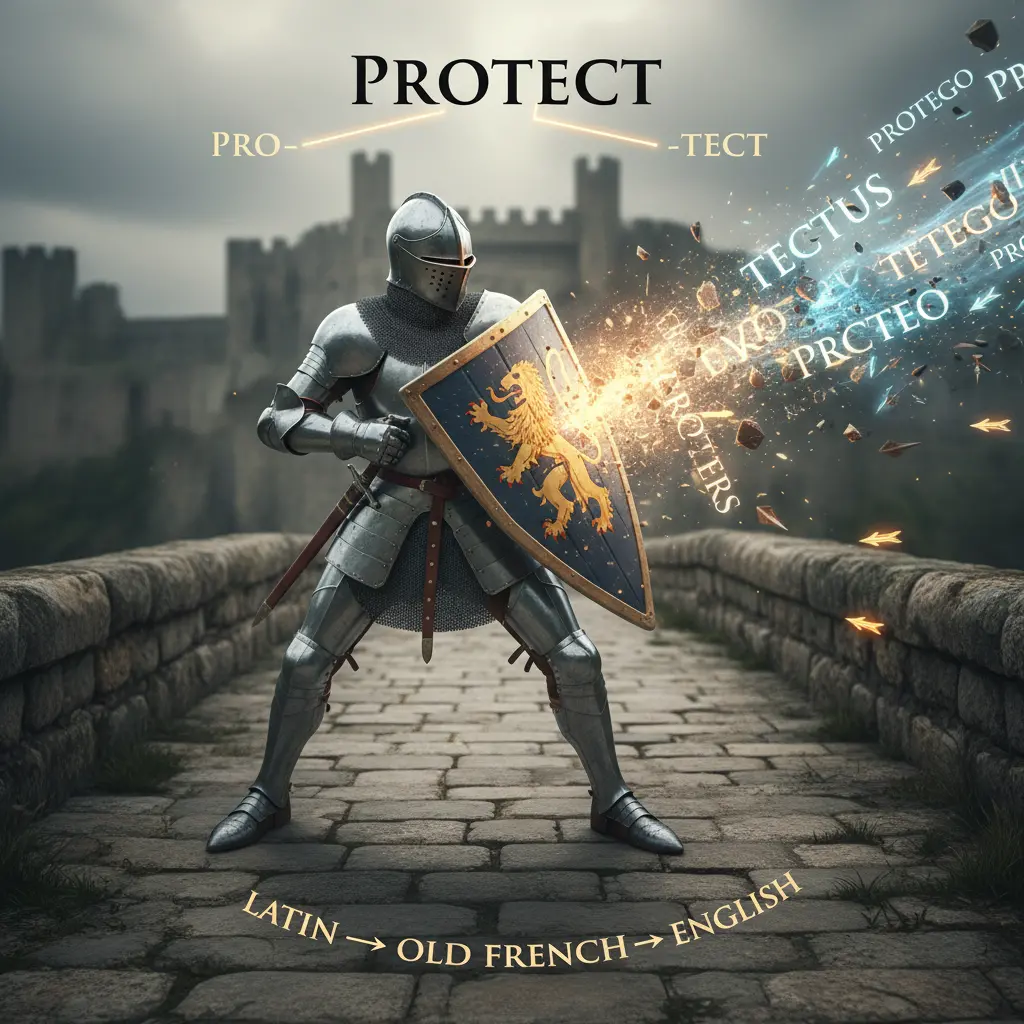
The root comes from 'pro-' meaning 'forward' and 'tect' from Latin 'tectus' meaning 'cover.' Originated from Latin → Old French → English. Imagine a knight raising a shield forward to protect against an incoming attack.
Note 1: These definitions and etymologies are not standard dictionary definitions, but extended explanations provided to help with memorization and understanding of the actual application of words. Through this background information, we strive to make words more vivid and easier to understand, and help you remember their meanings in real life.
Note 2: LexiTalk designs the learning flow around the linguistics principle of “Comprehensible Input.” When learners encounter material that is slightly above their level but still understandable from context, the brain naturally absorbs the language. That’s why we keep every word inside authentic contexts, using examples and associations to help you understand it and use it flexibly.
Read the FAQ explanation of Comprehensible InputFirst I reach for the door and pull it shut, my breath catching as the room slips into stillness. With a quick turn of the latch, a soft shield settles around us, and the muffled world outside feels distant. I adjust the door so the wind can't slip inside, and warmth stays for a little longer. These small actions remind me that protecting what matters can be a calm, practical choice in daily life.
Protect means to keep someone or something safe from harm, danger, or damage. It is used for physical safety, as in wearing helmets or guarding a door, and for safeguarding non-physical things such as privacy, rights, or plans. Common patterns include protect someone from harm, protect something against damage, and be protected by someone or something. The action is active: a person, system, or policy provides protection, not merely avoiding danger. Learners often confuse protect with preserve or keep; protect emphasizes a defense against risk rather than simply keeping as it is. Imagine a shield raised forward in battle to block an incoming attack, which helps connect the sense of defense and support.
For English speakers, protect often emphasizes active defense and practical scenarios (personal safety, data security). Learners may misinterpret it as purely preserving a state or object; the focus is on blocking risk, not just keeping things unchanged.
What is the meaning of the word 'protect'?
Which sentence uses the word 'protect' correctly?
Which word is most similar to 'protect'?
What is the opposite of 'protect'?
Can you give an example of a real-life scenario of 'protect'?
Download LexiTalk app for personalized learning experience
Download AppCookies
We use cookies for essential site functions, analytics, and ads. You can accept, reject, or manage preferences. Privacy Policy