
isotopes - Master This Word
Master this word with our 5-step learning method – Learn English in English
Train English Through Brain Routes, Not Translation.
This page helps you stop memorizing isolated translations and start understanding a word through its shared mental image, native-style thinking, and practical training steps.
Master this word with our 5-step learning method – Learn English in English
Example sentences are the start of understanding. Don't rush to memorize. First feel how the word works in a sentence.
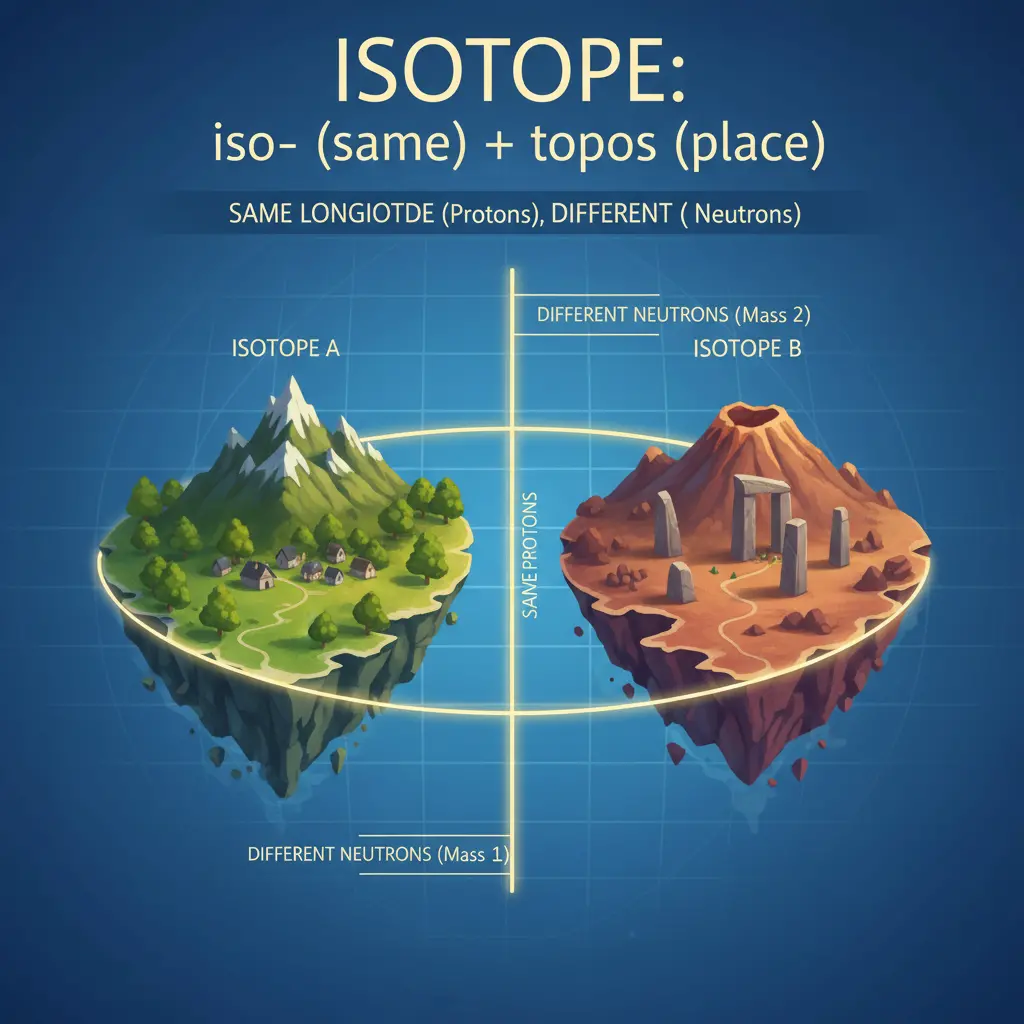
Root: iso- (same) + topos (place). Historical origin: from Greek, via Latin to English. Memory image: Imagine two unique islands (isotopes) that share the same longitude (same protons) but vary in latitude (different neutrons).
Note 1: These definitions and etymologies are not standard dictionary definitions, but extended explanations provided to help with memorization and understanding of the actual application of words. Through this background information, we strive to make words more vivid and easier to understand, and help you remember their meanings in real life.
Note 2: LexiTalk designs the learning flow around the linguistics principle of “Comprehensible Input.” When learners encounter material that is slightly above their level but still understandable from context, the brain naturally absorbs the language. That’s why we keep every word inside authentic contexts, using examples and associations to help you understand it and use it flexibly.
Read the FAQ explanation of Comprehensible InputIsotope is a term in chemistry describing atoms of the same element that vary in the number of neutrons. They share the same number of protons, giving identical chemical behavior, but different masses. Isotopes can be stable or radioactive, and scientists study their properties to understand nuclear processes and dating techniques. The concept helps explain why elements show characteristic mass patterns and how reactions depend on neutron count. The word comes from iso- (same) and topos (place) from Greek, reinforcing the image of two variants occupying the same chemical 'place' but with different 'neutron landscapes'.
English learners often separate the idea of a chemical element from its nuclear variants. English uses clear pluralization rules (isotope vs isotopes) and tends to emphasize chemical similarity across isotopes, which can clash with learners who focus on mass differences.
Download LexiTalk app for personalized learning experience
Download AppCookies
We use cookies for essential site functions, analytics, and ads. You can accept, reject, or manage preferences. Privacy Policy