leaking - Master This Word
Master this word with our 5-step learning method – Learn English in English
Train English Through Brain Routes, Not Translation.
This page helps you stop memorizing isolated translations and start understanding a word through its shared mental image, native-style thinking, and practical training steps.
Master this word with our 5-step learning method – Learn English in English
Example sentences are the start of understanding. Don't rush to memorize. First feel how the word works in a sentence.
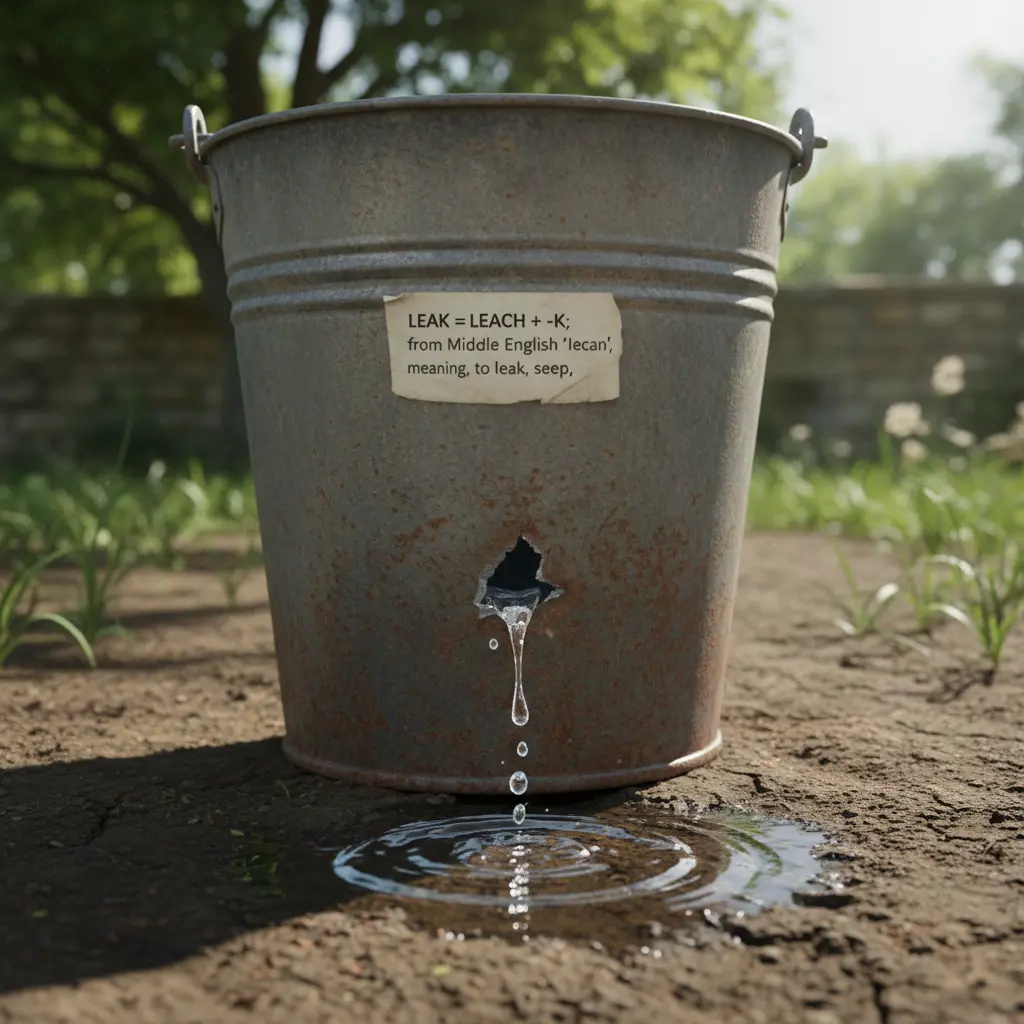
leak = leach + -k; from Middle English 'lecan', meaning 'to leak, seep'; imagine a bucket with a hole, slowly dripping water onto the ground.
Note 1: These definitions and etymologies are not standard dictionary definitions, but extended explanations provided to help with memorization and understanding of the actual application of words. Through this background information, we strive to make words more vivid and easier to understand, and help you remember their meanings in real life.
Note 2: LexiTalk designs the learning flow around the linguistics principle of “Comprehensible Input.” When learners encounter material that is slightly above their level but still understandable from context, the brain naturally absorbs the language. That’s why we keep every word inside authentic contexts, using examples and associations to help you understand it and use it flexibly.
Read the FAQ explanation of Comprehensible InputI move a water bottle in my hands and watch a thin thread of liquid begin to seep out from a tiny crack. I adjust my grip, hold the bottle tighter, and feel the flow shift as gravity takes a bit more. The effort to stop the leak makes the moment feel real, a small test of control I can learn from. When I manage to contain it, I set the cap back and keep the bottle steady, noticing how careful choices prevent the spill.
Leak is a versatile verb and noun. As a verb, to leak means to allow liquid or gas to escape through a hole or crack, or to reveal information unintentionally. As a noun, leak refers to a hole that lets substance escape, or to an incident in which information is disclosed. Common collocations include leak a pipe, leak water, leak a secret, leak-proof. People often confuse leak with drip or spill; leak emphasizes gradual escape through a weakness rather than a single spill. In tech and news, leaks of confidential documents highlight security and the risks of uncontrolled disclosure. Mastering leak improves accuracy in safety, journalism, and logistics contexts.
Learners must see leak as both a physical problem and an information event; English uses separate collocations (leak water, leak a secret) that don’t always map directly to other languages.
What does 'leaking' mean?
Identify the correct usage of the word 'leaking' in a sentence.
Which word is most similar to 'leaking'?
What is the opposite of 'leaking'?
Can you think of a real-life context where something is leaking?
Download LexiTalk app for personalized learning experience
Download AppCookies
We use cookies for essential site functions, analytics, and ads. You can accept, reject, or manage preferences. Privacy Policy