lichen - Master This Word
Master this word with our 5-step learning method – Learn English in English
Train English Through Brain Routes, Not Translation.
This page helps you stop memorizing isolated translations and start understanding a word through its shared mental image, native-style thinking, and practical training steps.
Master this word with our 5-step learning method – Learn English in English
Example sentences are the start of understanding. Don't rush to memorize. First feel how the word works in a sentence.
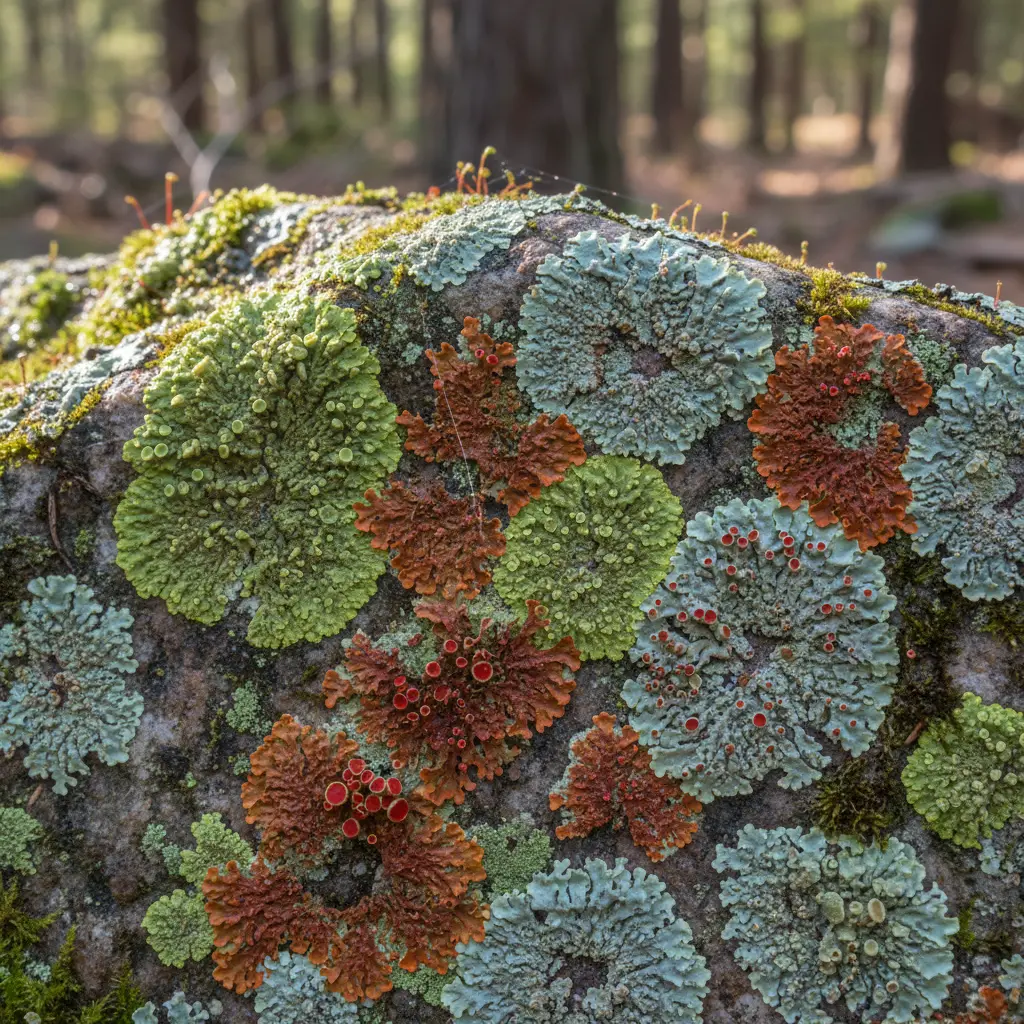
Root decomposition: 'lich' (Old English for lichen) + '-en' (suffix forming nouns). Historical origin: Latin 'lichen' → Old French 'lichens' → English 'lichen'. Memory image: Imagine a mossy rock covered in fuzzy, colorful patches—each patch represents a partnership between algae and fungi, thriving together.
Note 1: These definitions and etymologies are not standard dictionary definitions, but extended explanations provided to help with memorization and understanding of the actual application of words. Through this background information, we strive to make words more vivid and easier to understand, and help you remember their meanings in real life.
Note 2: LexiTalk designs the learning flow around the linguistics principle of “Comprehensible Input.” When learners encounter material that is slightly above their level but still understandable from context, the brain naturally absorbs the language. That’s why we keep every word inside authentic contexts, using examples and associations to help you understand it and use it flexibly.
Read the FAQ explanation of Comprehensible InputLichens are remarkable composite organisms formed by a partnership between fungi and algae or cyanobacteria. The fungal partner provides structure and protection, while the photosynthetic partner supplies sugars that feed both organisms. This mutualism enables lichens to colonize some of the world's harshest habitats, from bare rock faces to tree bark in open air. They come in a variety of colors and textures, from crusty patches on stone to leafy forms on wood. Because lichens are sensitive to air quality, scientists often use them as bioindicators of pollution and climate change. In everyday English, people sometimes use lichens as a metaphor for cooperation, resilience, and interdependence in nature.
For English learners, think of lichen as a classic biology example of mutualism rather than a plant. Emphasize the collaboration between two organisms and the nonliving fungal part. Common mistakes involve treating it like moss or assuming it grows only on rocks.
What is the definition of the word 'lichen'?
Identify the correctly used sentence containing 'lichen'.
Which word is most similar to 'lichen'?
What is the opposite of 'lichen'?
Can you think of a real-life scenario where 'lichen' might be mentioned?
Download LexiTalk app for personalized learning experience
Download AppCookies
We use cookies for essential site functions, analytics, and ads. You can accept, reject, or manage preferences. Privacy Policy