magma - Master This Word
Master this word with our 5-step learning method – Learn English in English
Train English Through Brain Routes, Not Translation.
This page helps you stop memorizing isolated translations and start understanding a word through its shared mental image, native-style thinking, and practical training steps.
Master this word with our 5-step learning method – Learn English in English
Example sentences are the start of understanding. Don't rush to memorize. First feel how the word works in a sentence.
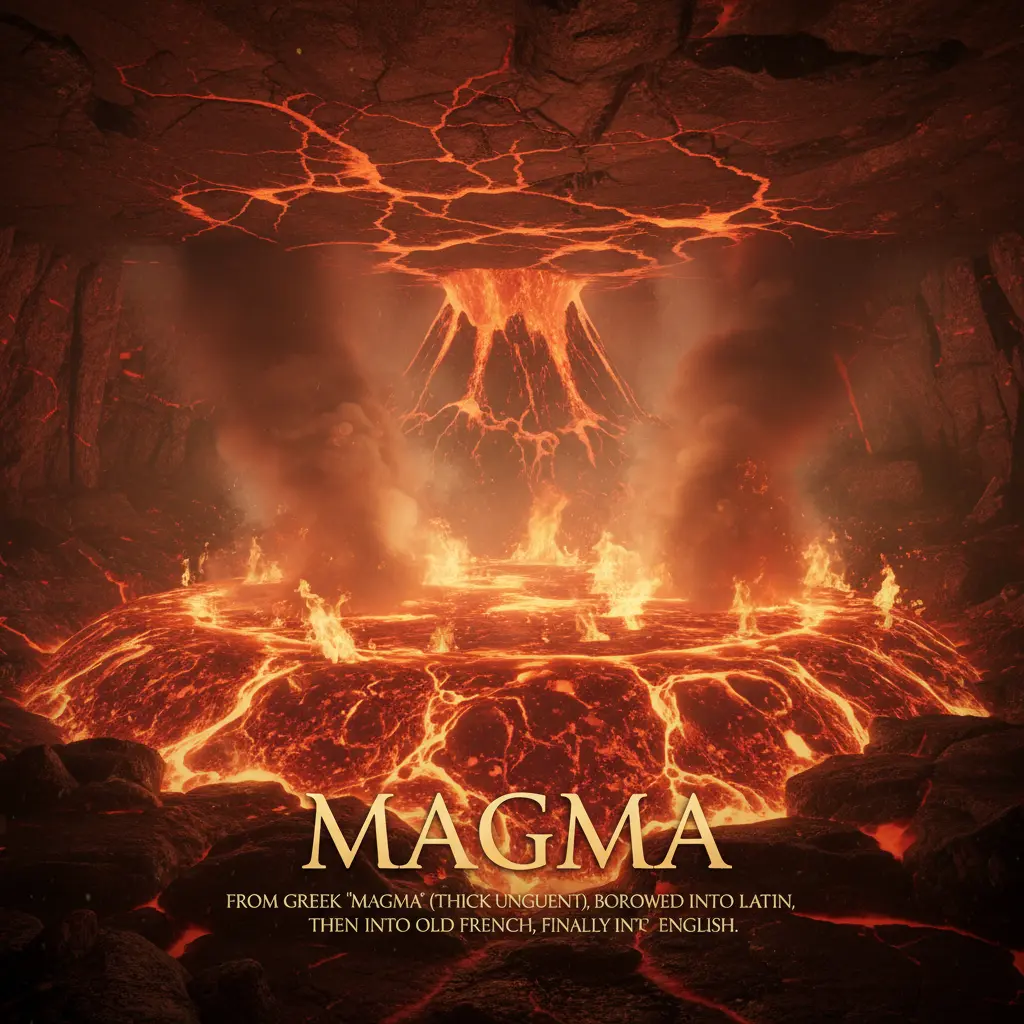
(a) From Greek 'magma' meaning 'thick unguent', (b) borrowed into Latin, then into Old French and finally into English as 'magma', (c) Imagine a bubbling cauldron of molten rock beneath the Earth, ready to erupt with fiery intensity, representing the raw power from which the planet is constructed.
Note 1: These definitions and etymologies are not standard dictionary definitions, but extended explanations provided to help with memorization and understanding of the actual application of words. Through this background information, we strive to make words more vivid and easier to understand, and help you remember their meanings in real life.
Note 2: LexiTalk designs the learning flow around the linguistics principle of “Comprehensible Input.” When learners encounter material that is slightly above their level but still understandable from context, the brain naturally absorbs the language. That’s why we keep every word inside authentic contexts, using examples and associations to help you understand it and use it flexibly.
Read the FAQ explanation of Comprehensible InputMagma is molten rock stored beneath the Earth's crust. It forms when rocks melt due to high temperatures, pressure, or the presence of volatiles, and it remains underground until it begins to move or collect in chambers. When magma erupts or surfaces, it is called lava. Magma also includes dissolved gases that can drive explosive eruptions and shape volcanic features as crystals crystallize during cooling. In everyday geology, magma is the raw material from which igneous rocks are made, and its composition—felsic, intermediate, or mafic—helps scientists predict eruption styles. For learners, remember that magma and lava describe the same molten material at different depths, not different substances.
Think of magma as underground molten rock; learners often imagine lava flowing on the surface. English uses a clear depth-based distinction, but many learners translate magma directly as lava without noting depth, which leads to errors in scientific writing and in describing eruptions.
What is the meaning of the word 'magma'?
Choose the sentence that uses the word 'magma' correctly.
Which word is most similar to 'magma'?
What is the opposite of 'magma'?
Can you think of a real-life context where 'magma' might play a role?
Download LexiTalk app for personalized learning experience
Download AppCookies
We use cookies for essential site functions, analytics, and ads. You can accept, reject, or manage preferences. Privacy Policy