marry - Master This Word
Master this word with our 5-step learning method – Learn English in English
Train English Through Brain Routes, Not Translation.
This page helps you stop memorizing isolated translations and start understanding a word through its shared mental image, native-style thinking, and practical training steps.
Master this word with our 5-step learning method – Learn English in English
Example sentences are the start of understanding. Don't rush to memorize. First feel how the word works in a sentence.
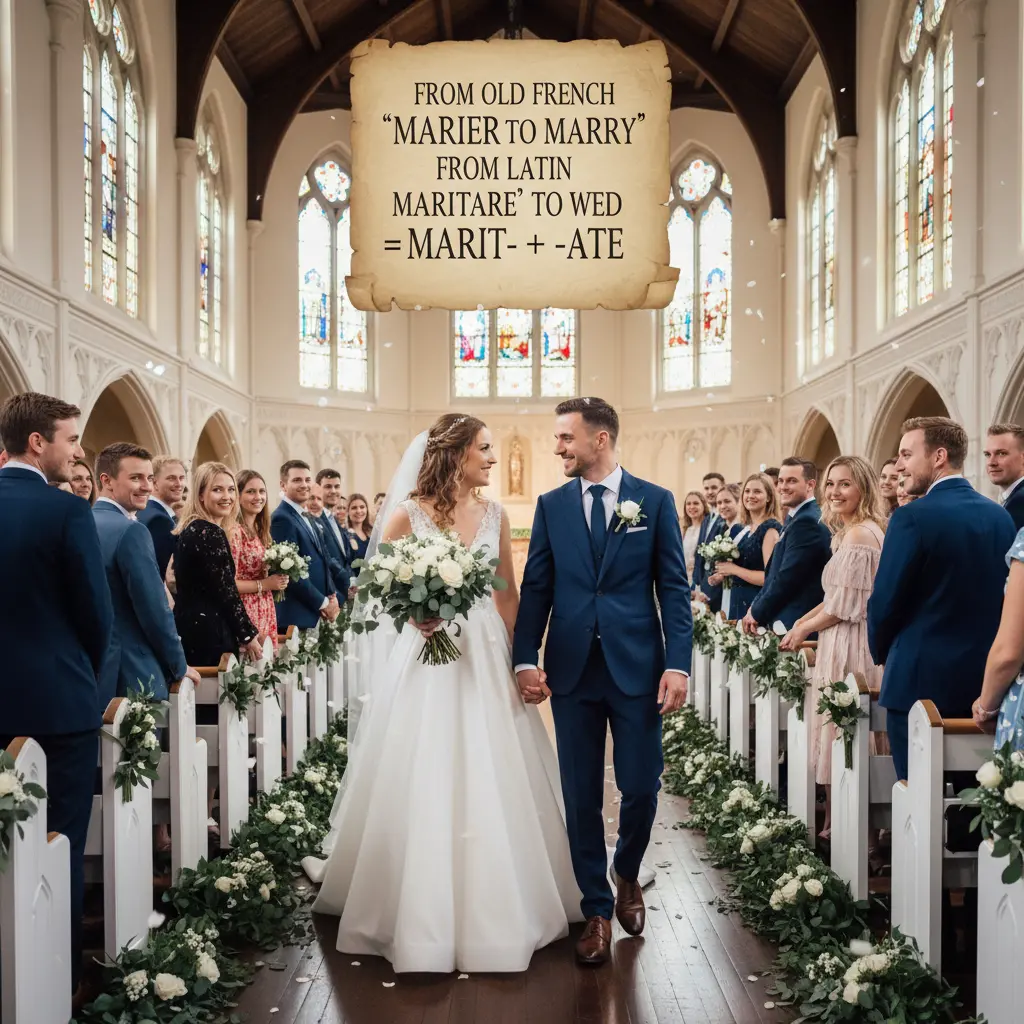
From Old French 'marier' (to marry) from Latin 'maritare' (to wed) = marit- (root, one who marries) + -ate (to make). Imagine a couple walking down the aisle, symbolizing their legal union.
Note 1: These definitions and etymologies are not standard dictionary definitions, but extended explanations provided to help with memorization and understanding of the actual application of words. Through this background information, we strive to make words more vivid and easier to understand, and help you remember their meanings in real life.
Note 2: LexiTalk designs the learning flow around the linguistics principle of “Comprehensible Input.” When learners encounter material that is slightly above their level but still understandable from context, the brain naturally absorbs the language. That’s why we keep every word inside authentic contexts, using examples and associations to help you understand it and use it flexibly.
Read the FAQ explanation of Comprehensible InputI slide my hand toward theirs, take a step closer, and settle my breath as I reach out. We exchange rings and pull the moment into a tighter future, feeling a small push of commitment. It changes the day in a physical, slow way—my heart lifts, my stance steadies, and a new direction seems to turn right in front of us. Saying we’re married becomes a natural line in conversation and a shared plan we carry forward.
Marry is the verb used to join in marriage with someone or to become the spouse of that person. In English you say 'to marry someone' (transitive) or 'to get married' (intransitive) when describing the ceremony or the state after it. A marriage is a formal or legally recognized union, often celebrated with a wedding. People marry for many reasons: love, family expectations, or cultural traditions, and laws in different countries grant spouses certain rights and responsibilities. The word appears in various tenses: 'they marry' (present), 'they married' (past), 'they have married' (present perfect). Its etymology traces back to Old French and Latin roots, emphasizing the act of becoming joined as partners for life.
English tends to treat marry as a concrete action with a direct person object; learners often confuse get married (the event/state) with marry (the action toward a person) and worry about ceremony connotations.
Which sentence below uses the word 'marry' correctly?
Which word is most similar to 'marry'?
What is the opposite of 'marry'?
Can you give an example of a real-life scenario involving 'marry'?
Download LexiTalk app for personalized learning experience
Download AppCookies
We use cookies for essential site functions, analytics, and ads. You can accept, reject, or manage preferences. Privacy Policy