medieval - Master This Word
Master this word with our 5-step learning method – Learn English in English
Train English Through Brain Routes, Not Translation.
This page helps you stop memorizing isolated translations and start understanding a word through its shared mental image, native-style thinking, and practical training steps.
Master this word with our 5-step learning method – Learn English in English
Example sentences are the start of understanding. Don't rush to memorize. First feel how the word works in a sentence.
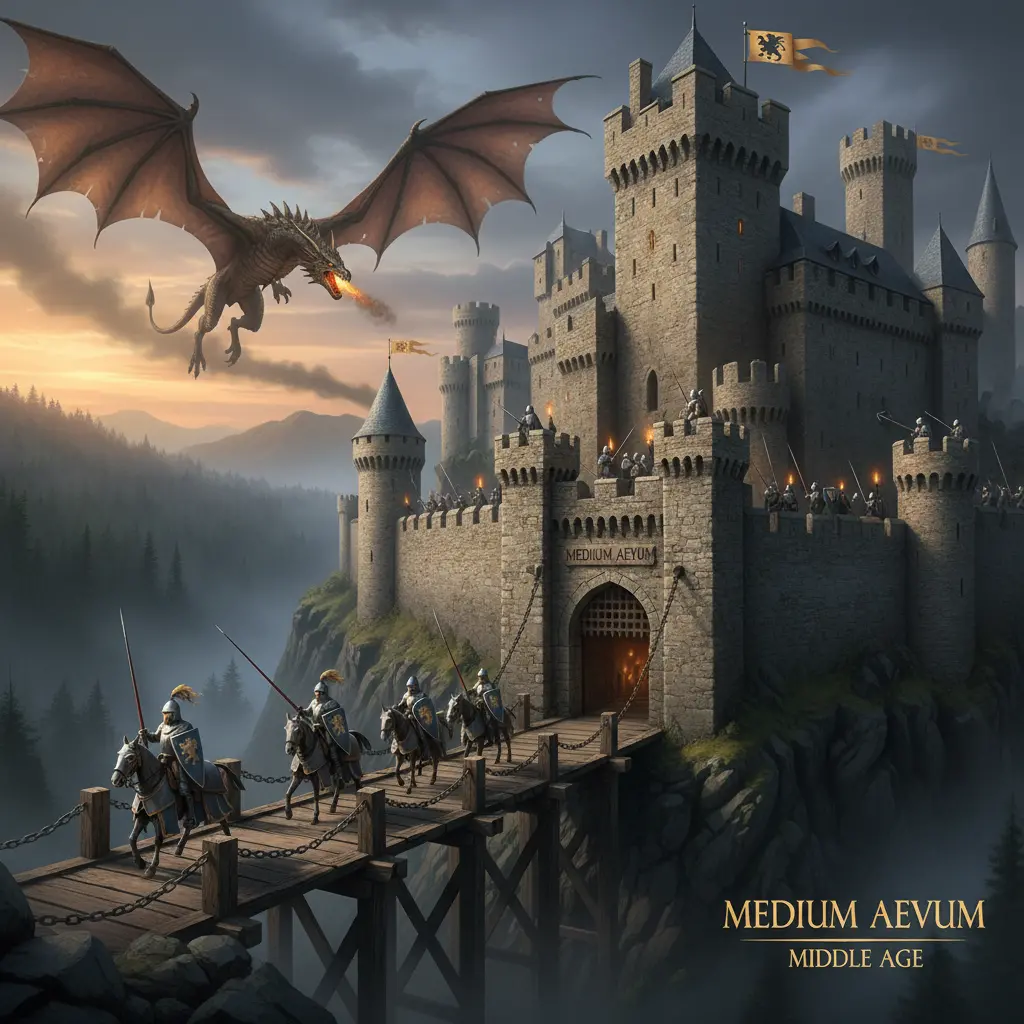
Medium aevum (Latin) = Middle + aevum (age) → Old French Medieval → English. Imagine a grand castle with stone towers and knights in armor, evoking the mystery and adventures of knights battling dragons.
Note 1: These definitions and etymologies are not standard dictionary definitions, but extended explanations provided to help with memorization and understanding of the actual application of words. Through this background information, we strive to make words more vivid and easier to understand, and help you remember their meanings in real life.
Note 2: LexiTalk designs the learning flow around the linguistics principle of “Comprehensible Input.” When learners encounter material that is slightly above their level but still understandable from context, the brain naturally absorbs the language. That’s why we keep every word inside authentic contexts, using examples and associations to help you understand it and use it flexibly.
Read the FAQ explanation of Comprehensible InputI clasp an old manuscript and turn its pages, the paper stiff and heavy. I adjust my grip, watching the ink shift where the light lands, and I feel a different mood rise, almost archaic. I set aside the bright modern glare and keep my attention on the simple, carved lines, where ideas feel grounded and slow. The sense of distance grows as I hold the page steady, and the word seems to describe a time when art and thought move at a different pace.
Medieval describes anything related to the Middle Ages, roughly from the fifth to the fifteenth century. As a historical term, it covers kingdoms, castles, warfare, religion, and daily life in Europe and other nearby regions. In modern English, the word often carries a metaphorical sense, implying something old-fashioned, crude, or impractically strict, as in a medieval legal system or a medieval mindset. The term also evokes chivalry, stone architecture, dragons, and vast cathedrals, which gives it a lively, sometimes romantic mood. The nuance depends on tone: used neutrally for history, or with criticism or humor when describing ideas, technology, or aesthetics that seem out of date.
Medieval in English blends neutral history with vivid imagery; learners from languages with a stricter distinction may overgeneralize it to any old thing or misuse it beyond the Middle Ages. Remember to place it before the noun (medieval castle) and watch out for tone: neutral history vs playful or critical nuance.
What is the meaning of the word 'medieval'?
Which sentence uses the word 'medieval' correctly?
Which word is most similar to 'medieval'?
What is the opposite of 'medieval'?
Can you give an example of a real-life scenario of 'medieval'?
Download LexiTalk app for personalized learning experience
Download AppCookies
We use cookies for essential site functions, analytics, and ads. You can accept, reject, or manage preferences. Privacy Policy