migration - Master This Word
Master this word with our 5-step learning method – Learn English in English
Train English Through Brain Routes, Not Translation.
This page helps you stop memorizing isolated translations and start understanding a word through its shared mental image, native-style thinking, and practical training steps.
Master this word with our 5-step learning method – Learn English in English
Example sentences are the start of understanding. Don't rush to memorize. First feel how the word works in a sentence.
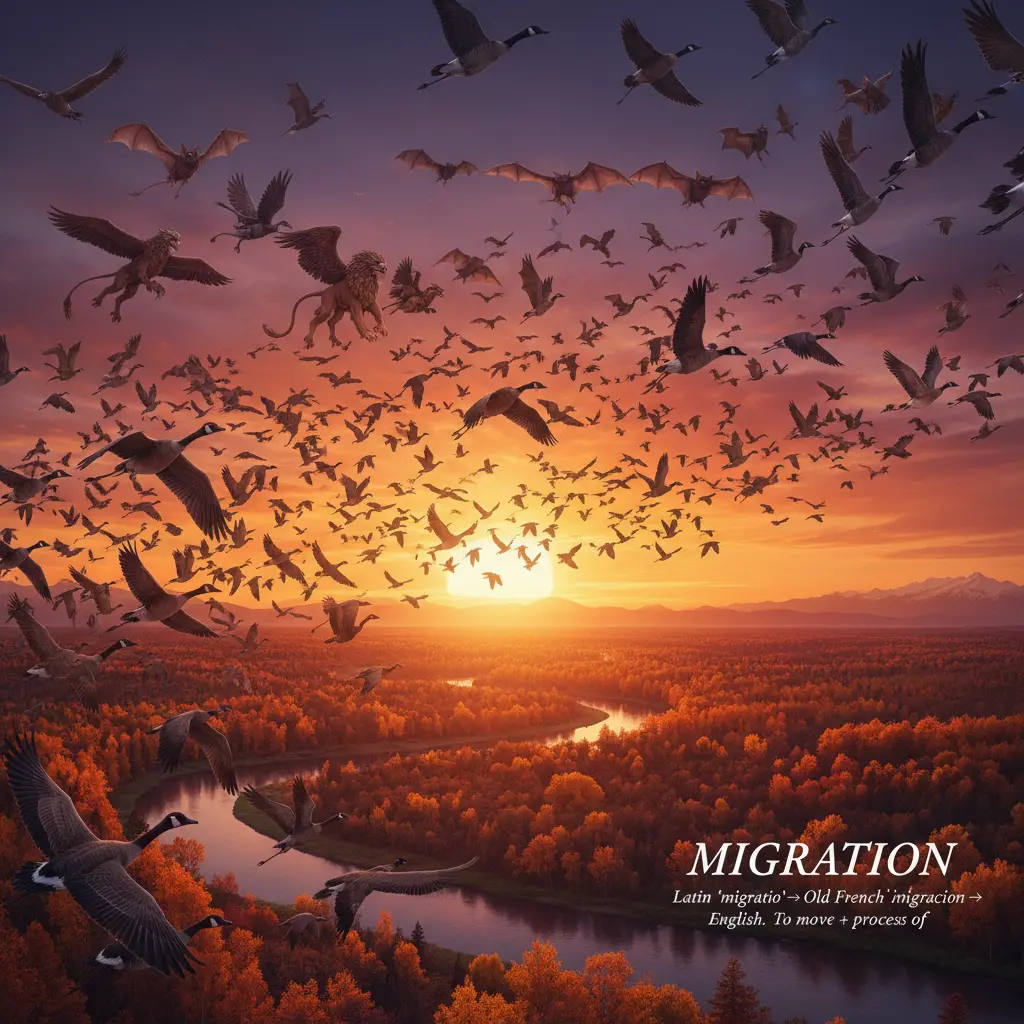
migrate = to move, -ation = process of; Latin 'migratio' → Old French 'migracion' → English. Imagine animals flying south as the seasons change, showcasing their migration journey.
Note 1: These definitions and etymologies are not standard dictionary definitions, but extended explanations provided to help with memorization and understanding of the actual application of words. Through this background information, we strive to make words more vivid and easier to understand, and help you remember their meanings in real life.
Note 2: LexiTalk designs the learning flow around the linguistics principle of “Comprehensible Input.” When learners encounter material that is slightly above their level but still understandable from context, the brain naturally absorbs the language. That’s why we keep every word inside authentic contexts, using examples and associations to help you understand it and use it flexibly.
Read the FAQ explanation of Comprehensible InputShift my weight, roll the suitcase, and take a step toward a new street. Each turn of my path feels like letting go of the old place and setting a new course, a small migration in motion. The city changes around me, I adjust my pace to crowd sounds, I keep moving. By the end, the idea of migration sits quietly as I place myself where I belong next.
Migration refers to the act or process of moving from one place to another. It covers both the seasonal journeys of animals and the longer, often cross‑border movement of people relocating to a new country. As a noun formed from migrate + -ation, migration emphasizes the ongoing process rather than a single act. This concept connects geography with culture, economics, and history, and it appears in discussions of population patterns, climate change, labor markets, and refugee flows. The term also sits alongside related verbs like migrate, as well as related nouns immigration and emigration, which specify entry to or departure from a country.
For English speakers, migration is often seen as a broad, ongoing process affecting populations, weathering historical and contemporary contexts. Learners may misinterpret it as only about moving across borders or as a singular act rather than a process.
What is the meaning of the word 'migration'?
In which sentence is 'migration' used correctly?
What is a synonym for 'migration'?
What is an antonym for 'migration'?
How does the concept of 'migration' apply to birds?
Download LexiTalk app for personalized learning experience
Download AppCookies
We use cookies for essential site functions, analytics, and ads. You can accept, reject, or manage preferences. Privacy Policy