misleading - Master This Word
Master this word with our 5-step learning method – Learn English in English
Train English Through Brain Routes, Not Translation.
This page helps you stop memorizing isolated translations and start understanding a word through its shared mental image, native-style thinking, and practical training steps.
Master this word with our 5-step learning method – Learn English in English
Example sentences are the start of understanding. Don't rush to memorize. First feel how the word works in a sentence.
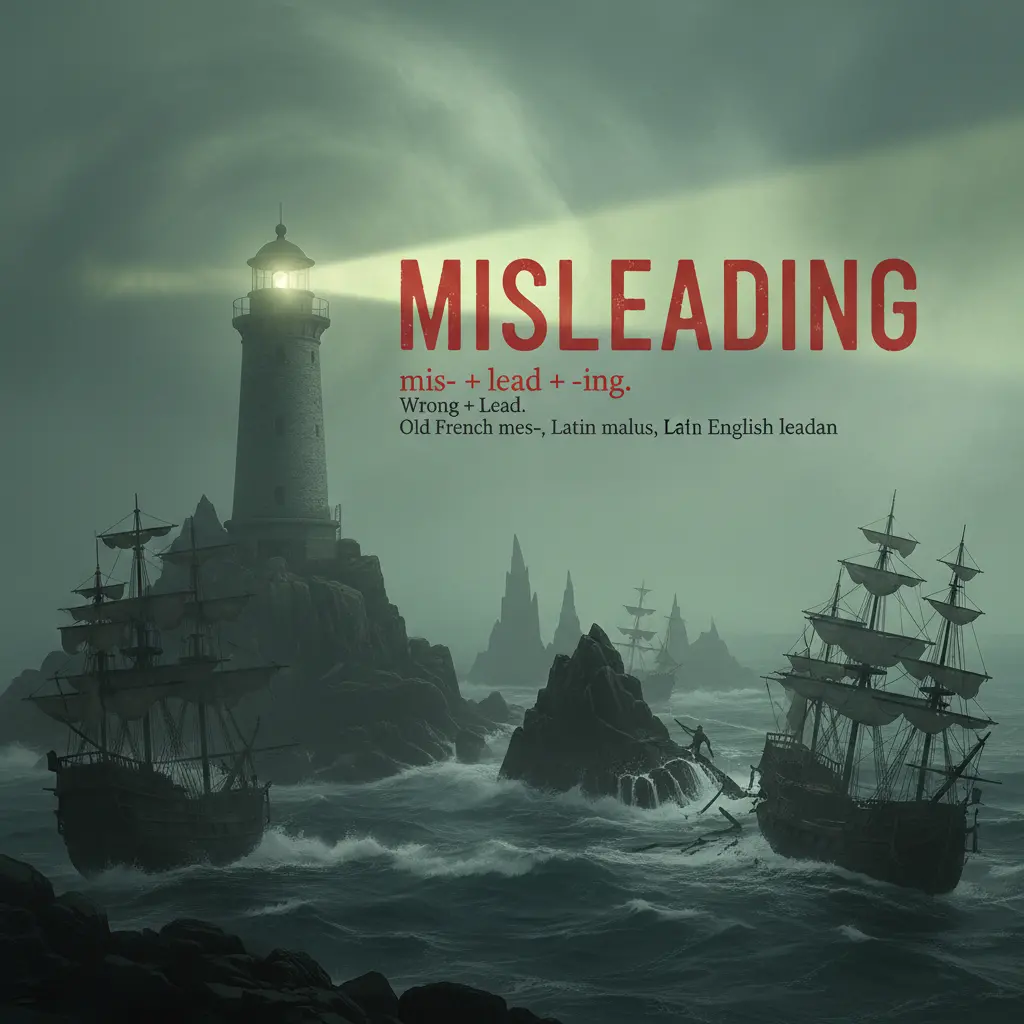
Root decomposition: mis- + lead; the -ing suffix forms the present participle adjective. Historical origin: from Old French mes- meaning wrong, via Latin malus meaning bad; lead comes from Old English leadan. Memory image: a foggy lighthouse beacon that misleads ships toward dangerous rocks, a vivid reminder of mis- plus lead.
Note 1: These definitions and etymologies are not standard dictionary definitions, but extended explanations provided to help with memorization and understanding of the actual application of words. Through this background information, we strive to make words more vivid and easier to understand, and help you remember their meanings in real life.
Note 2: LexiTalk designs the learning flow around the linguistics principle of “Comprehensible Input.” When learners encounter material that is slightly above their level but still understandable from context, the brain naturally absorbs the language. That’s why we keep every word inside authentic contexts, using examples and associations to help you understand it and use it flexibly.
Read the FAQ explanation of Comprehensible InputFirst I adjust the screen and lean in, watching the image settle into the light. The scene seems clear at first, but the colors shift and a caption nudges my brain to feel something true. I feel the pull of a story, a careful push to believe, a turn from doubt toward certainty. By the time I finish scrolling, the message has taken shape in me without me naming it as fact.
Misleading is an adjective that describes something that leads someone to believe something that is not true. It can describe statements, images, or designs that create a wrong impression, often by omitting key facts or presenting data in a biased way. A misleading claim might be technically true on the surface, but it twists the full context. People can be misled by statistics, selective quoting, or ambiguous language. The word carries a sense of manipulation, not just error. It contrasts with honest, straightforward information. You might hear it in media, advertising, politics, and everyday conversations. Common collocations include misleading impression, misleading advertisement, and a misleading graph.
In English, misleading often focuses on the impression created by incomplete or biased information rather than outright falsehood. Learners tend to mix it with 'deceptive' or 'false' and may miss subtle distinctions in context and tone.
In which sentence is 'misleading' used correctly?
What is a synonym for 'misleading'?
What is an antonym for 'misleading'?
In what real-life situation would something misleading be harmful?
Download LexiTalk app for personalized learning experience
Download AppCookies
We use cookies for essential site functions, analytics, and ads. You can accept, reject, or manage preferences. Privacy Policy