nation - Master This Word
Master this word with our 5-step learning method – Learn English in English
Train English Through Brain Routes, Not Translation.
This page helps you stop memorizing isolated translations and start understanding a word through its shared mental image, native-style thinking, and practical training steps.
Master this word with our 5-step learning method – Learn English in English
Example sentences are the start of understanding. Don't rush to memorize. First feel how the word works in a sentence.
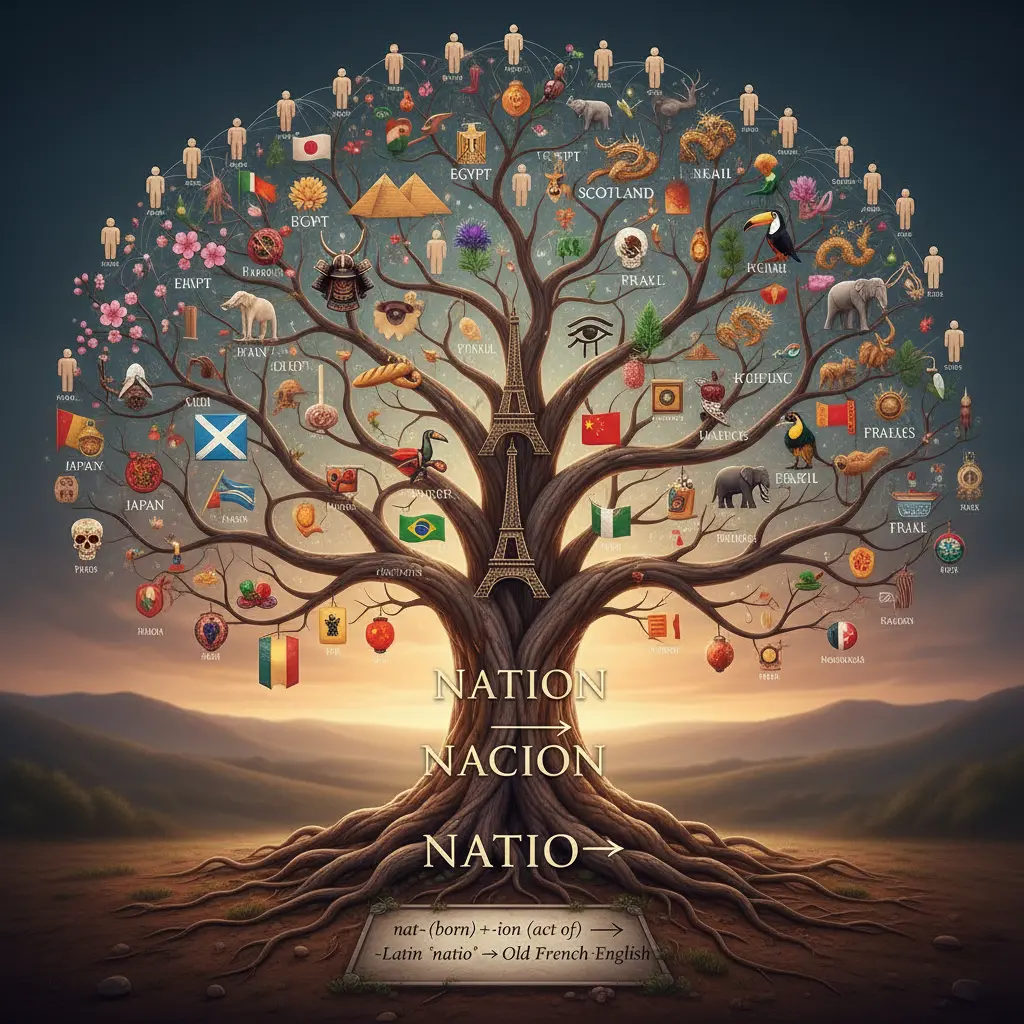
nation = nat- (born) + -ion (act of) → Latin 'natio' → Old French 'nacion' → English. Picture a large family tree where every branch symbolizes a different nationality.
Note 1: These definitions and etymologies are not standard dictionary definitions, but extended explanations provided to help with memorization and understanding of the actual application of words. Through this background information, we strive to make words more vivid and easier to understand, and help you remember their meanings in real life.
Note 2: LexiTalk designs the learning flow around the linguistics principle of “Comprehensible Input.” When learners encounter material that is slightly above their level but still understandable from context, the brain naturally absorbs the language. That’s why we keep every word inside authentic contexts, using examples and associations to help you understand it and use it flexibly.
Read the FAQ explanation of Comprehensible InputI press the edge of a map and slowly move it, nudging two places closer. I adjust the light, turn the page, and feel a small shift in my chest as the idea of a nation takes shape around us. The motion is careful, like finding the right balance between belonging and independence, and it leaves a quiet ache that settles when I commit to a plan. In daily life, I notice the same push and pull in travel, voting, and conversations with neighbors, because a nation lives in what I do.
Nation is a versatile English noun that can refer to a large group of people sharing a common culture, a politically organized body under a government, or a distinct territory with its own identity. In everyday speech it often overlaps with country, state, or homeland, but nation stresses shared culture and identity as well as sovereignty. It appears in phrases like 'a nation-state', 'national pride', or 'the nations of the world'. Learners should notice that 'nation' is rarely used to mean a small region or city; it typically implies a collective people, sometimes at odds with borders. When talking about citizenship, people become part of a nation, not merely a geographical place.
Nation often centers on people and identity, not just land. Learners may pick up the habit of equating nation with country; remind them to emphasize culture and sovereignty when appropriate.
In which of the following sentences is 'nation' used correctly?
Which word is similar to 'nation'?
Which word is the opposite of 'nation'?
In what context would you use the word 'nation'?
English Learning Listening Content
Listen NowDownload LexiTalk app for personalized learning experience
Download AppCookies
We use cookies for essential site functions, analytics, and ads. You can accept, reject, or manage preferences. Privacy Policy