native - Master This Word
Master this word with our 5-step learning method – Learn English in English
Train English Through Brain Routes, Not Translation.
This page helps you stop memorizing isolated translations and start understanding a word through its shared mental image, native-style thinking, and practical training steps.
Master this word with our 5-step learning method – Learn English in English
Example sentences are the start of understanding. Don't rush to memorize. First feel how the word works in a sentence.
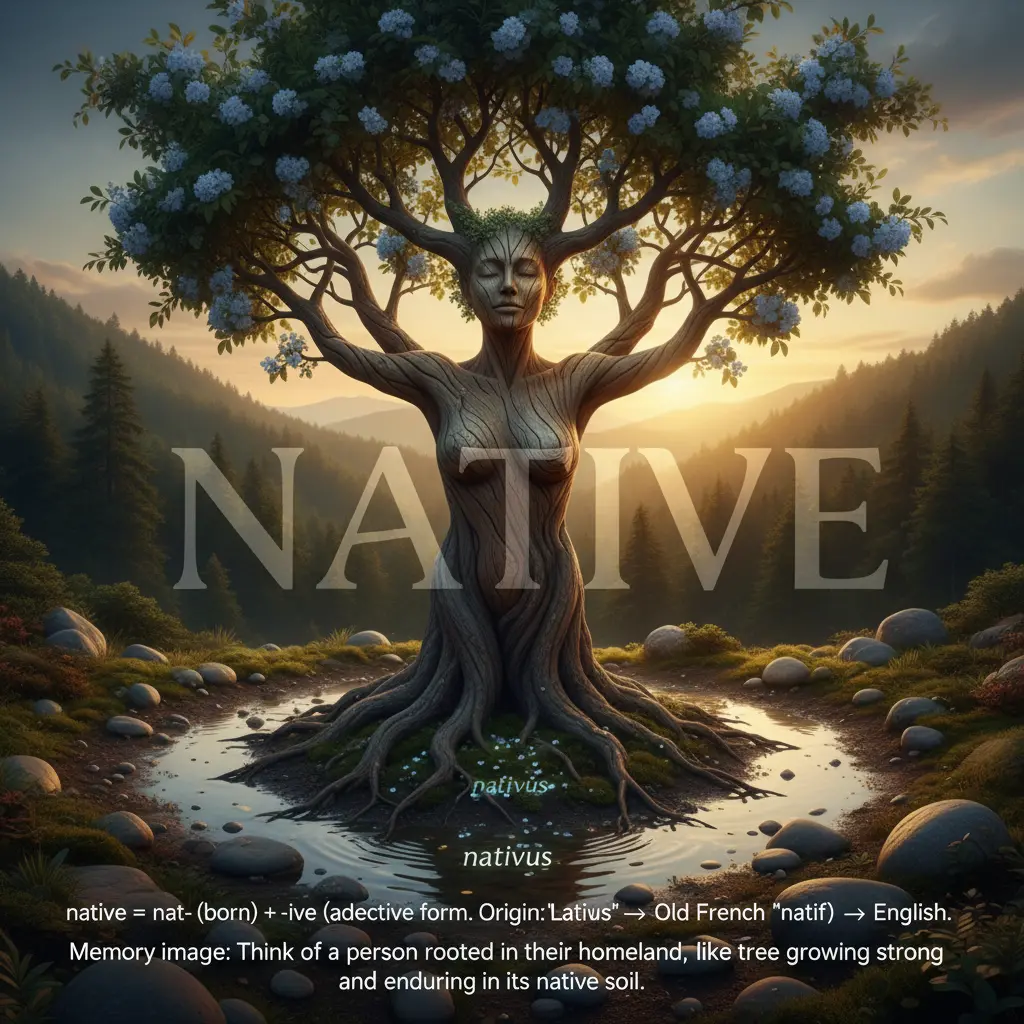
native = nat- (born) + -ive (adjective form). Origin: Latin 'nativus' → Old French 'natif' → English. Memory image: Think of a person rooted in their homeland, like a tree growing strong and enduring in its native soil.
Note 1: These definitions and etymologies are not standard dictionary definitions, but extended explanations provided to help with memorization and understanding of the actual application of words. Through this background information, we strive to make words more vivid and easier to understand, and help you remember their meanings in real life.
Note 2: LexiTalk designs the learning flow around the linguistics principle of “Comprehensible Input.” When learners encounter material that is slightly above their level but still understandable from context, the brain naturally absorbs the language. That’s why we keep every word inside authentic contexts, using examples and associations to help you understand it and use it flexibly.
Read the FAQ explanation of Comprehensible InputI pick up a postcard from my hometown and move it around the desk, tilting it to catch the sun. As the light shifts, I hear the old street names in my head and the way my voice softens when I say them. So I adjust my posture, feel the memory settle in my chest, and keep that quiet sense of belonging rooted in a place I was born. The word native stops feeling abstract and fits into how I stand, speak, and listen—like a familiar rhythm I carry with me.
Native has two broad senses in everyday English. It describes something or someone that belongs to a place by birth or origin, as in a native of Ireland or a native plant that grows there naturally. It also describes something produced or originating in a particular country or place, such as native fruits, native software, or a native fashion brand. Additionally, native is common in phrases like native speaker and native language, where it signals a person’s linguistic background rather than nationality. Learners often confuse native with natural, indigenous, or local; native emphasizes birthplace or origin, while natural refers to a trait or quality, and indigenous refers to long-standing presence in a region. Use native with nouns like country, region, or species.
Native encodes origin or birthplace, not citizenship or current residence; learners often assume it means local or immigrant status, leading to mistakes like saying ‘native of’ a place when you mean ‘born in’ a country.
What is the meaning of the word 'native'?
Which sentence uses the word 'native' correctly?
What is the most similar word to 'native'?
What is the opposite of 'native'?
Can you think of a real-life context for the word 'native'?
English Learning Listening Content
Listen NowDownload LexiTalk app for personalized learning experience
Download AppCookies
We use cookies for essential site functions, analytics, and ads. You can accept, reject, or manage preferences. Privacy Policy