speaker - Master This Word
Master this word with our 5-step learning method – Learn English in English
Train English Through Brain Routes, Not Translation.
This page helps you stop memorizing isolated translations and start understanding a word through its shared mental image, native-style thinking, and practical training steps.
Master this word with our 5-step learning method – Learn English in English
Example sentences are the start of understanding. Don't rush to memorize. First feel how the word works in a sentence.
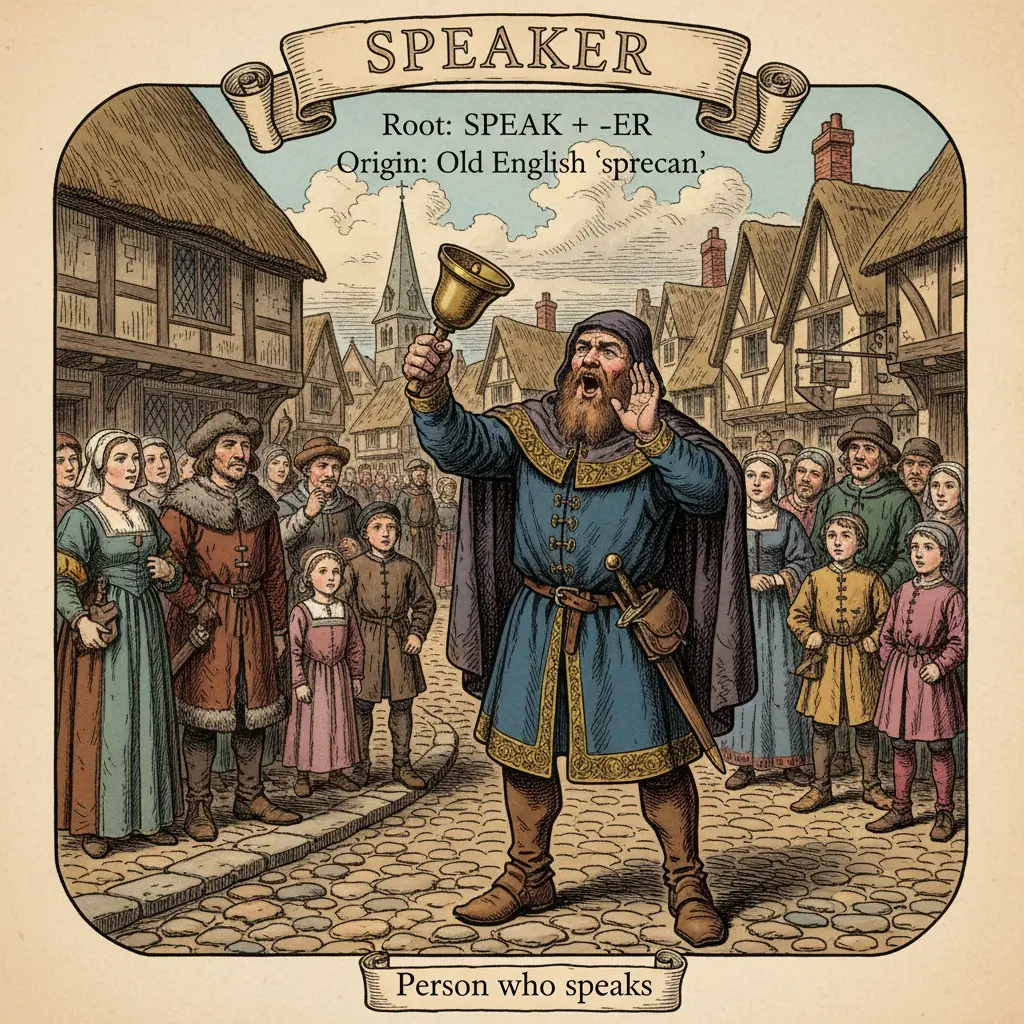
(a) Root decomposition: speak + -er form 'speaker' meaning a person who speaks. (b) Historical origin: from Old English sprecan 'to speak', via Middle English speker to Modern English speaker. (c) Memory image: picture a town crier on a street corner shouting messages to a crowd.
Note 1: These definitions and etymologies are not standard dictionary definitions, but extended explanations provided to help with memorization and understanding of the actual application of words. Through this background information, we strive to make words more vivid and easier to understand, and help you remember their meanings in real life.
Note 2: LexiTalk designs the learning flow around the linguistics principle of “Comprehensible Input.” When learners encounter material that is slightly above their level but still understandable from context, the brain naturally absorbs the language. That’s why we keep every word inside authentic contexts, using examples and associations to help you understand it and use it flexibly.
Read the FAQ explanation of Comprehensible InputWith a quick breath, I lean forward, grip the mic, and slowly turn the speaker's volume up. Sound fills the room as the voice travels from lips through the speaker to curious ears. I feel the effort to control the tone, the change in mood as I adjust, push, and let the sound settle. When the word speaker comes back to me later, I picture three scenes: a person onstage, a box carrying the voice, and the person who presides over the meeting.
Speaker has three broad senses. First, a person who speaks in public—an orator, presenter, lecturer, or panelist. Second, a device that emits sound from electrical signals—the loudspeaker. Third, someone who represents or voices the views of others (a spokesperson) or the official who presides over a meeting (as the Speaker of the House). The form comes from the verb speak plus the agent suffix -er. Learners often confuse the device and person senses, especially when you hear 'the speaker announced' in a room versus 'the speaker' on a loudspeaker system. Remember the context, and you’ll choose the right sense.
English learners often notice a precise split between person and device, so they tend to ask about which sense is intended by speakers. Keep in mind collocations like 'public speaker' vs 'loudspeaker' and remember formal roles like 'Speaker' as a title.
In which of the following scenarios would you use the word 'speaker'?
Which word is most similar to 'speaker'?
What is the opposite of 'speaker'?
In a seminar, the invited expert was the main ___________.
Download LexiTalk app for personalized learning experience
Download AppCookies
We use cookies for essential site functions, analytics, and ads. You can accept, reject, or manage preferences. Privacy Policy