nephew - Master This Word
Master this word with our 5-step learning method – Learn English in English
Train English Through Brain Routes, Not Translation.
This page helps you stop memorizing isolated translations and start understanding a word through its shared mental image, native-style thinking, and practical training steps.
Master this word with our 5-step learning method – Learn English in English
Example sentences are the start of understanding. Don't rush to memorize. First feel how the word works in a sentence.
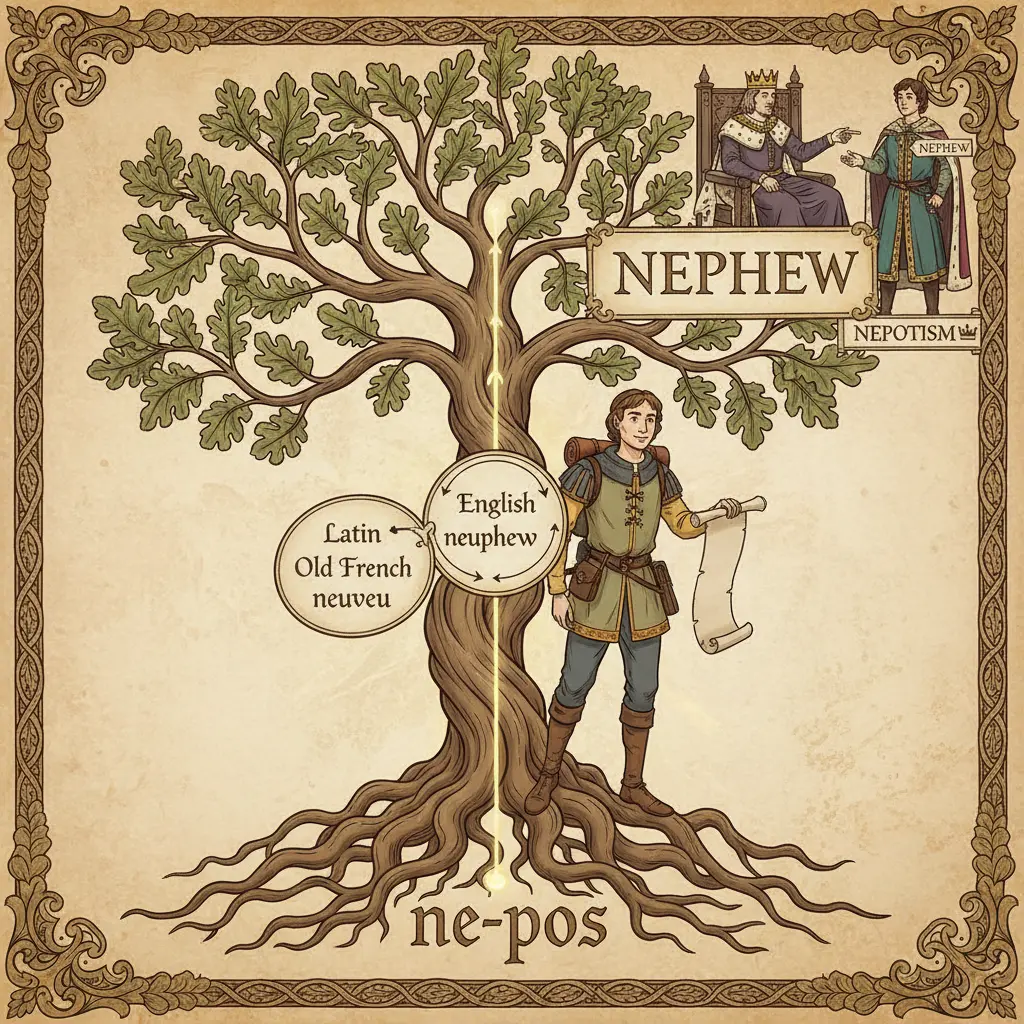
(a) Root decomposition: no prefix; root from Latin nepos meaning 'grandson/descendant', via Old French neveu. (b) Historical origin: Latin nepos → Old French neveu → English nephew. (c) Memory image: picture a family tree with the root labeled ne-pos, showing a descendant stepping forward as the nephew; this image also hints at nepotism by showing a king favoring his nephew.
Note 1: These definitions and etymologies are not standard dictionary definitions, but extended explanations provided to help with memorization and understanding of the actual application of words. Through this background information, we strive to make words more vivid and easier to understand, and help you remember their meanings in real life.
Note 2: LexiTalk designs the learning flow around the linguistics principle of “Comprehensible Input.” When learners encounter material that is slightly above their level but still understandable from context, the brain naturally absorbs the language. That’s why we keep every word inside authentic contexts, using examples and associations to help you understand it and use it flexibly.
Read the FAQ explanation of Comprehensible InputA nephew is a male relative who is the son of your brother or sister, placing him in the next generation of your family. It’s the male counterpart to niece, who is female. You can say, for example, "My nephew is visiting this weekend" or "She has two nephews and a niece." The word is commonly used in everyday family talk and can carry affectionate or humorous tones. Etymology traces back to Latin nepos, via Old French neveu, and English kept that lineage sense in everyday use.
For English learners, nephew is a precise, gendered term that marks a specific blood relation and generation. Some languages bundle gender and kinship differently, so learners often pick a generic word or confuse nephew with cousin or grandson. Also, in some cultures the term carries emotional nuances or jokes that do not translate literally, which can make practice feel awkward.
What is the meaning of the word 'nephew'?
In which of the following sentences is the word 'nephew' used correctly?
Which of the following is an antonym for 'nephew'?
In what real-life context would you most likely refer to your nephew?
Can you think of a sentence using the word 'nephew'?
Download LexiTalk app for personalized learning experience
Download AppCookies
We use cookies for essential site functions, analytics, and ads. You can accept, reject, or manage preferences. Privacy Policy