object - Master This Word
Master this word with our 5-step learning method – Learn English in English
Train English Through Brain Routes, Not Translation.
This page helps you stop memorizing isolated translations and start understanding a word through its shared mental image, native-style thinking, and practical training steps.
Master this word with our 5-step learning method – Learn English in English
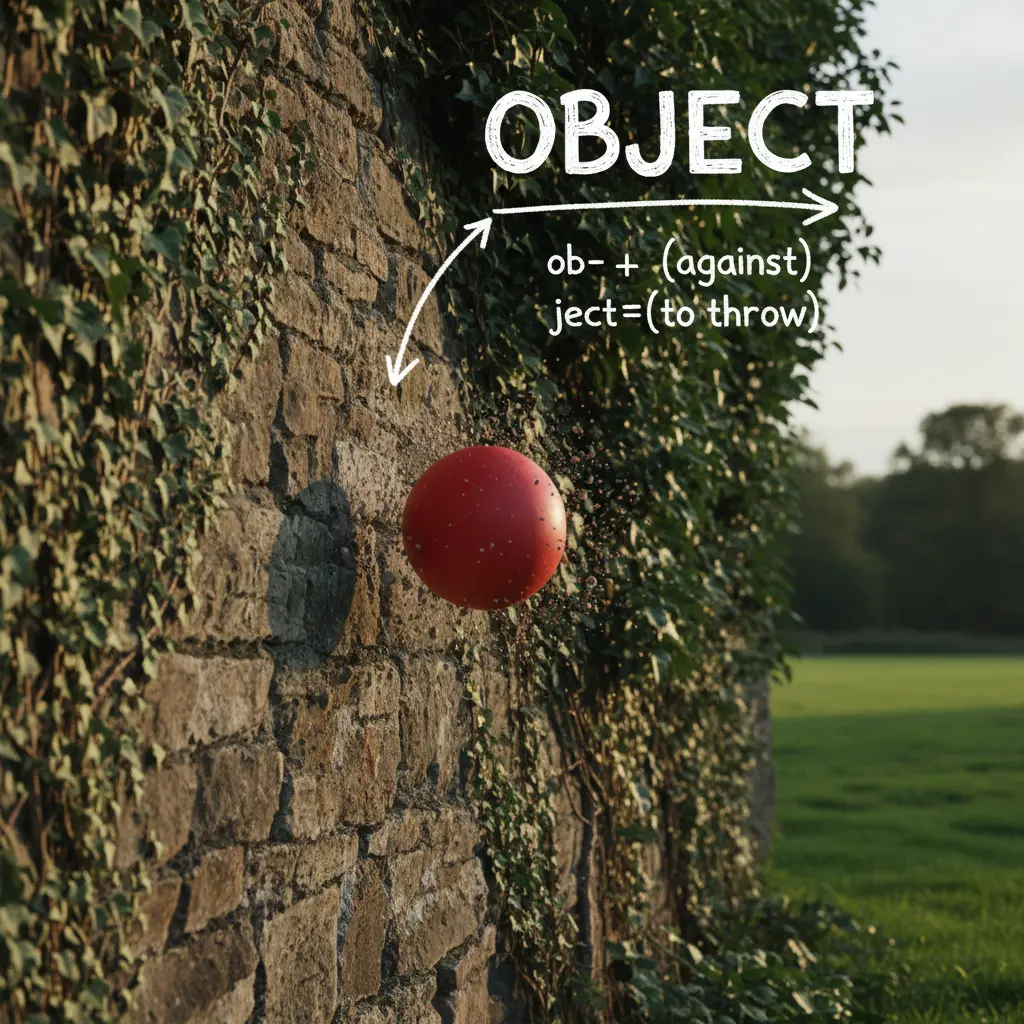
Example sentences are the start of understanding. Don't rush to memorize. First feel how the word works in a sentence.
Root decomposition: ob- (against) + ject (to throw) – meaning 'thrown against'. Historical origin: Latin 'obiectum' → Old French 'objet' → English 'object'. Memory image: Imagine throwing a ball against a wall, the wall is the 'object' receiving the throw, connecting the action directly to the word.
Note 1: These definitions and etymologies are not standard dictionary definitions, but extended explanations provided to help with memorization and understanding of the actual application of words. Through this background information, we strive to make words more vivid and easier to understand, and help you remember their meanings in real life.
Note 2: LexiTalk designs the learning flow around the linguistics principle of “Comprehensible Input.” When learners encounter material that is slightly above their level but still understandable from context, the brain naturally absorbs the language. That’s why we keep every word inside authentic contexts, using examples and associations to help you understand it and use it flexibly.
Read the FAQ explanation of Comprehensible InputI reach out and close my fingers around a cool object, guiding it toward me and moving it with my hand. I adjust my grip, feel the weight shift, and turn it a little so I can see the face. I place it down, keeping the effort steady as my other hand hovers for balance. In that slow, tactile sequence the object starts to mean more than a thing: it’s something you act on, decide about, and move toward a goal.
Object is a versatile English word that can be a noun or a verb. As a noun it means a thing that you can see or touch, such as a mug or a gadget; it can also refer to the goal or purpose of an action, as in the object of this study. As a verb it means to express disapproval or opposition, usually followed by to, as in I object to that plan. In everyday speech the noun sense is common, while the verb sense tends to appear in formal debate or policy discussions. Note the stress: OB-ject for the noun, ob-JECT for the verb.
Native English tends to separate tangible nouns from abstract goals clearly, while the verb sense relies on a formal, debate-friendly construction with to. Learners often mix the noun and verb forms or misplace the stress, so practice with contrasting examples and mark the shift from OB-ject to ob-JECT.
How is the word 'object' used in a sentence?
Which word is similar to 'object'?
What is the opposite of 'object'?
In what real-life context would you use the word 'object'?
English Learning Listening Content
Listen NowDownload LexiTalk app for personalized learning experience
Download AppCookies
We use cookies for essential site functions, analytics, and ads. You can accept, reject, or manage preferences. Privacy Policy