
occurrence - Master This Word
Master this word with our 5-step learning method – Learn English in English
Train English Through Brain Routes, Not Translation.
This page helps you stop memorizing isolated translations and start understanding a word through its shared mental image, native-style thinking, and practical training steps.
Master this word with our 5-step learning method – Learn English in English
Example sentences are the start of understanding. Don't rush to memorize. First feel how the word works in a sentence.
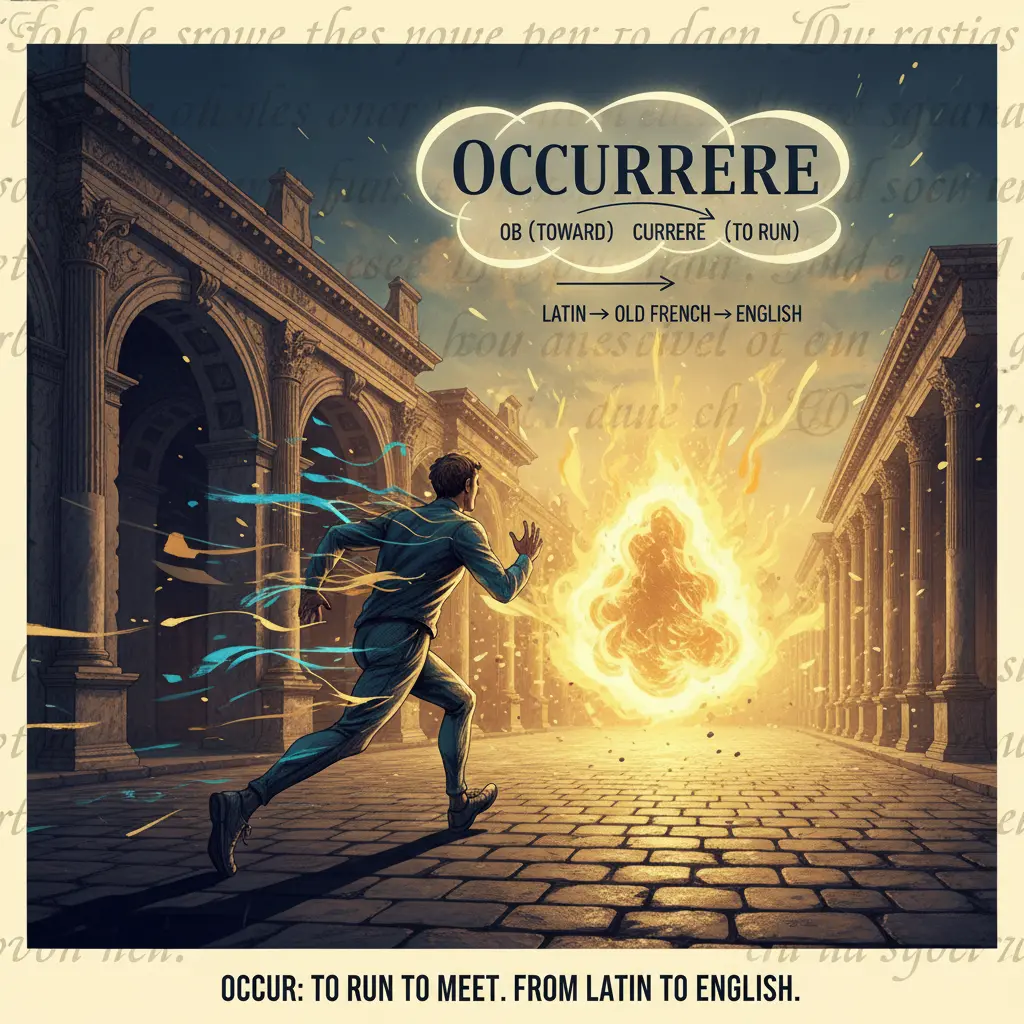
Root: 'occurrere' (to run to meet) = 'ob' (toward) + 'currere' (to run). Origin: Latin → Old French → English. Memory image: Imagine a person running towards an event, representing the moment something happens.
Note 1: These definitions and etymologies are not standard dictionary definitions, but extended explanations provided to help with memorization and understanding of the actual application of words. Through this background information, we strive to make words more vivid and easier to understand, and help you remember their meanings in real life.
Note 2: LexiTalk designs the learning flow around the linguistics principle of “Comprehensible Input.” When learners encounter material that is slightly above their level but still understandable from context, the brain naturally absorbs the language. That’s why we keep every word inside authentic contexts, using examples and associations to help you understand it and use it flexibly.
Read the FAQ explanation of Comprehensible InputFirst I steady my breath and set my mug on the desk. A car horn outside catches my ear and the sound slips into the room. I pause, adjust my posture, and let the moment linger—an occurrence that changes the mood without anyone saying a word. That small shift becomes a cue I carry into the next task, a reminder of how an event can ripple through the day.
Occurrence is a noun that denotes an event or instance of something happening, often focusing on a particular moment rather than a broad pattern. It is common in formal or technical writing, statistics, and reporting to say 'the occurrence of X' to count how many times something occurred. An occurrence can be ordinary or notable, and it is countable: one occurrence, two occurrences. It sits between 'event' and 'instance' in nuance: more specific than just 'something happened' but less sweeping than a trend. Remember to pair it with 'of' or to use 'an occurrence' to highlight a single incident.
English learners often distinguish occurrence from event by nuance: occurrence is a formal, countable instance of something happening, not a broad trend. Common mistakes: treating occurrence as frequency, or using it for habitual patterns.
What is the meaning of the word 'occurrence'?
In which sentence is 'occurrence' used correctly?
What is a synonym for 'occurrence'?
What is an antonym for 'occurrence'?
In what real-life context would you use the word 'occurrence'?
Download LexiTalk app for personalized learning experience
Download AppCookies
We use cookies for essential site functions, analytics, and ads. You can accept, reject, or manage preferences. Privacy Policy