once - Master This Word
Master this word with our 5-step learning method – Learn English in English
Train English Through Brain Routes, Not Translation.
This page helps you stop memorizing isolated translations and start understanding a word through its shared mental image, native-style thinking, and practical training steps.
Master this word with our 5-step learning method – Learn English in English
Example sentences are the start of understanding. Don't rush to memorize. First feel how the word works in a sentence.
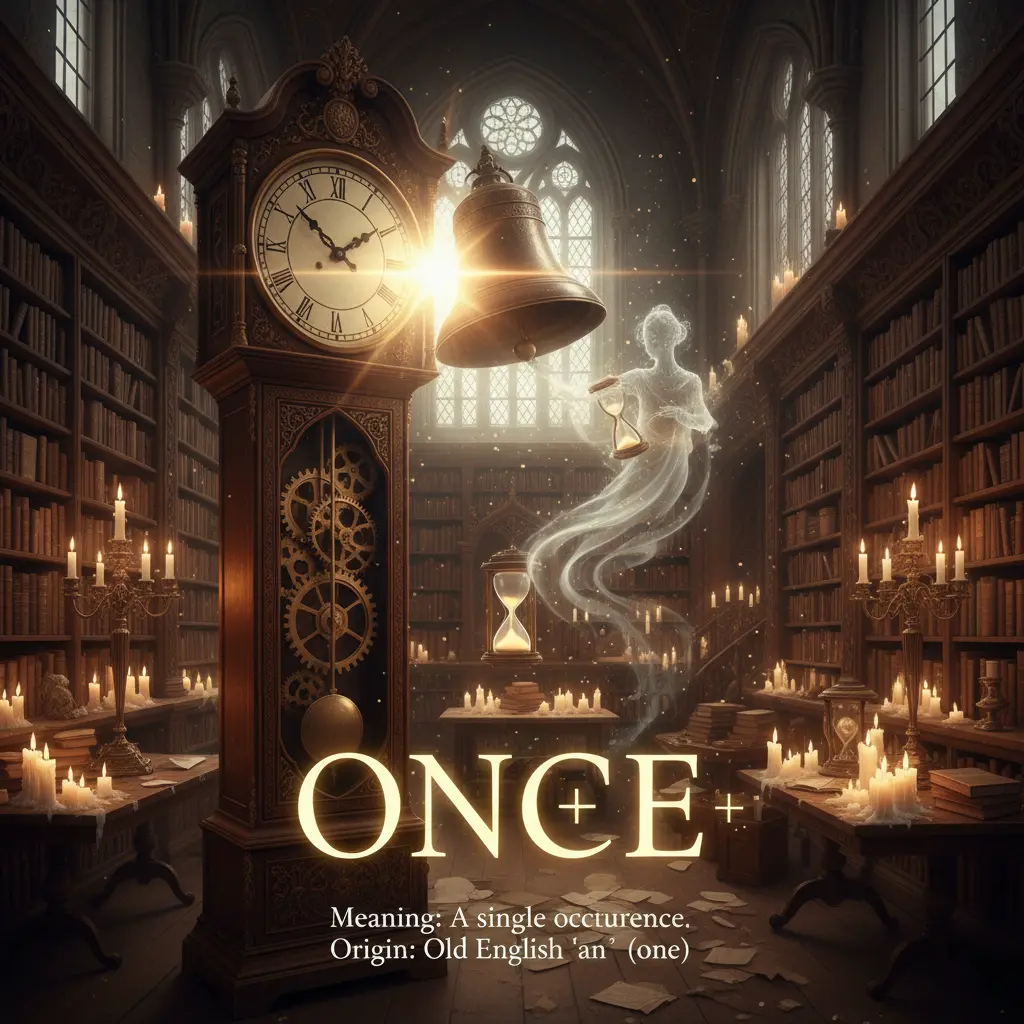
once = on + ce (a variant of 'the'); Origin: Old English 'ān', meaning 'one', which morphed into middle usages signifying singular occurences. Memory image: Picture a clock striking once at midnight, symbolizing a single moment in time.
Note 1: These definitions and etymologies are not standard dictionary definitions, but extended explanations provided to help with memorization and understanding of the actual application of words. Through this background information, we strive to make words more vivid and easier to understand, and help you remember their meanings in real life.
Note 2: LexiTalk designs the learning flow around the linguistics principle of “Comprehensible Input.” When learners encounter material that is slightly above their level but still understandable from context, the brain naturally absorbs the language. That’s why we keep every word inside authentic contexts, using examples and associations to help you understand it and use it flexibly.
Read the FAQ explanation of Comprehensible InputI set my phone down and push it to the edge of the table, watching the screen shift as I scroll back through a memory. A story flickers and I adjust my posture, as if the scene is still about to move in my head. The moment feels like a single page opened in a quiet book—once, on one occasion, everything could change. I keep the feeling tucked away, a small habit I can pull out again when I want to remember that it happened once.
Once is a versatile adverb used to refer to a single time in the past, often contrasting with repeated actions described by many times or often. It can introduce a past event, a one-off occasion, or a hypothetical condition starting in the past with once as a conjunction, as in once you finish, we can start. In everyday usage, it appears in phrases like once upon a time, and with numbers (once, twice, thrice) to indicate the frequency of a specific past event. The memory image from its etymology is a clock striking once at a single moment, reinforcing the idea of a unique moment in time.
In English, once most often marks a single past moment or a future condition starting at that past moment; speakers frequently use it with past tenses or future clauses. Learners sometimes treat once as interchangeable with 'one time' or misplace it with 'always' or 'every time'.
What is the meaning of the word 'once'?
In which of the following sentences is 'once' used correctly?
Which word is similar to 'once'?
What is the opposite of 'once'?
Can you think of a real-life situation where someone might say 'once'?
Download LexiTalk app for personalized learning experience
Download AppCookies
We use cookies for essential site functions, analytics, and ads. You can accept, reject, or manage preferences. Privacy Policy